Climate-X
We are the only country in the European Union developing this water management project.

The Hungarian Ornithological Society (MME) has launched a project to rehabilitate the salt marshes of the Southern Great Plain with EU support, in cooperation with the Kiskunság National Park Directorate and the local government of Sándorfalva. During the six-year project, more than a thousand hectares of the original habitat will be restored, according to information provided by the MME to MTI.
They can retain 2.7 million cubic metres of water annually.
The project will manage four alkaline lakes located in the Tisza Valley in the Southern Great Plain: Fehér Lake in Gátér, Lyukashalmi-puszta in Tömörkény, Müller-szék in Balástya and Macskás-szék in Sándorfalva will be rehabilitated, covering a total area of 1,038 hectares.
Two new structures will be built as part of the water infrastructure development project. In addition, an existing structure will be renovated and a siphon system will be installed to ensure water replenishment. All this will ensure the retention of 2.7 million cubic metres of water per year.
The goal
- restoring the mosaic character of saline wetlands,
- ensuring adequate water conditions,
- improving the reproductive success of bird species characteristic of the area and increasing the size of the breeding population,
- and reducing the number of invasive species.
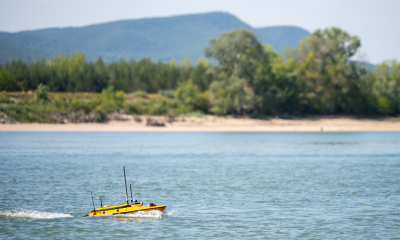
Water management is modelled using modern drone technology.
Modern drone technology is being used to monitor results and survey saline areas, and artificial intelligence-based software is being developed.
„The areas must be flown over, 3D maps must be created for water management modelling, and map overlays must also be prepared,” reads the MME website.
The total budget for the project is €2.043 million (almost HUF 780 million), 75 per cent of which is provided by EU funding.
The duration of water coverage decreased by 20-30 days.
According to the announcement, the Pannonian salt steppes and marshes are among the European Union's priority habitat types that occur exclusively in the Carpathian Basin.
This type includes alkaline lakes, which are shallow, mostly seasonal wetlands characterised by high dissolved salt content and alkaline chemistry.
Due to climate change, the distribution of slightly decreasing annual precipitation has become unfavourable for bird species that nest on the ground and are associated with wetland habitats. Breeding sites dry out very early, often as early as the end of April, and thus become unsuitable for breeding. In natural habitats, the duration of water coverage has decreased by 20-30 days.
Fenced-off nesting islands are being created
The success of the rehabilitation work is measured by the settlement of four bird species – black-tailed godwit (Limosa limosa), common redshank (Tringa totanus), Eurasian wigeon (Spatula querquedula) and common pochard (Aythya ferina) – and the increase in their breeding success.
As part of the project, electric fences that have already been tested in a previous EU project will be used in the spring to create one- to five-hectare breeding islands adapted to the current water conditions, where birds can raise their young with a high breeding success rate.
Source: Link








The town centre on the banks of the Tisza is being regenerated

The Market has fulfilled its promise: it has delivered the 10,000 tonnes of natural stone offered for the raising of the bottom sill at Paks

The construction industry is both vast and marvellous – the Duna Group Szabadegyetem has been launched

ESG is now a business issue for suppliers in the construction industry too

Rain gardens are coming to Budafok, with over 3,000 square metres of green space set to be developed

Contemporary art deco in Csopakon

Four new bridges to be built in the heart of the former industrial city

Safer driving on the motorways: new digital signs for the MKIF
-

 Industry news 2026. 08. 18.
Students were introduced to the high-tech construction industry at BME’s field camp in Göd
-
Bound track 2026. 08. 17.
New pedestrian crossings and a junction with traffic lights are being built in Angyalföld
-
What is being built? 2026. 08. 18.
Hungary’s new McDonald’s restaurant has moved into a modernist listed building in the centre of Budapest
-
What is being built? 2026. 08. 18.
New paving, a playground and visitor facilities are being planned for the Várkör area in Pannonhalma