Climate-X
A cooling vest, greener tarmac and digital work management: this is how the STRABAG is responding to climate change

This summer, not only the capital’s all-time heat record but also the national record was broken. A temperature of 42 degrees Celsius was recorded in Szécsény, whilst in Budapest, the 41 degrees Celsius recorded in Lágymányos surpassed the previously recorded all-time high. Despite the intense heat, construction work could not be halted!
In our article, we spoke to experts from STRABAG experts in Hungary to explore how summer roadworks and extreme weather events have brought about changes in health and safety and work organisation. We also reviewed the measures being taken by the Group’s Hungarian companies to reduce their operational emissions.

A strategic study to determine the impacts of climate risks
„Heatwaves and high UV radiation are no longer isolated, exceptional events, but form part of the physical climate risks that must be taken into account with increasing frequency during construction. This category also includes sudden downpours, floods and severe storms. The frequency of these events requires analysis at a strategic level to determine as accurately as possible what risks they pose to workers, projects and machinery, and how best to adapt to them”
– Áron Bánhidy , sustainability officer for STRABAG, told our website .

The company’s manual workers tested cooling vests
As well as project management, this period also poses a major challenge for health and safety.
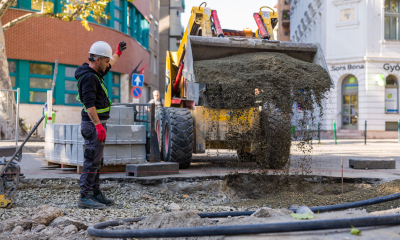
„This summer we had to contend with two or three heat waves, which exposed workers on the construction sites – particularly the asphalters and road-builders, numbering nearly seven to eight hundred Hungarian manual and white-collar workers – to an exceptionally high heat load. On the hottest days, they worked in ambient temperatures of between 35 and 40 degrees Celsius; the asphalt arriving at the worksite was approximately 160–170 degrees Celsius, and even during laying, its temperature was only a few degrees lower, at roughly 150–160 degrees Celsius. The high outside temperature and the direct heat from the hot asphalt placed a dual strain on our colleagues working on the road construction project, both during the laying process and in the subsequent phases of the work; we therefore had to provide them with equipment and measures to help mitigate this effect.”
– Tamás Horváth told our website . The health and safety manager at STRABAG Magyarország highlighted that staff working on road construction projects tested cooling vests this summer. Based on the positive feedback, they would like to introduce these as standard equipment in future. In addition to meeting the requirements for high-visibility vests, these vests cool the wearer by utilising the principle of evaporation when moistened. In addition, they provided their employees with summer cooling packs containing cooling towels and sun cream, as well as rehydration drinks; manual labourers were also given effervescent tablets to replenish the salts and minerals lost through sweating.

Employees were protected during periods of extreme heat by reorganising working hours to include rest days
Employees are always informed about second- or third-level heat alerts. Project managers are advised, where possible, to bring forward the start time of work during periods of extreme heat, so that staff do not have to spend any time – or only a minimal amount of time – on site during the hottest part of the day. Tamás Horváth explained that there were several instances where roadworks were carried out from 5.00 am until 11.00 am. During heatwave periods, STRABAG also provided its staff with a day off to protect their health.

The health and safety specialist also pointed out that, in addition to heat, other extreme weather conditions must also be taken into account, and employees are trained to deal with these.
These are set out in both the risk assessment and the health and safety plan, detailing what to do in the event of, for example, lightning, extremely strong winds or heavy, sudden downpours. There are also plans for an IT development that will be able to send notifications via the app to operational staff about approaching storms, the UV index, high or low temperatures and other hazardous weather conditions.

It is not only the heat but also UV radiation that poses a risk
Tamás Horváth emphasised that UV and heat protection will be one of the key topics for the STRABAG in 2026.
Staff were given training sessions on how to find out about current UV levels and what they can do to protect their health.
The health and safety specialist added that the company has a separate budget for wellbeing activities, which is used to organise mental health talks and provide lifestyle advice to staff, as well as health screening opportunities.
In recent years, the company has already made use of the services offered by the national health screening programme; this year, it purchased vouchers for routine laboratory tests and lung screening, which were primarily made available to those engaged in manual labour. The company plays an active role in prevention and is therefore constantly seeking to make further preventive tests available. Due to extreme UV radiation, discussions are currently underway with service providers regarding the availability of melanoma screening.

„We are constantly developing and expanding the measures we take to help safeguard our employees„ health and ensure their safety. The most important thing for us is that everyone returns home safe and sound at the end of the working day. Our ”1-2-3 Safety” slogan is also linked to this objective: stop, think, act!”

The STRABAG will become climate-neutral in its own operations by 2040
In addition to maximising the safety of its employees, the STRABAG Group has set itself the target of becoming climate-neutral in its own operations by 2040. The company’s sustainability officer told our portal that they had carried out a double materiality analysis at the group’s Hungarian subsidiaries as well, to identify the areas of their operations that cause the greatest environmental impact. Áron Bánhidy explained that, in doing so, they examined not only how the company’s activities affect the environment and society, but also what financial impact environmental changes and climate risks might have on the company’s operations.

They reviewed the entire road construction value chain: the environmental impacts of raw material extraction, asphalt production, transport and laying, as well as the longer-term consequences of the completed infrastructure.
One of the most significant environmental impacts occurs right at the start of the value chain, during the extraction of aggregate required for road construction. Mining may involve the use of high-powered machinery, dust and noise pollution, landscape alteration, and the disruption of habitats and biodiversity. Whilst these impacts must be partially offset in accordance with legal requirements, the position of STRABAG is that sustainable operation cannot be limited to merely meeting the mandatory minimum standards.

Due to their high energy consumption, asphalt mixing plants may be among the most significant direct sources of carbon dioxide emissions for construction companies. When heating the aggregate, the use of coal dust alongside natural gas makes production more cost-effective; however, the use of this technology entails a significant environmental impact.

STRABAG has therefore begun to implement this decision, which imposes an additional economic burden in the short term, and is gradually phasing out the use of coal dust from its asphalt mixing plants in Hungary. In addition, it is encouraging a higher rate of recycling of milled asphalt in order to achieve climate targets.
The company is also seeking to reduce unreasonably high production temperatures at its asphalt mixing plants through internal regulations. Áron Bánhidy told us that the mixing plants are required to report any instances where the specified maximum temperature is exceeded, and that they use a proprietary digital platform to record such deviations. The company also produces WMA asphalt, which is manufactured using foamed bitumen, requires less heat and is more environmentally friendly, in ever-increasing volumes year on year. We wrote about this in detail in one of our previous articles.

They are making the vehicle fleet more environmentally friendly
Another potential means of reducing emissions from work machinery is the partial replacement of fossil diesel with HVO fuel produced from hydrogenated vegetable oil. The STRABAG group is already testing and using HVO fuel in certain countries.
The electrification of the company’s vehicle fleet has begun: a significant proportion of the shared passenger cars have been replaced with electric models, and the process is also being extended to smaller machinery used in road construction. Plate compactors and tampers are gradually being replaced with battery-powered equipment, and fossil-fuel-powered versions are no longer available as new machinery in these categories.
The group is also experimenting with larger construction machinery powered by alternative fuels. The conversion of the sites’ energy supply is also part of this process; solar panel systems have been installed at several asphalt mixing plants and regional offices.

The conservation of local ecosystems is a key issue
The effects of climate change are linked to the state of the natural environment. For this reason, alongside reducing emissions, priority must also be given to protecting biodiversity and local ecosystems. Áron Bánhidy added that, in addition to the sustainability assessments carried out at the group’s international level, it is also necessary to explore local specificities.
The long-term effects of the completed road include habitat fragmentation and the adverse effects of vehicle traffic on wildlife. In addition to reducing carbon dioxide emissions, attention must therefore also be paid to the local protection of biodiversity. This is because a deteriorating natural environment may further exacerbate the local consequences of climate change, whilst the loss of certain species or habitats may be irreversible. The Hungarian operating companies of STRABAG have a biodiversity conservation policy in place for their own sites. At the same time, we are currently investigating what further measures we could take to mitigate or offset the negative impacts occurring along our roads.

Funding is also steering the market towards sustainable construction
A key tool for achieving climate targets is the EU taxonomy, which sets out, on the basis of uniform criteria, when an economic activity can be considered environmentally sustainable. It distinguishes between activities that fall within the scope of the system and those that actually meet the requirements. A solar panel installation, for example, can only be classified as sustainable if its implementation does not significantly harm other environmental objectives, such as biodiversity or water resources.

Áron Bánhidy expressed the view that taxonomic compliance could have an increasingly significant impact on funding as well, given that financial institutions also measure the environmental performance of their own portfolios; duly verified sustainable projects may therefore be eligible for more favourable terms. The expert also drew attention to the fact that
The options available to contractors are determined by the client’s tender specifications and the budget. Energy-efficiency solutions can generate savings during operation, whilst, for example, additional commitments to protect biodiversity may increase investment costs.

More efficient organisation can also reduce the heat stress experienced by staff
Digital solutions and the lean approach can both play a significant role in reorganising work due to weather conditions and in achieving climate targets. At STRABAG, however, the application of the lean approach and the SSO system is not solely linked to the summer heat.
Imre Békési, the company’s lean representative, points out that more efficient work organisation can also offer occupational health and safety benefits during heatwaves. Thanks to faster execution with fewer disruptions, teams can complete their daily tasks sooner, meaning they spend less time working in high external temperatures and near hot tarmac.

Essentially, the aim of lean is to identify losses in the production process and eliminate them wherever possible.
The STRABAG has incorporated this approach into the development of SSO, which provides digital support for the planning, monitoring and post-analysis of asphalt production, transport and paving.
For the system to function, the following must be recorded accurately:
- the geometric parameters of the design;
- transport routes and distances;
- the vehicles available and their turnaround times;
- the asphalt mixing plant;
- the units of the processing line
t; - the planned daily installation volume and the construction target.
The software uses the basic information to draw up a scheduled delivery plan. This ensures that the asphalt arrives at the work site in the required quantities, at the right time and at a steady pace. This reduces waiting times for the machinery convoy and congestion of lorries, whilst also minimising delays at the plant, during transport and at the laying site. The system can only operate effectively with accurate baseline data, a realistic plan, consistent use and continuous data entry. The software alone does not solve organisational problems: this also requires cooperation between the construction and lean teams.

A consistent flow of material also helps to maintain the quality of the asphalt
Asphalt is a material that is sensitive to time and temperature. Imre Békési explained that if delivery vehicles are left waiting for a long time, the material may cool down, which can make it difficult to lay and achieve the required compaction. In extreme cases, this may lead to a deterioration in quality, or it may become necessary to return the asphalt. By coordinating the processes, the time the material spends waiting and cooling down can be minimised, as can the risk of work being interrupted.
The energy crisis and increasingly frequent heatwaves further highlight the importance of efficiency in business operations.
If lorries spend less time idling with their engines running, this can reduce idling and fuel consumption. Better-organised delivery rounds can help avoid unnecessary journeys and congestion at work sites, whilst a more continuously operated production line may require fewer stoppages and restarts.

The STRABAG measures pollutant emissions from construction projects. The company is also investigating how the system’s logistics and construction data can be linked to fuel consumption and emissions.

STRABAG has been testing SSO for several years. The system has since evolved significantly to better align with the company’s construction processes and the specific characteristics of projects in Hungary. The experience gained and suggestions made on site are passed on by the construction teams to the relevant colleagues, who then examine how these suggestions can be incorporated into the software’s development. The key benefit of SSO is that its use can make the production, transport and laying of asphalt more predictable, transparent and analysable.
Road construction that adapts to climate change presents a challenge in terms of health and safety, technology and sustainability, in which, alongside state-of-the-art equipment, precise planning and the coordinated work of construction teams remain key factors.
Source: Link







A cooling vest, greener tarmac and digital work management: this is how the STRABAG is responding to climate change

A centre is being built for couples struggling with infertility under project Debreceni Egyetemen

A modern central ventilation system can also increase the value of blocks of flats

The area around Malom Lake in Oroszlány has been revitalised with the addition of an owl castle and a viewing hill

Four new bridges to be built in the heart of the former industrial city

Rain gardens are coming to Budafok, with over 3,000 square metres of green space set to be developed

Contemporary art deco in Csopakon

Safer driving on the motorways: new digital signs for the MKIF
-

 Industry news 2026. 09. 19.
Duna Aszfalt paid more than 10 billion forints in interest to state-owned banks
-
Climate-X 2026. 09. 22.
From the heating plant to the library – solar panels are to be installed on eight local authority buildings in Kiskunfélegyháza
-
Climate-X 2026. 09. 26.
The first municipal thermal power station in Transylvania is under construction
-
Industry news 2026. 09. 19.
The cream of three industries in one place: the HOMEINFO Építőipari, Faipari és Kertépítő Mester Workshow is coming!