Industry news
The road construction sector celebrated its half-century anniversary in Eger

The 9th Magyar Közlekedési Konferencia conference in Eger took place amidst an exceptionally high level of interest compared to the usual attendance figures for construction industry conferences; it was also the 50th Útügyi Napok event. The anniversary event, attended by over 700 participants, was also notable because it marked the first time Dávid Vitézy had met in person with representatives from the road, rail and other transport sectors; the minister also gave an interview to our newspaper following his opening address at the conference.
The joint event organised by Közlekedéstudományi Egyesület (KTE), Magyar Közút and MÁV was made possible, amongst other things, with the support of Duna Group. The event was opened by János Fónagy, President of KTE. In his speech at the 30th Útügyi Napok conference, the former Minister for Transport and Water Management emphasised that the transport sector has always been characterised by long-term thinking: „This sector has a past, a present and a future, as evidenced by the number of people present here today,” said the chairman.
Provided there is sufficient transparency, the M1 project can go ahead
In the ensuing discussion, Dávid Vitézy provided a detailed overview of both the main strategic directions of the Közlekedési és Beruházási Minisztérium (KBM) programme and the condition of the domestic road network. His speech revealed that the government will be allocating a significantly larger sum to domestic road development than in previous years, and in connection with this, the procurement autonomy of Magyar Közút will also be increased. In addition to this, he outlined the major infrastructure developments currently underway in Hungary, as well as their planned continuation.
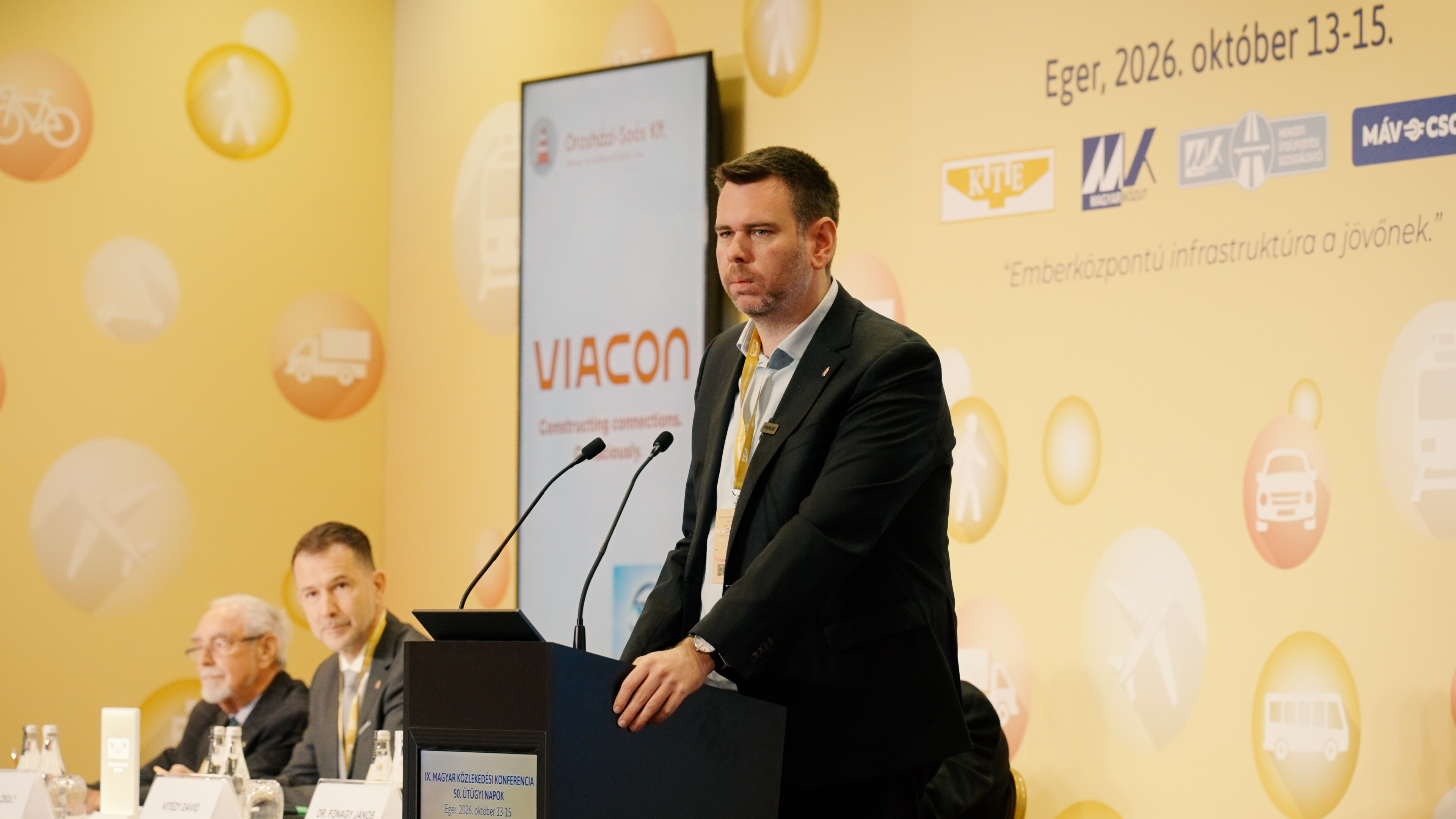
Among these, the government also set out its intentions regarding the ongoing expansion of the M1. „Our position is is that if the various contractors operating under MKIF are able to ensure sufficient transparency and clarity regarding their own costs, and if an agreement can be reached on this matter in connection with the conclusion of the concession, then in the case of the M1, we do not believe it will be necessary to halt the project. We believe that if this project were to be left unfinished, it would entail disproportionate disadvantages. We will wait to see how the concession agreement is finalised; but fundamentally, our intention is that, whilst Magyar Közút will take back full operational control, we would bring the M1 back under state management once the project is completed.”
Six key leaders from the sector around one table
Another highlight of the opening day was the afternoon round-table discussion, moderated by Szabolcs Nyíri, Deputy State Secretary responsible for the KBM road transport strategy. The discussion, entitled „The Survival and Reallocation of Construction Industry Capacities”, was attended by six leading figures from the sector: Zsolt Hegyi, Chief Executive of MÁV Zrt.; Attila Kerékgyártó, Chairman of the Board of Duna Aszfalt; József Pántya, Deputy State Secretary for Road Development; Szabolcs Vingelmann, Managing Director of Swietelsky Vasúttechnika Kft.; György András Zsiga, Chairman and Chief Executive Officer of Colas Magyarország Zrt.; and Dr Szabolcs Rózsa, Dean of BME, all shared their views on this topic.
The Duna Group was also featured in another programme organised by the Útügyi Napok: the session entitled „Construction economics in the road sector: the measurable benefits of technologies” was chaired by Szabolcs Rosta, Chief Innovation Engineer at Duna Aszfalt Zrt.. As part of this, Dániel Wolf, the company’s project manager, and Attila Purgel, the company’s chief technologist, gave presentations on the construction and early monitoring experiences with the SMA 8 (mI) wearing course.
In the same session, Dr Péter Füleki, Technology Director at Colas Magyarország Zrt., discussed the practical applications of recycled asphalt based on its value; whilst László Ézsiás, Chief Technology Engineer at Colas Északkő Kft., gave a presentation on sustainability issues relating to the asphalt industry’s demand for aggregates.
The Baroque town is a fitting venue for this long-established event
In addition to all this, the three-day event, which was held to a full house, covered the widest possible range of topics in the transport sector, showcasing the full spectrum of industry stakeholders. The event’s main organiser, Gábor Szerencsi, also emphasised the conference’s diversity to our newspaper: „Alongside road and rail development and bridge construction, public transport, air transport and cycling are also represented at these conferences,” emphasised the director of the road transport operator Magyar Közút.
He also highlighted the importance of the supplementary programmes organised as part of the conference, which is traditionally held in the countryside. Thanks to these, conference participants were able to attend, amongst other things, an organ concert in the Basilica of Eger, and they also visited an observatory. In conclusion, he explained that, as a resident of Eger, he was proud to have once again been able to organise the conference – which attracted considerable interest – in this Baroque town; as well as being a major event for the transport sector, it also generates significant tourism revenue for the town and boosts its marketing profile.
Source: Link





The road construction sector celebrated its half-century anniversary in Eger

Young skilled workers can set off on their apprenticeship placements today as well

Spectacular arches, ingenious solutions – the designers of the FŐMTERV present Venice’s award-winning bridge

Fót and Dunakeszi are finally to get a cycle route linking the two towns

Four new bridges to be built in the heart of the former industrial city

Rain gardens are coming to Budafok, with over 3,000 square metres of green space set to be developed

Contemporary art deco in Csopakon

Safer driving on the motorways: new digital signs for the MKIF
-

 Current at 2026. 09. 09.
A first-hand look at a career in engineering – Duna Group Szabadegyetem is back
-
Current at 2026. 09. 09.
Rental flats, Rákosrendező, decentralisation – important ideas were put forward on the Real Estate Beach Conference stage
-
Climate-X 2026. 09. 09.
Nyíregyháza Spartacus FC goes green – four hundred solar panels to be installed on the stadium roof
-
Bound track 2026. 09. 15.
Nearly 50,000 people travel on it every day – the refurbishment of the Cegléd main line continues