Industry news
AI has already changed our lives - Proptech Hungary 2025

While last year the topic of the Proptech Hungary conference was still the future-focused discourse of the AI boom, this year the question surrounding the all-day programme, which promised 67 speakers on two stages, not to mention workshops and countless exhibiting companies, was more along the lines of „OK, this and that works, but what next?” surrounded the all-day programme, which promised 67 speakers on two stages, not to mention the workshops and the many exhibiting companies, summarises the organiser's announcement of the basic mood of this year's conference. At the successful event on 22 May, visitors were able to listen to long keynote presentations as well as ten-minute crash courses and in-depth roundtable discussions.
Smart cities were at the heart of the concept, but there was no futuristic idea chasing, instead the focus was on curricular examples and practices - the audience even got to see what happens when four large language models run the same deep research task at the same time.

JOMO and agility
The event was opened by Zoltán Kalmár, the founder of the Proptech conference series, as last year's event was, the information note reminds. "I believe that the use of agile methodology and the development of organizational culture is one of the most important things to be done in the real estate market, which can be the basis for successful real estate transformation and digitalization. It's not about creating the perfect first time, it's about making the audience feel that the conference is constantly evolving. This, along with the valuable presentations and meaningful discussions, is what makes it a value-added event." - the main organiser introduced the event and then drew the audience's attention to the concept of Joy of Missing Out, modelled on FOMO.

Robots are already taking over and transforming work
"Think of a global capitalism where an incredibly small number of companies have the big models that everyone will be working with in the whole global economy" - set the tone for the opening keynote speech by Zoltán Pogátsa, an economist who spoke about the evolution, future and social implications of the AI market dominated by big tech. By Pogátsa's own admission, he is neither a property tech expert nor a construction industry expert, but he did provide some interesting revelations in the light of global economic trends, even to an audience that was clearly prepared. He pointed out that although there used to be giant companies that dominated the economy (such as banks and industrial magnates), now everything is going towards one sector, the technology sector - Zoltán Pogátsa cited the Nvidia stock market crash, which at one point involved more money than the entire German stock market. It would be easy to blow up a balloon, especially as share prices are quite volatile, but there are also changes that are irreversible."There is a lot of debate about whether robots and artificial intelligence will take the jobs," he said.
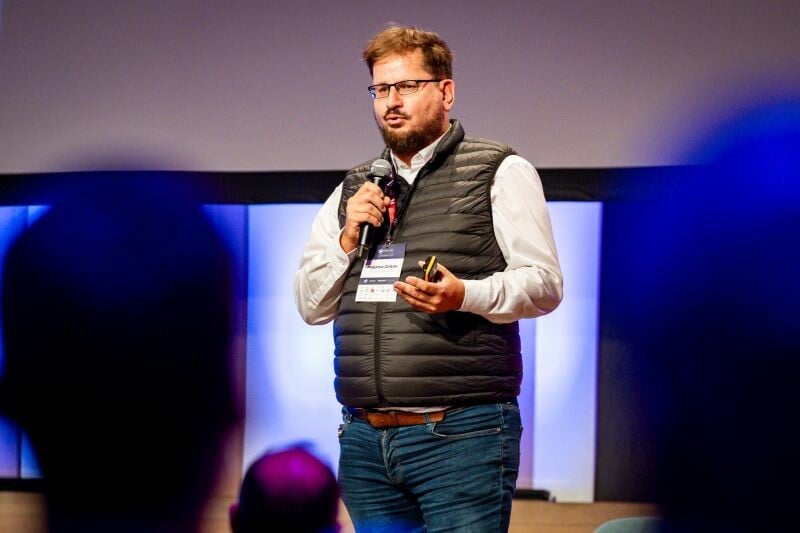
"I'm always amazed when they play this debate in the future tense when it's in the present tense. I can already name a number of companies in Hungary where human work has been replaced en masse by robots and AI. That's not going to happen. It's already partially done and underway."
- he pointed out, among other things.
Faster adaptation!
Although Zoltán Pogátsa's presentation was by far the most wide-ranging and serious, even the construction professionals were not the most optimistic. Andrew Gamblen, head of AEC (Architecture, Engineering, Construction), a company that develops Dalux construction software, spoke about the value of digitalisation in increasing efficiency and how the construction industry is very slow to adapt to new technologies. Although Gamblen said there is no reason to panic, a general change of mindset is needed. The mental and emotional health of the industry's workforce is important, including more sophisticated, flexible work processes and the training that enables them. In addition, everything is available - Andrew Gamblen cited the 360-degree cameras that many people use to document their holidays, but which can be seen as little BIM devices, just like the smartphones that were in the pockets of every viewer. Even QR codes can be included, as the expert argues that we are used to doing everything online.

"If you want a new house, you don't necessarily go to a realtor anymore, you go to a website, look at a neighborhood, and snatch up a house before someone else snaps it up"
- illustrated with an everyday example.
So what about at home?
The importance of shaping attitudes was also a recurring theme in the panels on Hungary. In the roundtable discussion on smart cities in Hungary, Zoltán Erő, Budapest's chief architect, among others, spoke about how it is not so much the technical background of "smartness" that matters, but what the city dwellers experience from it. "We have a lot of work to do in smart decision-making, smart use, and in making the whole urban culture work well," he said. And the number one tool for the latter is not innovation, but communication - Zoltán Erő recalled the story of the Southern Railway Station moving metres in official documents, which although it has indeed physically moved over time, even now not all documents say it has. The reason is that the responsible organisations have not yet agreed to update everything according to reality - so the problems in the city are not primarily digitalisation obstacles, but bureaucratic ones. "It's worth putting together collaborations and not thinking in pyramids," he said, among other things.

Of course, it doesn't hurt if our city is as digital as possible, because future trends can even be read from the data. An excellent example of this was given by László Balogh, lead analyst at Ingatlan.com, who talked about how, with their approximately 500 terabytes of data, they detected trends in property prices in the capital a year earlier than the MNB or KSH would have published.

BIM-bamm
One thing is certain: there will be no shortage of data and AI solutions in the Hungarian construction industry either. At the Proptech Hungary conference, numerous companies exhibited their own smart solutions, whether in lighting technology, parking, energy, or even the BIM, which was once used in large-scale investments and is now useful even on a very small scale – just one example, but at the Brick+Data stand, visitors could see for themselves how well the digital twin model of a library room scanned into a point cloud with LiDARral looks in Meta Quest 3. The demonstration also includes an example: someone once wanted to have special doors installed in their home, and to measure them accurately, the contractor used a 3D model because everything was where it should be.
Integrators are needed
But of course, we are still a long way from digital paradise – Csaba Livják, founder and managing director of Buildext Kft. gave another brilliant presentation on what is hindering digital innovation in Hungary. In short: the old-fashioned mindset that is prevalent among all members of the process, meaning that even if someone wants to innovate, they will constantly run into walls. However, according to Csaba Livják, progress will not stop, and he believes that in the future, an integrator role will emerge, connecting old-school professionals with actors using new solutions and customers who often arrive with sparkling eyes.
"I have the experience that in large companies, which have hundreds of thousands of square meters, hundreds of sites, this is built in-house. But in the Hungarian market, I don't think there is enough real estate, or the market is not big enough, for a single operator to build this, so I think that this will be used as a service by those who want to have a working BIM model".

magyarepitok.hu will also report on the event as a technical sponsor of Proptech Hungary 2025.
Source : Link




It’s time for a refurbishment: HEDO is carrying out work on one of Miskolc’s key transport routes

Four ‘1’s in a row: Esztergom’s transport headache has been resolved

The care home in Fertőd is to be refurbished

An innovative, distinctive PHOENIX Logistics Centre has been established in Győr: the Óbuda Group has reimagined the spaces for pharmaceutical logistics

Rain gardens are coming to Budafok, with over 3,000 square metres of green space set to be developed

Four new bridges to be built in the heart of the former industrial city

Contemporary art deco in Csopakon

Safer driving on the motorways: new digital signs for the MKIF
-

 Kirakat 2026. 10. 01.
A leading machinery distributor in the construction and haulage sectors is building a new service centre and extending its existing premises
-
Industry news 2026. 10. 02.
Hungary has joined the single electricity market
-
Railway development 2026. 09. 29.
The railway line leading to the Hungarian border is also set to be upgraded as part of Croatia’s large-scale development programme
-
Bound track 2026. 10. 07.
Aurora beneath the Apennines – Another tunnel is being built on the Naples–Bari railway line