Water management
A comprehensive development for the future of Lake Venice is ready

The KEHOP project is a joint venture between the National Water Authority and the Central Transdanubian Water Management Directorate, as consortium partners, in the investment of Colas Alterra Zrt. and the SWIETELSKY Hungary Kft. will be implemented with a budget of HUF 14 billion.
The project aims to improve the water quality of Lake Venice in a sustainable way, to maintain and ensure a higher standard of the near-natural condition of the shore areas and to rehabilitate them in an environmentally friendly way.
During the complex water management, bank protection works were renewed at 47 locations, 25 kilometres long, and dredging was carried out to improve the flow. At a further 25 sites, dredging of the estuaries of stormwater drainage ditches was carried out. In addition, natural spawning grounds for fish have been created, and sediment traps and water management facilities have been renovated.

One of the project's priorities is the protection of natural assets
This involved the rebuilding of obsolete, low-lying seawalls using a number of different technologies, adapted to the nature of the site and the specific operational needs.
Remediation of inlet watercourses and water quality storage reservoirs, as well as flow improvement dredging in nature reserves, will all contribute to improving water quality. Some of the priority riverbed material has been used to create breeding islands in the marshland part of the reedbed, which is home to a number of bird species that nest around the lake.
The HIDRO port was also renewed as part of the project. In addition to the reconstruction of the vertical seawalls, a new harbour and hall building was constructed and the portal building was renovated.
Special techniques were also used to build the seawall
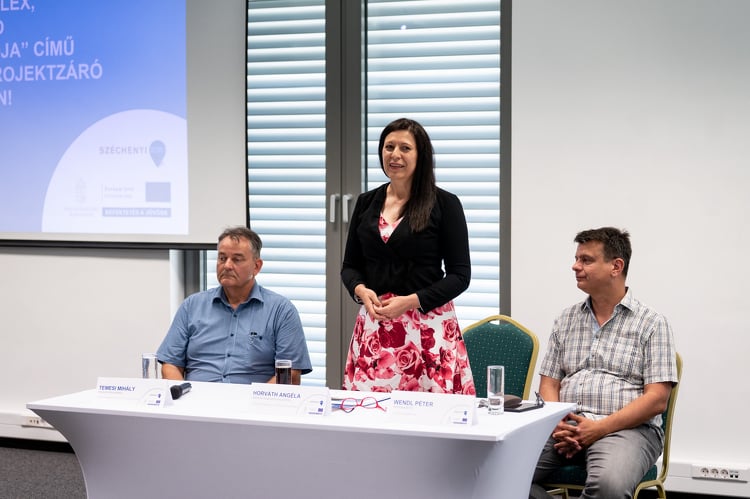
In her speech, Angéla Horváth, Deputy Technical Director of the Central Transdanubian Water Directorate said:
"We are coming to the end of nearly 6 years of work. Lake Venice is special in several respects: its catchment area is relatively small, its feeding watercourses are limited, it attracts a lot of social attention, it has many conservation values and it is also important for tourism. A development has taken place which I believe represents the future for the lake, which is on the threshold of a new development. As water professionals, we can use the tools of water management to serve the development of the lake, and we hope that a new future is now beginning, and that the lake will be revitalised by the development"
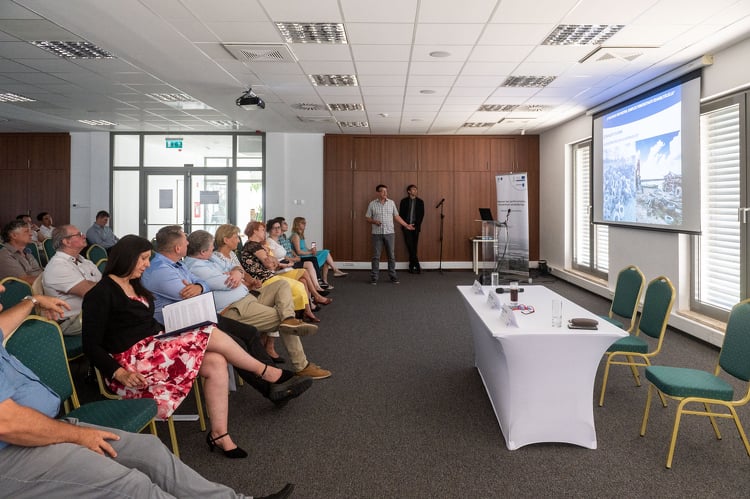
The details of the construction were presented by Peter Wendl, the construction manager of Colas Alterra Zrt..
„The construction of the embankment was one of the main segments of the work. We used prefabricated products from Leier to carry out the individual tasks.”
The work involved the installation of steel support columns that only need to be removed every 3-4 metres, thus reducing noise and only elements that are embedded or lifted from a floating installation. This technical solution also ensures aesthetic consistency and has resulted in a technology that is usable from all points of view. An important consideration was that the product should be made of high quality concrete (sulphate-resistant cement) that is resistant to environmental corrosion.
"During the dredging, we extracted about 120 thousand cubic metres of material from the lake" - the construction manager concluded.
Source : Link





It’s time for a refurbishment: HEDO is carrying out work on one of Miskolc’s key transport routes

Four ‘1’s in a row: Esztergom’s transport headache has been resolved

The care home in Fertőd is to be refurbished

An innovative, distinctive PHOENIX Logistics Centre has been established in Győr: the Óbuda Group has reimagined the spaces for pharmaceutical logistics

Rain gardens are coming to Budafok, with over 3,000 square metres of green space set to be developed

Four new bridges to be built in the heart of the former industrial city

Contemporary art deco in Csopakon

Safer driving on the motorways: new digital signs for the MKIF
-

 Kirakat 2026. 10. 01.
A leading machinery distributor in the construction and haulage sectors is building a new service centre and extending its existing premises
-
Industry news 2026. 10. 02.
Hungary has joined the single electricity market
-
Railway development 2026. 09. 29.
The railway line leading to the Hungarian border is also set to be upgraded as part of Croatia’s large-scale development programme
-
Bound track 2026. 10. 07.
Aurora beneath the Apennines – Another tunnel is being built on the Naples–Bari railway line