Engineer of the month
Engineer of the Month knows the winning recipe in the increasingly competitive construction industry

As February's Engineer of the Month, Adam Krivarics is working in one of the most exciting areas of the construction industry: as WEST HUNGÁRIA BAU Kft.'s Contract Director, he is responsible for winning new projects. Despite his young age, he already has a wealth of experience behind him that helps him to perform this complex role at the highest level.
He started his career in the German construction industry
His first connection to the industry was his uncle, who worked as a road construction engineer. "It was what I heard from him that gave me the motivation to go in this direction during my studies," he says. At the Budapest University of Technology, in addition to his studies in civil engineering, he also completed a degree in finance as a technical manager at the Faculty of Economics (GTK).
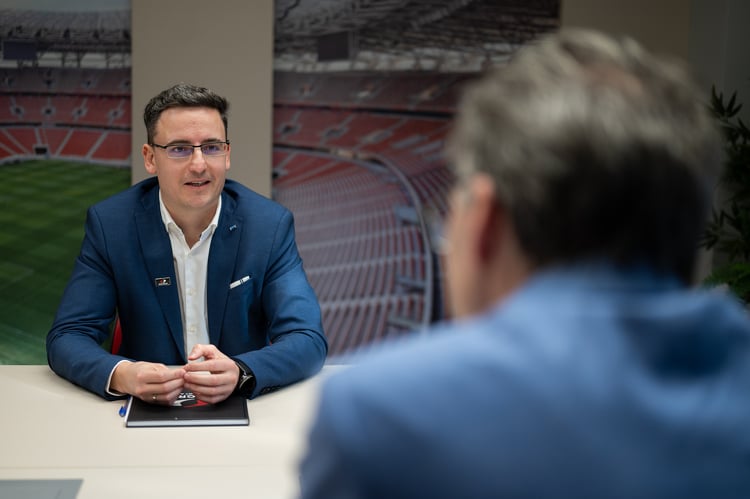
As we indicated in our previous interview with him, his versatility was further enhanced by the fact that he found a job in Germany after university thanks to a successful thesis, which was supported by a study abroad trip. There, he worked first for a small construction company with a family atmosphere and then for a start-up company building detached houses.
Innovative approach quickly confirmed with the WHB
With a total of six years of work experience, he returned home in 2019 for personal reasons and started working at WHB. "It turned out to be a good decision because the girl I met then has been my wife ever since," he adds with a smile. At the same time, he looks back on this step with satisfaction for his career:
"I was looking for a large company where I could be involved in big projects, where the operation is secure, the company's market position is stable, and it has a steady flow of work." Beyond all that, what attracted me to WHB was its family feel.
As he said earlier, the engineer was involved in a complex structural engineering project in Budapest when he arrived. He was already involved in the preparatory work, carrying out minor tasks in the contracting department and making proposals. His innovative approach was quickly confirmed, as at the end of the project he was no longer assigned to another development, but was put in charge of the contracting department, which is now a key area with almost 20 employees.
The stars align: the most important conditions are met
According to him, the fact that he felt very much at home in the company and working with a well-motivated and good team may have contributed to his decision. The fact that he has always had the economic and financial mindset needed for the business department and that he has already tailored his studies accordingly has also been a major factor in his decision.
As an important element, he stressed that the owners of the WHB are always open to new ideas and perspectives: "If an idea has imagination, you are given the opportunity to realise it. "0
This is what you brought from Germany
Asked how much of his German experience he took home with him, he gave a frank answer. "There is a well-established system for all processes there, even in areas where the Hungarian construction industry is still in its infancy. In the case of BIM, for example, at the time of my departure, in 2019, they were roughly where we are now in the WHB Group."
He also explained that the systemic and well-meaning German mentality is still very close to him and he tried to bring it with him. "At the same time, you obviously have to recognise how long it works, where the limits are, and you can't take the German market as an example, but you have to think systemically."
It's a very difficult game that requires teamwork
Based on his career so far and especially his work at WHB, February's Engineer of the Month can best be described as a man of change. This attitude has been reinforced by the market changes of recent years. "You need a completely different approach and a different way of building a contractor team than before. With the presence of Hungarian companies on the market, as well as Chinese, Turkish and other foreign companies, the only way to compete on price is to put together a very well-developed bid."
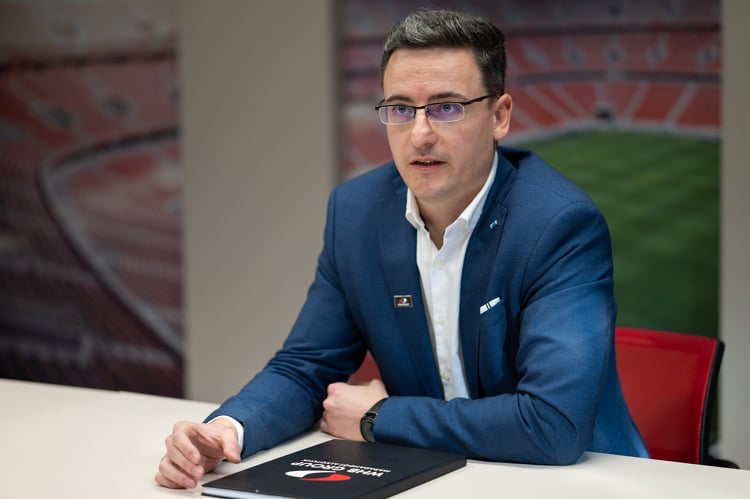
This effect has been exacerbated by the fact that in the last 1-2 years a significant share of construction GDP has been accounted for by industrial investment attracting the above-mentioned foreign firms. "We are also seeing similar competition for public investment, as there is much less work available for firms in the domestic sector", adds Ádám Krivarics. "In addition, many firms are taking on jobs at below cost to maintain employment until the industry gets back on track. It's a very difficult game, which is why it requires teamwork at all levels, from design to implementation."
You have to find out why the foreign competitor is cheaper!
While many would see market protection as a good solution to the rise of foreign firms, Ádám Krivarics puts the focus elsewhere: by looking at the possibility that foreigners do certain processes more efficiently.
"The current situation may also reflect the fact that the Hungarian construction industry was a bit complacent in previous years. We definitely need to step out of our comfort zone and look at why we are more expensive. It may turn out, for example, that services that we traditionally buy at home are so much cheaper to do next door that it is worth switching. In short, you have to open up the spectrum, look more widely, even beyond the usual subcontracting."
Openness also includes making trips abroad to explore more effective methods abroad. "I'm not saying that they're keen to adopt all of them, but we are making changes that were indicated by our professional trip to China, for example."
Opportunity comes out of nowhere and you have to pounce immediately
One of the ways to compete with foreigners, he says, is to invest much more in preparation. "It is not enough, for example, to be generous with the price of concrete. You have to model whether a given amount of concrete is available in the area, what type, when it will be delivered, whether winter conditions have been taken into account. It's the nuances that will make the difference, the situation in the sector is so critical."
Also, the competitiveness described above is helped by the ability to react quickly, as market opportunities tend to come out of nowhere and it takes 1-2 weeks to put together a first-round offer. "The latter is hugely important because there is very little room for manoeuvre compared to the price worked out there," he stresses.
The old world is gone
The rapid responses needed to address the above need to be managed at the level of subcontractors, the group and direct colleagues. "This is where the aspect of strengthening teamwork and working in a system where colleagues in Győr and Biatorbágy can work on the same tender at the same time comes in," he pointed out. "Gone is the old world where an experienced colleague would get a project and report back two weeks later to price it." He added that this required many people to step out of their comfort zone, as the coordinated use of online interfaces, among other things, was a new element compared to the previous way of working.
He said that the owners of the WHB are operationally aware and flexible enough to support a project, which is an excellent background for tenders that require quick actions and decisions. "With proper preparation, we can essentially call the owner at any time to see if a particular bid can go."
Chinese partner schedules a technical meeting for Sunday
He has successfully represented the approach and working methods described above, as he has seen continuous improvement in his team since he has been in charge of the entrepreneurship department. Highlighting a concrete example of progress, he mentioned the CATL investment in Debrecen, where the technical material for the tender received very good feedback. "When I look at how much more headache was previously caused by the preparation of our first Chinese bid, the progress is clear. Here, of course, it is not only the professional development of the department, but also our growing experience in China that counts."
The latter process was also helped by last year's tour of China: "We spent a very intensive week on a professional basis, visiting investors, partner companies and potential partners."
He specifically mentioned the Chinese work culture, which is very different from the Hungarian one. "I honestly thought that we work a lot in the Hungarian construction industry, but there is a completely different social model there, as children are raised by grandparents.
This working culture is also a factor to be reckoned with: a letter from your Chinese partner on a Friday evening asking if you can meet on Sunday. There's a level at which you have to do that, but obviously you have to find the boundaries, because we have a family model where I want to take my kid to the playground on Saturday afternoon."
Being in a tender for a long time is also an important feedback
The question then arises as to how the progress described by the Director of Enterprise can be measured and reported back in a concrete way. "Of course, the most important feedback is if the WHB wins a tender, but there are many other measures," he pointed out. "If, for example, we come bottom of a tender, that's also a good feedback, because with a little refinement we can bring that project next time."
Another important figure for the Enterprise Department comes afterwards: feedback on the profitability of a project is given at management meetings. "We discuss where margins have been better and where they have been less good." He added that focusing on clients, including potential new partners, is also an important job for the enterprise department through relationship building and relationship management.
The entry of the TSPC has serious payoffs
He also pointed out that their work will not end with the award of the project, as they will then start negotiating the details with the contractor. "The fewer problems that need to be clarified afterwards at this stage, the more positive it is for our operation."
The above joint work is greatly helped by the fact that under the leadership of Ádám Krivarics, we have managed to improve the coordination between the contracting department and the construction department. In fact, the construction specialists were involved in the final stage of the bidding process, as the manager explained in an earlier interview with our newspaper. "One important change since that interview is that since last year the TSPC Csoport is now part of the group. Together with a design company with a highly innovative approach, using artificial intelligence and with an office abroad, we form a very powerful group of companies."
AI will not bring explosive change
In view of the currently unforeseen opportunities offered by AI, the interview also touched on the exploitation of the field of digitalisation: here again, the leader highlighted the importance of the TSPC Kft.. "I don't necessarily have the time to go into this, but the experts at TSPC are much more involved in this area and we are gaining a lot of information from our cooperation."
Overall, he doesn't expect AI to bring explosive change to the construction industry: "I think it's a long-term process, and that's why it's important that we keep changing, adapting to external changes."
Doing what you love
As the interview drew to a close, we also touched on the core values needed for quality work. He highlighted the low turnover in the business department, which employs nearly 20 people. And as one of the most important internal attitudes, he said: "I think you have to do what you love, because then you have the motivation and ambition to be successful."
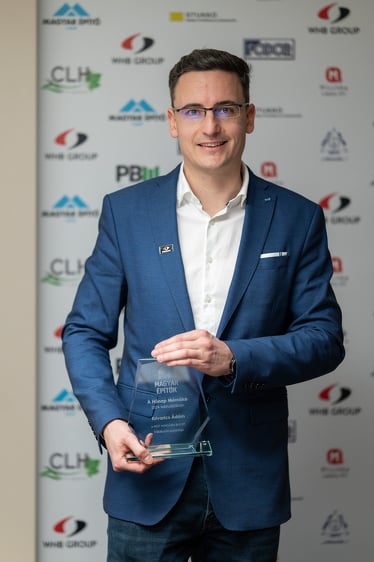
Other key elements, he says, are a systems approach, effective cooperation with the group's partner companies and the use of available software. "Mastering the latter is often beyond our comfort zones, but without them we can only do the work that computers do for us with a considerable amount of overtime," the enterprise director stressed.
It is important for him that there is no standing still
Given its young age and role as a representative of constant change, the question arises as to how it can bring about the necessary innovations in its staff. "It's never advisable to turn everything upside down, but you can proceed with caution and purpose. It's not about forcing change on someone, it's about achieving involvement: when that colleague realises that, within a certain timeframe, they will be able to do their job faster or more efficiently with the new tool."
We usually ask the Engineer of the Month to highlight his favourite project or most memorable achievement, but not surprisingly Adam Krivarics highlighted a process instead.
"The best thing for me is progress. How to bring the business team even closer together, how to move forward together with the rest of the group, how to innovate, how to manage friction. For me, that's really what motivates me!"
He added that it is very important for him that he sees change every year instead of stagnation, and that the direction is visible. "Moreover, there is maximum support from the owners for this process."
Source : Link







The first municipal thermal power station in Transylvania is under construction

A huge brush was driven through the Sopron tunnel on the M85 – with video

The town centre on the banks of the Tisza is being regenerated

The Market has fulfilled its promise: it has delivered the 10,000 tonnes of natural stone offered for the raising of the bottom sill at Paks

Rain gardens are coming to Budafok, with over 3,000 square metres of green space set to be developed

Contemporary art deco in Csopakon

Four new bridges to be built in the heart of the former industrial city

Safer driving on the motorways: new digital signs for the MKIF
-

 Industry news 2026. 08. 18.
Students were introduced to the high-tech construction industry at BME’s field camp in Göd
-
Bound track 2026. 08. 17.
New pedestrian crossings and a junction with traffic lights are being built in Angyalföld
-
What is being built? 2026. 08. 18.
Hungary’s new McDonald’s restaurant has moved into a modernist listed building in the centre of Budapest
-
What is being built? 2026. 08. 18.
New paving, a playground and visitor facilities are being planned for the Várkör area in Pannonhalma