Industry news
Paks II - active and passive systems for safety

Evolution is not just in the living world, but also in the nuclear industry, for example. Newer and newer types of reactors are becoming more modern and safer than the old ones. Technology is constantly being improved to maximise safety. In doing so, they draw on experience gained in construction, operation and the accumulated knowledge of the industry.
The 3+ generation VVER-1200 is one of the newest and most modern members of the VVER family, based on decades of development and operational experience with the Roszatom. These innovative technology units offer better economics than their predecessors and the most efficient protection possible. Such units are also being built in Paks.
The new units will be built according to standards and specifications set by European and world organisations - the International Atomic Energy Agency (IAEA), the Western European Nuclear Regulators Association (WENRA) and the European Utility Requirements (EUR).

The two upgraded third-generation pressurised water units have a planned gross electrical capacity of 1,262 MW per unit and an expected lifetime of at least 60 years. The development of the VVER-1200 unit type has focused on safety improvements. The safety of this type is guaranteed by an optimal combination of active and passive safety protection systems. The active systems require energy input for their operation, the passive systems are able to perform their function without energy input and without human intervention.
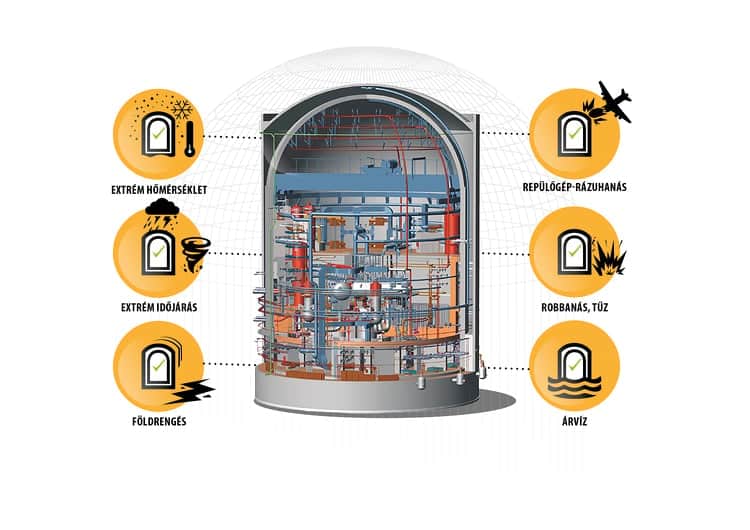
In the new units, the reactor and the primary circuit are located in a double-walled containment building, the containment shell. This protects the equipment against external hazards, making it resistant to earthquakes, tsunamis, external explosions, snow, ice and wind, and even allowing the units to be shut down safely in the event of an aircraft impact.
This type is also capable of operating in manoeuvring mode, in which the power can be varied by up to 20-100 percent depending on the load. The block type built in Paks meets Hungarian and international safety requirements to the maximum extent possible. It is not a "prototype" power plant, the first such unit - the first unit of the Novovoronezh NPP II - started commercial operation in February 2017, and since then five more VVER-1200 units have been connected to the grid.
| The nuclear safety of the VVER-1200 unit is based on safety systems assigned to the levels of protection, in accordance with the defence-in-depth philosophy, capable of performing the necessary interventions in a timely and efficient manner. The safety systems of the unit are designed along the following principles: passive safety systems (systems capable of performing their function without power input and without human intervention) are available to deal with extremely low probability failures and accidents within the design basis extension. The principle of redundancy applies to the design of active safety systems (requiring energy input for their operation). Active safety systems are usually built up of four parallel branches, one of which is sufficient to fully implement the required safety intervention. The spatial, physical separation of the redundant branches of the safety systems ensures that the systems are protected against common cause failure (e.g. fire). In addition to redundancy, the principle of diversity is important, i.e. security systems consisting of different equipment and, where possible, with different principles of operation (e.g. passive and active) should be available to perform the security intervention. |
|---|
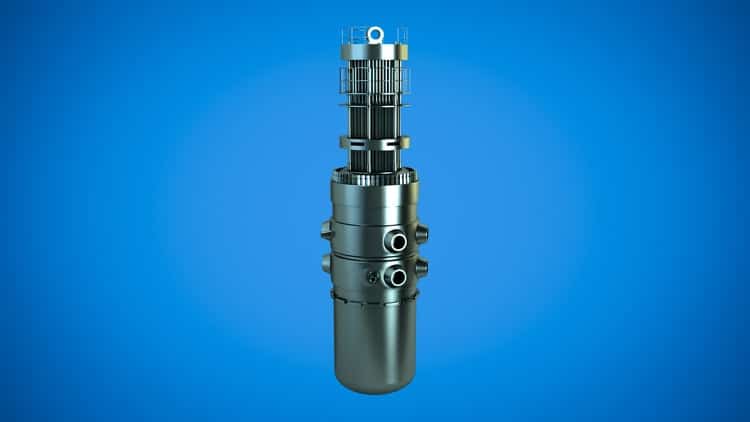
Main features of VVER-1200 3+ generation block
| Type of reactor | pressurised water |
| Thermal performance | approx. 3220 MW |
| Electric power | approx. 1200 MW* |
| Fuel | U-235, with max. enrichment 4,95% |
| Number of primary loops | 4 |
| Number of steam generators | 4 |
| Reactor cooling water outlet temperature | 328,9 °C |
| Reactor cooling water inlet temperature | 298,2 °C |
| Primer circuit pressure | 16,2 MPa |
| Secondary circuit pressure | 7 MPa |
| Primary circuit volume flow rate | 86000 m3/h |
| Volume of steam produced in steam generators | 6400 t/h |
| Operating life | at least 60 years |
| Availability | >90% |
| Power plant efficiency | 37% |
* The new Paks units will have a rated electrical output of 1262 MW thanks to the planned turbo-generator system
Source : Link






Major Hungarian construction project in the Serbian capital – a specialised world exhibition is on the way

Roadworks are taking place at 15 locations in Balatonfüred

SWIETELSKY is inspecting and repairing the surface defects on Main Road 25

Pécs, Gödöllő and Budapest: four SPAR stores have been refurbished – here’s which ones

Rain gardens are coming to Budafok, with over 3,000 square metres of green space set to be developed

Four new bridges to be built in the heart of the former industrial city

Contemporary art deco in Csopakon

Safer driving on the motorways: new digital signs for the MKIF
-

 Road building 2026. 10. 13.
A consortium comprising STRABAG and Duna Aszfalt has been awarded the contract to build the North Macedonian motorway
-
What is being built? 2026. 10. 09.
One of Budapest’s oldest nurseries is being renovated whilst preserving its timber roof structure
-
Current at 2026. 10. 10.
„The focus will not be on Lean’s equipment, but on how we operate” – the ‘Lean in the Construction Industry’ conference in November
-
Bound track 2026. 10. 08.
Déli railway station is set to undergo a major refurbishment, paving the way for double-decker trains