Industry news
„We dared to take on bigger challenges” – decisions and lessons learnt from Market’s thirty years

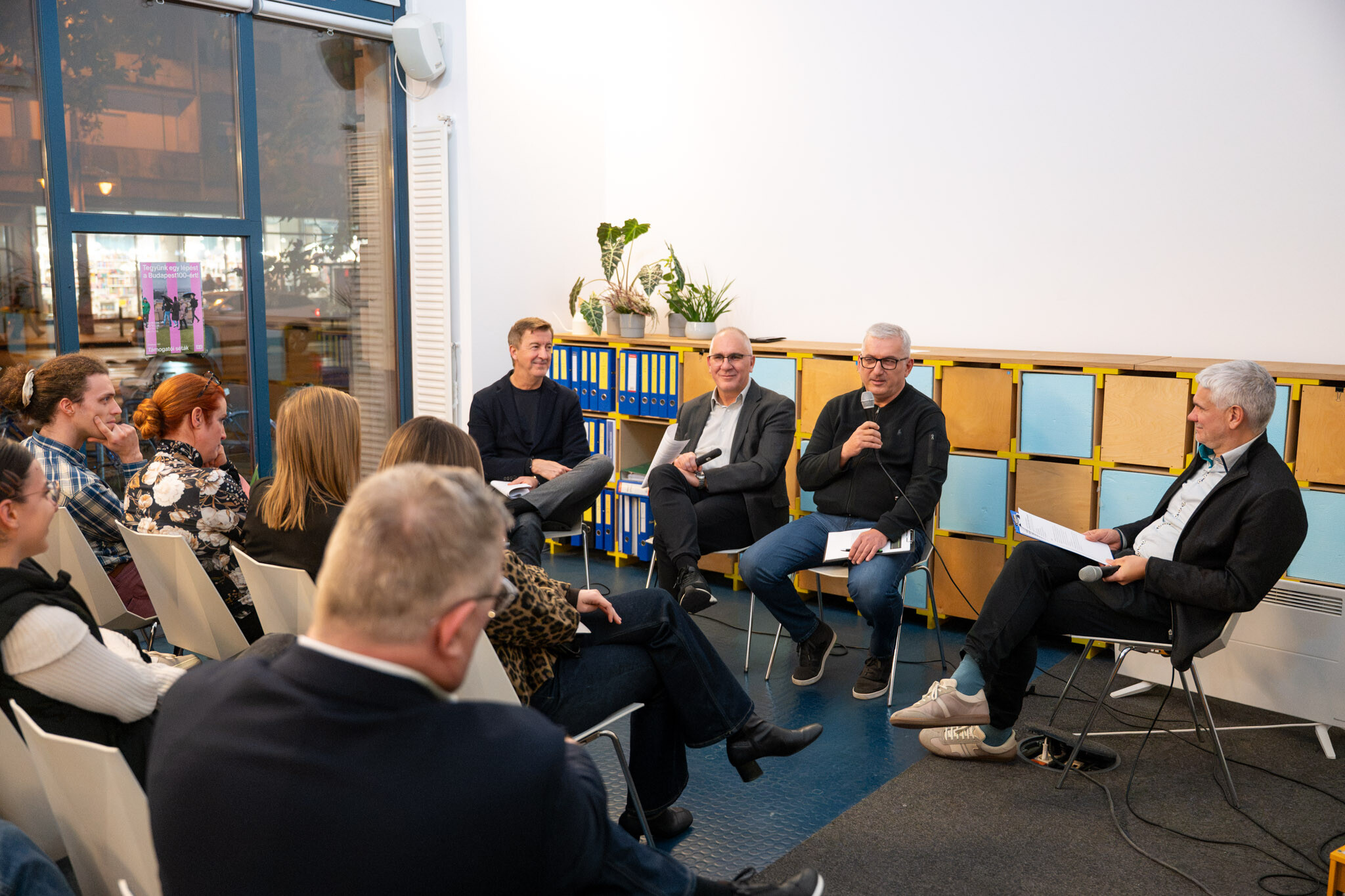
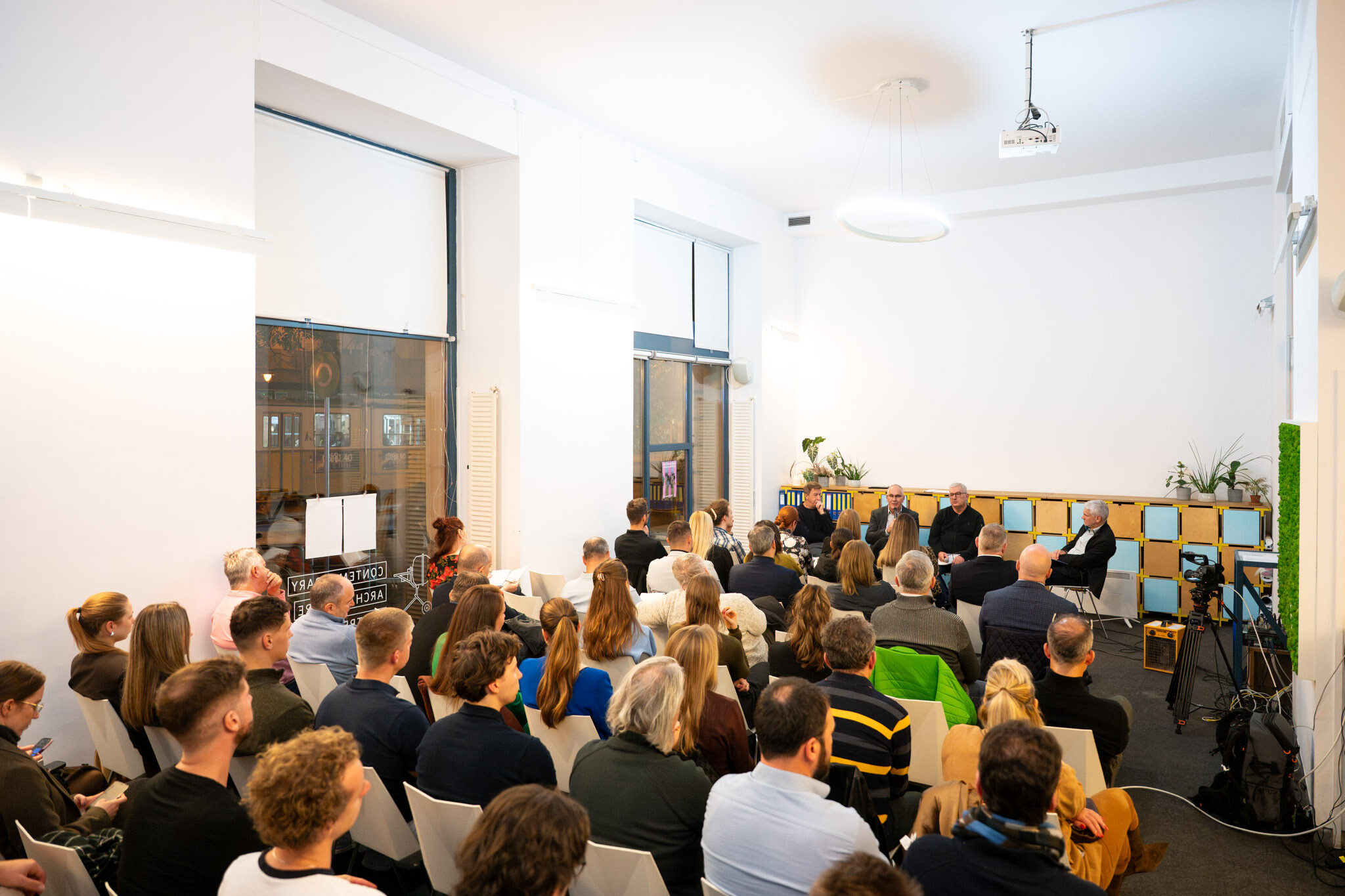
At the Kortárs Építészeti Központ (KÉK) Trust Your Architect! Special event Sándor Scheer, founder and chief executive, András Wolf, deputy chief executive for technical affairs, and Csaba Szűcs, chief construction manager, recalled the defining milestones in the three-decade history of Market. The discussion revealed the development trajectory of a company whose operations have, from the very beginning, been guided by the same question: how can we grow without losing sight of what made it worthwhile to set out in the first place?
Building on financial discipline and partnership
The history of Market actually began even before the company was founded. During the years of the political transition, Sándor Scheer worked for a construction firm, where he spent six years. At that time, the country was learning how a market economy worked; many businesses began to grow rapidly, but not everyone knew how to make this sustainable in the long term.
The owner kept buying up more and more plots of land and companies, but the pace of growth was not matched by an equivalent level of financial discipline. The story ultimately ended with the company’s collapse.
„I started out as a forced entrepreneur” – recalled Sándor Scheer.
At a young age, he realised that, as an employee, he could repeatedly find himself in situations where he would have to bear the consequences of other people’s poor decisions. He therefore saw setting up his own business not merely as a business opportunity, but also as a chance to create a different operating model.
At the outset, they set out a few simple guiding principles. They do not take out loans to fund day-to-day operations, but only for development purposes. They do not build their business on excessive debt. And, under all circumstances, they prioritise their partners over themselves when it comes to payments.
Over the years, some rules have changed, but the thinking behind them has not. Financial discipline and predictability have been a constant feature of the company’s development right up to the present day.
There can be no compromise when it comes to quality
Recalling the early days of Market, Csaba Szűcs and András Wolf repeatedly returned to the same characteristic: Sándor Scheer’s consistent high standards.
Csaba Szűcs recalled an incident during a pre-handover inspection. In one room, the row of grout lines running along the wall did not follow the wall’s line perfectly. It was a discrepancy that probably nobody would have noticed. Sándor Scheer did, however. And he ordered the repair to be carried out immediately.
The story may seem insignificant in itself, yet it reveals a great deal about the philosophy that, over the years, has become one of the most important elements of Market’s culture – precision and accuracy in execution.
András Wolf gave another example. A project had already been completed, the client was satisfied, and the building had received recognition. Despite this, the Market team continued to work on it for weeks. Not because they were contractually obliged to do so, but because they believed there was still room for improvement.
Throughout the conversation, the idea kept coming up that, for them, the benchmark for quality had never been solely the clients’ expectations. Their own professional conscience played at least as important a role.
The first big leap: when the coat still seemed too big
In the early years of Market, the company grew rapidly. McDonald’s restaurants, petrol stations and, later, Penny Market stores and logistics centres were built. The scale of the projects gradually increased, and the organisation evolved alongside them. The first truly major test came with the EuroCenter in Óbuda. The chief executive described this project as one of the most important turning points in the company’s history.
„We dared to wear coats that were bigger than our size at the time.”
The scale of the investment was practically equal to the company’s total annual turnover at the time. The risk was enormous, and the pressure was even greater.
„It nearly killed us, but it’s finally finished.”
With EuroCenter, more than just a shopping centre was built. During the project, it became clear that Market is capable of handling tasks that are far more complex and on a much larger scale than before.
The next significant milestone was the entry of Wallis Ingatlan as an investor. Sándor Scheer recalled that, during a business meeting, he was told that the company was expected to achieve a profit of one billion forints. Given the company’s size at the time, he considered this impossible. However, the response opened up a new perspective for him: why shouldn’t the company be built on a larger scale?
The following years were all about this. Not about the success of a single project, but about establishing an organisation capable of carrying out various types of investment projects to a high standard across multiple sites simultaneously.
To achieve growth, we first had to learn
A recurring theme in the discussion was that Market’s forays into new areas were almost always preceded by a learning phase. According to the chief executive, the organisation’s development also involved bringing in external experts.
„One mustn’t imagine that one is an expert in everything or knows everything. If one believes that, one will be brought down to earth very quickly.”
Organisational developers, training programmes and HR consultants helped drive this growth, whilst the company gained experience in a succession of new sectors. Alongside industrial and logistics developments, office buildings emerged, followed by hotels and, subsequently, residential projects.
The history of hotel construction illustrates this approach well. During the early projects, more than twenty developments were underway simultaneously; yet they were prepared to take on this risk in order to gain experience, particularly during the initial phase. By the third hotel project, they were already turning a profit. Today, they have the experience of having completed nearly forty hotels.
A similar learning process was also associated with collaborations with Chinese investors. After overcoming initial difficulties, they made a conscious effort to gain a better understanding of their partners’ business culture. Their staff regularly attended Chinese trade fairs, gained first-hand experience and gradually built up a body of knowledge that later gave them a competitive advantage.
The MOL Campus is a symbol of an era
Although several iconic projects were mentioned during the conversation, András Wolf spoke with particular emphasis about the MOL Campus. Prior to the construction of the tower block, there was no existing experience in Hungary that could be relied upon. Experts from Market studied the practice of high-rise construction in Warsaw and Dubai, whilst the preparation of the tender alone took nearly a year. The construction work took a further three years.
For the Deputy Chief Technical Officer, however, the most important lesson to be learnt from the project was not primarily of an engineering nature. There were constant professional exchanges of views between the client, the designers, the technical supervisor and the contractor, yet not a single raised voice was heard.
„There were heated professional debates, but we resolved them through consultation.”
Perhaps this best illustrates just how much the company has changed in the years since EuroCenter. The challenge used to be not whether they were capable of taking on a major task, but rather how to bring an extremely complex project to a successful conclusion through the collaboration of several hundred stakeholders.
As well as the profession, you also need to learn how to strike a balance
According to the three executives, the same values still underpin their professional success today: hard work, humility and perseverance. Csaba Szűcs also pointed out, however, that it is important for the younger generation to strike a balance between work and family life.
András Wolf emphasised the joy of creation – that feeling when the work of a team gives rise to something of lasting value.
As Sándor Scheer put it: „Ours is a wonderful profession.” He added, however, that it is also a combat sport.
The greatest undertaking of the next thirty years
Towards the end of the discussion, the topic of the future also came up. Sustainability, artificial intelligence, robotisation, international cooperation. These are issues that are expected to shape the construction industry for decades to come.
According to Sándor Scheer, a more ambitious approach is needed in several areas. As he put it, those companies that prepare in good time for increasingly stringent sustainability requirements and technological changes may gain an advantage. Ultimately, however, the most powerful idea to emerge from the discussion was not linked to a specific project, technology or market entry. Rather, it centred on the question of what it truly means to build a company for the long term.
„I’d like this company to stop being associated with me, as it shouldn’t be about just one person.”
Thirty years ago, the challenge lay in setting up a business. This was followed by increasingly large-scale projects, new markets and new areas of expertise. Today, the challenge is to build something on a different level: to create an organisation capable of carrying forward the same values, knowledge and operating principles even when the founders are no longer involved in day-to-day operations.
Just as they took on a bigger challenge than they were ready for during the EuroCenter era, they now find themselves facing another major undertaking. This time, however, they do not have to build a building, but rather an institution capable of enduring for generations, so that Market will still be here in 50 years’ time.
Source: Link








„We dared to take on bigger challenges” – decisions and lessons learnt from Market’s thirty years

Celldömölk’s main road is being upgraded with a rain garden, a turning lane and a well-maintained pavement

The water mains reconstruction on Jósika Street in Szeged will soon be completed

Major Hungarian construction project in the Serbian capital – a specialised world exhibition is on the way

Rain gardens are coming to Budafok, with over 3,000 square metres of green space set to be developed

Four new bridges to be built in the heart of the former industrial city

Contemporary art deco in Csopakon

Safer driving on the motorways: new digital signs for the MKIF
-

 Road building 2026. 10. 13.
A consortium comprising STRABAG and Duna Aszfalt has been awarded the contract to build the North Macedonian motorway
-
Current at 2026. 10. 10.
„The focus will not be on Lean’s equipment, but on how we operate” – the ‘Lean in the Construction Industry’ conference in November
-
Current at 2026. 10. 17.
Young skilled workers can set off on their apprenticeship placements today as well
-
Current at 2026. 10. 13.
It’s time to provide information to those in the sector – that’s what this year’s Építőipar Summit was all about