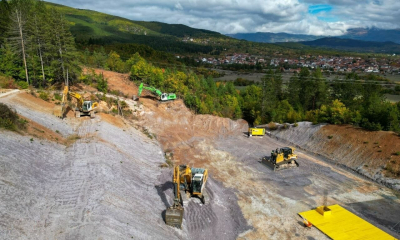
Road building
The water mains reconstruction on Jósika Street in Szeged will soon be completed

The water mains modernisation programme in Szeged city centre has been underway for several years, thanks to the collaboration between Szegedi Vízmű Zrt. and the City of Szeged with County Rights. These are large-scale projects of particular importance to the local population, which will shape everyday life in the area for decades to come. In our previous article, we reported that Délút Építő és Bányászati Kft. can continue the renovation of Jósika Street, in the third phase between Gogol and Gyertyámos Streets, on behalf of Szegedi Vízmű Zrt..
We contacted staff at Délút regarding the details of the works, and they informed our newspaper that, in order to ensure efficient organisation of the works and to minimise disruption to residents, the modernisation of Jósika Street has been divided into three phases, which are progressing according to schedule:
Section I: The section between Gogol Street and Kálvária Avenue
Section II: The section between Kálvária Avenue and Béke Street
Section III: The section between Béke Street and Gyertyámos Street

Three temporary power lines are supplying the local population
The sequence of operations involved in water main reconstruction is determined by a series of strictly interlinked work processes. The main stages of the project follow the order set out below:
- taking over the worksite and carrying out the necessary coordination with utility companies,
- installation, pressure testing and disinfection of a temporary pipeline,
- the temporary connection of the properties concerned to the provisional network,
- the dismantling of the ageing backbone cable using open-trench technology,
- laying, backfilling and backfilling of a new pipeline, as well as its pressure testing and disinfection,
- the commissioning of the upgraded backbone cable and the final reconnection of consumers,
- the final restoration of the road surface in accordance with technical specifications.

The reconstruction of the drinking water network on Jósika Street in Szeged is proceeding at a rapid pace, in close cooperation with staff from the operator Szegedi Vízmű Zrt.: the contractors must complete the modernisation in full within just four months, by 28 November 2026. The work is being carried out by a team of 10–14 workers divided into two operational teams, and where necessary, the schedule will be maintained by immediately increasing the workforce.
„We will maintain the continuity of supply to the public,” they said, “by operating three independent, above-ground temporary pipelines during the construction period.”

The town is now free of major traffic jams
One of the most fortunate aspects of the project is the underpass beneath the Kálvária Avenue junction: this access road, which is vital for Szeged, carries 10,000–12,000 vehicles a day, as well as heavy tram and bus traffic, so breaking up the road surface would have caused major difficulties.
The Operator and its specialist contractors therefore inspected the section beneath the junction using end-point excavation and camera-based pipe diagnostics, which revealed it to be in surprisingly good condition, highly suitable for welding and of an adequate cross-section. Following a successful pressure test and the receipt of flawless bacteriological water samples, it was confirmed that the pipeline was fully functional, so only limited excavation was required on the section beneath the busy junction; the junction of Jósika Street and Kálvária Avenue was completed by the end of the school holidays, thereby avoiding significant traffic restrictions.

The modernisation of the cable network continues with precision engineering solutions
On the other sections of the network, the renovation is being carried out using the traditional open-trench method, which demands a high standard of professional and safety discipline. The old pipes are being removed in their entirety and transported away in sealed containers to protect the environment and reduce dust pollution. During construction, particular attention is paid to ensuring a durable watertight seal: the old and new sections are connected using Multi/Joint universal fittings, whilst the polyethylene pipes are joined using state-of-the-art electrofusion welding.

They pay particular attention to durability
Maintaining the dense network of underground utilities and traffic flow in the city centre requires continuous on-site coordination and flexible engineering decisions from the civil engineers, but strict requirements also apply to the finishing works: the backfilling of trenches is carried out with careful layering, using a combination of manual and mechanical compaction, to ensure that the surface does not subside in the long term.
The load-bearing capacity and degree of compaction of the restored road surface will be verified through accredited laboratory tests, meaning that following the handover in November, the people of Szeged will not only have a safe drinking water network but also a road surface that has been restored to a high standard.
Source: Link









„We dared to take on bigger challenges” – decisions and lessons learnt from Market’s thirty years

Celldömölk’s main road is being upgraded with a rain garden, a turning lane and a well-maintained pavement

The water mains reconstruction on Jósika Street in Szeged will soon be completed

Major Hungarian construction project in the Serbian capital – a specialised world exhibition is on the way

Rain gardens are coming to Budafok, with over 3,000 square metres of green space set to be developed

Four new bridges to be built in the heart of the former industrial city

Contemporary art deco in Csopakon

Safer driving on the motorways: new digital signs for the MKIF
-

 Road building 2026. 10. 13.
A consortium comprising STRABAG and Duna Aszfalt has been awarded the contract to build the North Macedonian motorway
-
Current at 2026. 10. 10.
„The focus will not be on Lean’s equipment, but on how we operate” – the ‘Lean in the Construction Industry’ conference in November
-
Current at 2026. 10. 17.
Young skilled workers can set off on their apprenticeship placements today as well
-
Current at 2026. 10. 13.
It’s time to provide information to those in the sector – that’s what this year’s Építőipar Summit was all about