Road building
The renovation of Hajnóczy Street in Szeged is focusing on climate-adaptive and sustainable solutions

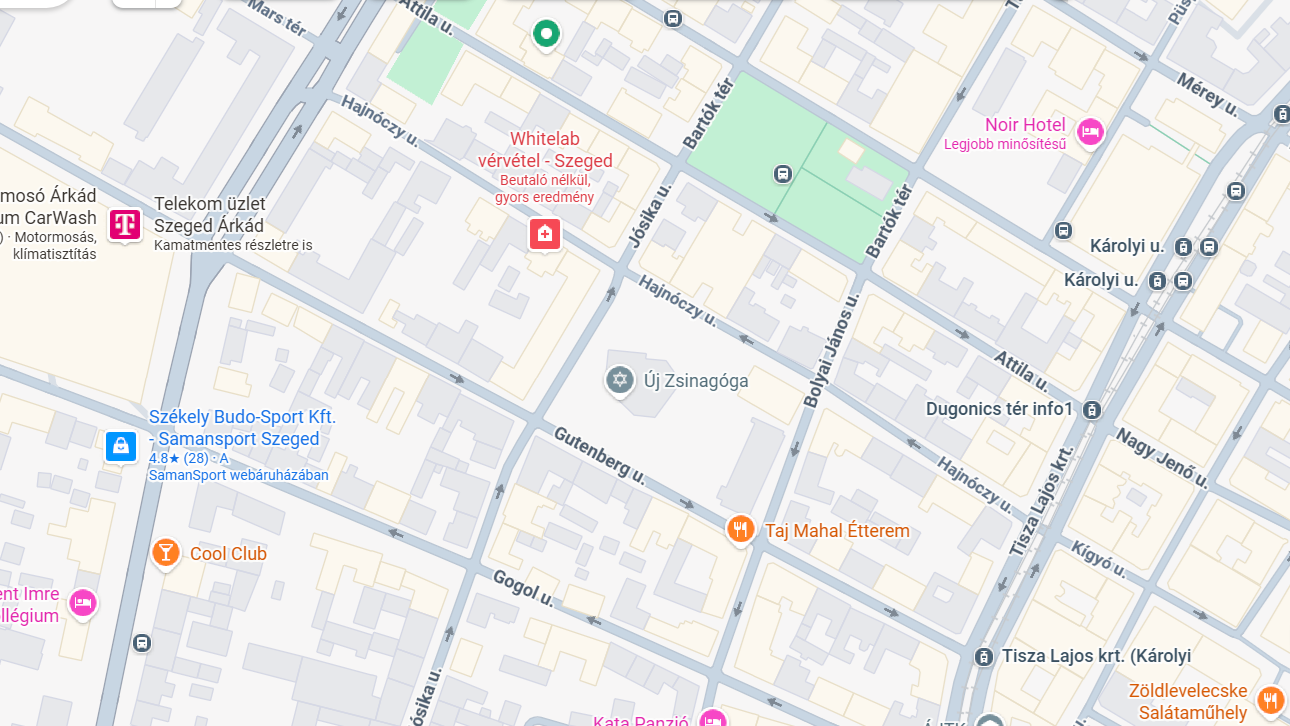
An exemplary development project is set to begin in December on Hajnóczy Street in Szeged. The development, which covers the section between Jósika Street and Londoni Boulevard, is being carried out by the KÉSZ Csoport and the city, with the contract for its implementation awarded to Délút Kft..
The Hajnóczy Street modernisation project will demonstrate the coordination of public and private investment, with its primary aim being the regeneration of green spaces and the retention of rainwater on site.
Careful preparation enhances the value of the work
As Attila Pálinkó, lead project manager of the COOL LIFE programme, informed our newspaper: as part of the preparatory work prior to construction, the previous row of trees – which had become significantly thinned out, aged and, in many cases, diseased – was removed, and the utility provider also carried out the reconstruction of the sewer connections. Further utility works will be carried out in line with the renovation schedule: the replacement of electrical cables, co-ordinated with the renewal of the road surfacing, is intended to ensure that the infrastructure beneath the renovated public space remains well-organised and reliable in the long term.
Co-ordinating utility works can reduce the need to dig up new road surfaces again within a short period of time.
Particular attention is paid to the effectiveness of green spaces and water retention solutions, as together these help to ensure the long-term survival of vegetation.
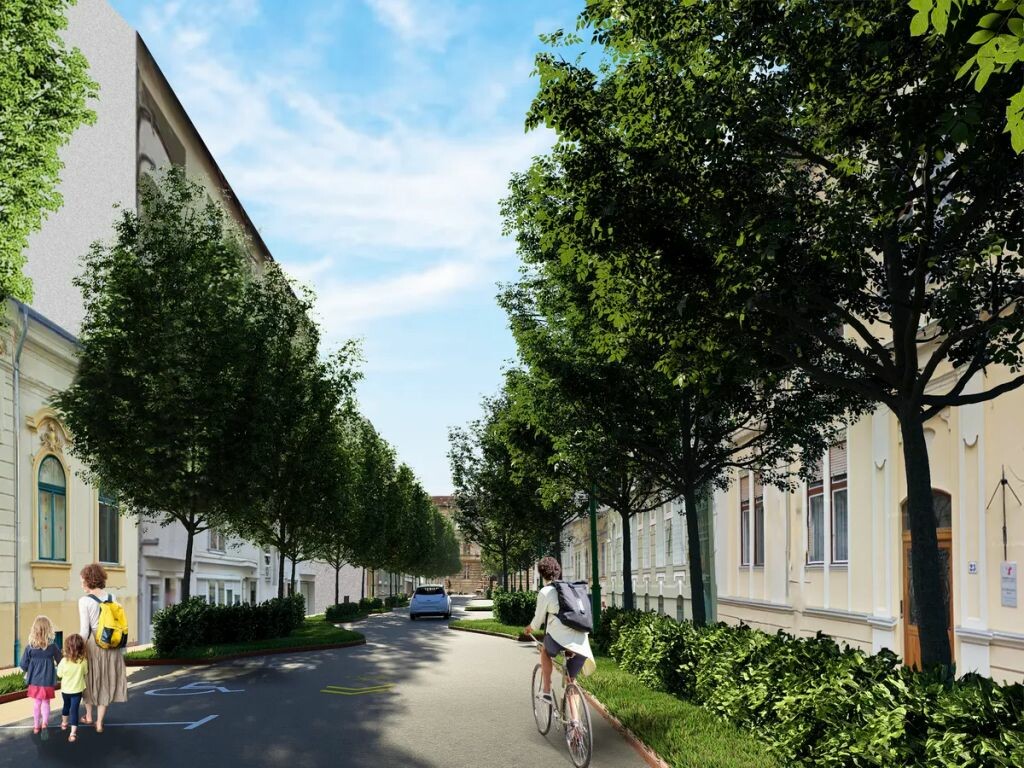
Focused on climate adaptation
The development project combines tree planting with improvements to the plants’ water supply: a total of 47 new trees, 1,270 hedge shrubs and 1,274 ground-cover plants will be planted along the street, with the species and varieties selected to ensure better adaptation to the urban environment and to hot, dry periods. The vegetation will be supported by soil replacement, as well as watering bags and stakes to aid the trees’ initial establishment.
An automated, controlled drip irrigation system is being installed, which delivers water directly to the plants.
In addition, a rainwater retention and infiltration system similar to the one on Gogol Street will be installed. The aim is to ensure that rainwater is utilised locally as much as possible and to support the growth of trees by improving soil moisture levels. Retaining rainwater locally and controlled irrigation are complementary solutions here.
The combination of renewable vegetation, a more favourable root environment and more conscious water management results in a climate-adaptive public space where an attractive streetscape can be maintained in the long term.
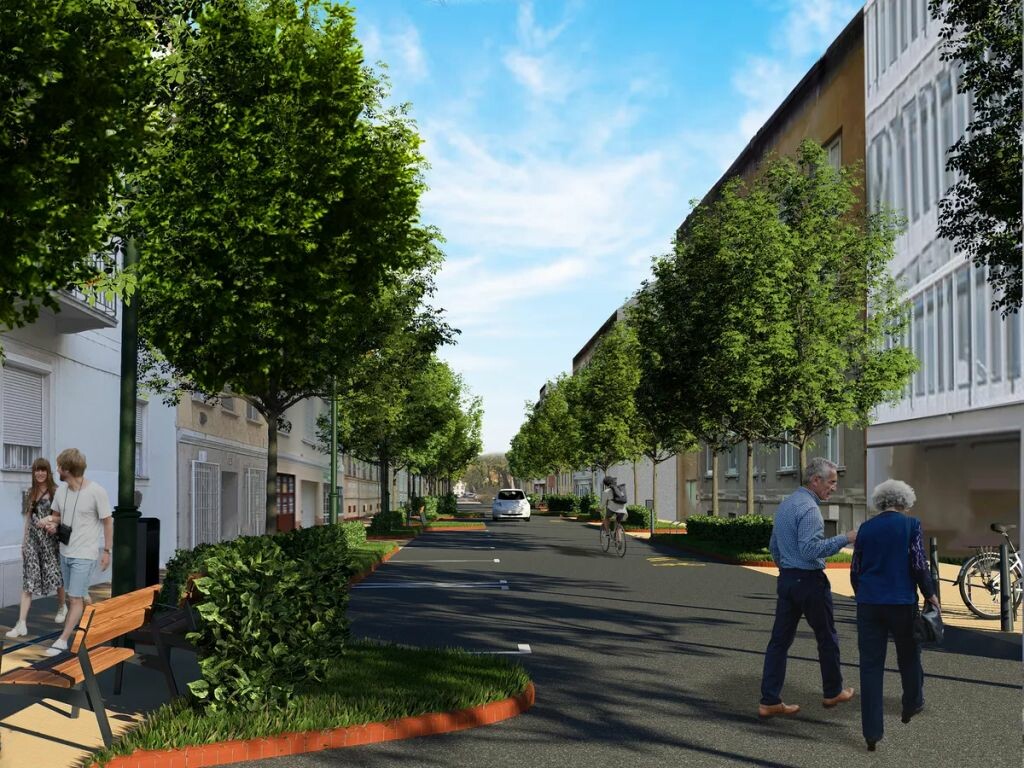
One and a half kilometres of drip irrigation will help to even out the erratic distribution of rainfall
The modernisation project is due to start in December 2026 and is expected to last ten months. During this time, approximately 770 m² of clinker brick paving will be removed, and 1,200 m² of road surface will be milled and resurfaced with asphalt by staff from Délút staff, whilst 1,510 running metres of drip irrigation system, complete with controls and valve chambers, will be installed.
Although the current phase concerns the section between Jósika Street and Londoni Boulevard, two further sections of Hajnóczy Street may also be renovated: planning for these is expected to begin in the first half of 2027, with construction expected to take place in 2028–2029.
Key solutions and implementation requirements
„Although the project builds on materials and technologies that have been used before, its distinctive feature is the coordinated use of these elements: the pavements, tree-lined avenues, green belts, irrigation and the system designed to retain rainwater on site are all being renewed in an integrated manner,” pointed out Attila Pálinkó.
Investors, meanwhile, have very high expectations regarding the quality of construction at Délút: given the city centre location, the proximity of the synagogue and the new Tilia irodaház on the same street, they must take great care in their choice of materials, the appearance of the cladding and the quality of the finishing details.
The aim is, in fact, to create a streetscape that is enduring, carefully designed and in keeping with the historic surroundings.
Source: Link






A new binder and wearing course is to be laid on a 1.3-kilometre stretch of Road 67

Preparations for the refurbishment of the main railway line in Pécs are set to begin

The renovation of Hajnóczy Street in Szeged is focusing on climate-adaptive and sustainable solutions

A section of a street spanning two districts is to be renovated in Budapest

Rain gardens are coming to Budafok, with over 3,000 square metres of green space set to be developed

Four new bridges to be built in the heart of the former industrial city

Contemporary art deco in Csopakon

Safer driving on the motorways: new digital signs for the MKIF
-

 Bound track 2026. 10. 07.
Aurora beneath the Apennines – Another tunnel is being built on the Naples–Bari railway line
-
Road building 2026. 10. 13.
A consortium comprising STRABAG and Duna Aszfalt has been awarded the contract to build the North Macedonian motorway
-
Current at 2026. 10. 05.
Sofitel Hotel is the only Hungarian project in the running for the Dalux Award 2026 award – Watch the video too!
-
What is being built? 2026. 10. 09.
One of Budapest’s oldest nurseries is being renovated whilst preserving its timber roof structure