Water management
The landscape will be able to retain more water thanks to the Tápió–Hajta development

The project, funded by the Danube–Ipoly National Park Directorate, is being carried out at a net cost of 348.94 million forints
As part of a project by the Danube–Ipoly National Park Directorate, with a net value of 348.94 million forints, the Comprehensive Development of the Tápió–Hajta Small Watercourses is set to be implemented. The winner of the public procurement procedure was AQUA-GENERAL Szennyvíztechnológia-építő, Kereskedelmi és Szolgáltató Kft..
The development of the Tápió–Hajta system goes beyond that of a conventional water management project.
The project serves the dual purposes of nature conservation, the preservation of wetland habitats, mitigating the effects of periods of water scarcity, and improving long-term water management in the region.
Danube-Ipoly National Park Directorate website states that the management of areas classified under the Natura 2000 network is of paramount importance, where the conservation of species and habitats of Community importance is a key task from a nature conservation perspective. The project not only serves to conserve and regenerate existing habitats, but also increases their resilience to periods of water scarcity caused by climate change, thereby strengthening the region’s ecological balance.
The investment project is being carried out across three major geographical areas in Pest and Jász-Nagykun-Szolnok counties.
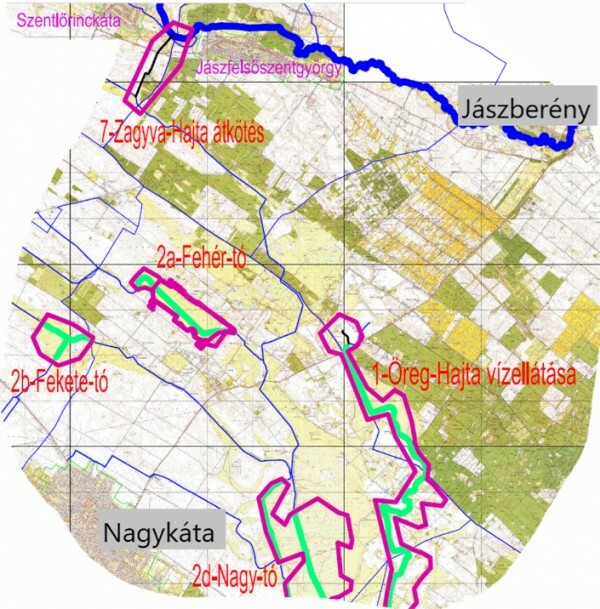
Image: dunaipoly.hu
The Hajta Stream receives water from the Zagyva
According to the information in the public procurement notice, the first phase of the development is the complex construction of the Zagyva-Hajta link in the Szentlőrinckáta area.
The aim of the project is to ensure that the Hajta Stream is replenished from the River Zagyva by means of a new water abstraction system. As part of this, a submerged pump station will be built at river kilometre 84+890 of the Zagyva, on the right bank.
Connected to the system
- a gravity-fed pipe sluice is being built,
- Two sliding locks are being made,
- A 1,660-metre-long irrigation and water-supply pressure pipeline will be constructed,
- A 17-metre-long reinforced concrete filtration basin is being built at the Hajta Stream.
The pipeline will be capable of carrying 52 litres of water per second.
A solar farm provides the energy supply
The energy required to operate the pumping station will be supplied by a hybrid, off-grid solar panel system.
As part of the development
- 120 solar panels, each with a capacity of 530 watts, are being installed,
- the total capacity of the system will be 63.6 kWp,
- An energy storage facility with a capacity of 200 kWh is being built,
- as well as inverters, fencing and more than 300 metres of underground cable.
The water balance of several lakes and wetlands could improve
The second sub-area of the project focuses on the development of the lakes and tributaries along the Hajta. The aim here is to retain water, regulate water levels and improve the condition of habitats.
A new artwork is being built at Fehér Lake and Fekete Lake
A so-called ‘tiltós’ culvert is being built at Fehér Lake, near Nagykáta, and another at Fekete Lake, on the outskirts of Szentmártonkáta.
These facilities enable water levels to be regulated, water to be retained and, where necessary, back-flooding to take place, whilst also ensuring access for operating staff.
The area around Lake Gyula is being restored
A wetland restoration project is being carried out at Lake Gyula. According to the plans,
- The water-carrying capacity of the ditch will be restored along a 750-metre stretch,
- they are dredging the riverbed,
- improve water replenishment in the marshland,
- and will also restore the embankment around the lake.
The aim of the measures is to ensure that the area is once again able to retain an adequate amount of water.
Several water level control facilities are being built at Lake Nagy
A comprehensive development project is being carried out in the Nagy-tó area. Water management in the Nagy-tó area is primarily achieved through the regulation of water levels and water retention in the Bíbicfészeki branch canal and the ditch running almost parallel to it.
According to the plans
- a threshold made of natural stone is being built,
- two new pipe crossings are being built,
- the landfills are being restored,
- and are also developing systems for water level control.
The aim is to make the water balance of the lake and its surroundings more predictable and stable.
The water supply to Öreg-Hajta is also being upgraded
The third component of the project is the development of the water supply system for Öreg-Hajta in the Nagykáta and Jászberény area.
As part of the project, sections of the former riverbed of the Hajta will be restored, riverbed corrections will be carried out at several locations, and four new water-level control structures will be built.
The new facilities serve both
- water retention,
- the water supply for irrigation purposes,
- the management of periodic flooding,
- the management of inland waters,
- and to ensure transport connectivity.
As part of the development, the riverbed is being deepened and reshaped over a length of almost 1,850 metres, and the excavated soil is being reused in a designated area.
Source: Link











One of Abony’s most important transport routes is to be redesigned

This is how flash floods on the vineyard-covered hills in the Pécs conurbation are being prevented

Order has been restored: production of the new Közlekedési Múzeum can now go ahead as originally planned

We took a look at how the refurbished Igazságügyi palota building turned out

Four new bridges to be built in the heart of the former industrial city

Rain gardens are coming to Budafok, with over 3,000 square metres of green space set to be developed

Contemporary art deco in Csopakon

Safer driving on the motorways: new digital signs for the MKIF
-

 Current at 2026. 09. 09.
A first-hand look at a career in engineering – Duna Group Szabadegyetem is back
-
Climate-X 2026. 09. 09.
Nyíregyháza Spartacus FC goes green – four hundred solar panels to be installed on the stadium roof
-
Bound track 2026. 09. 15.
Nearly 50,000 people travel on it every day – the refurbishment of the Cegléd main line continues
-
Current at 2026. 09. 09.
Rental flats, Rákosrendező, decentralisation – important ideas were put forward on the Real Estate Beach Conference stage