Current at
The blocks under construction in the Paks expansion can withstand the harshest external impacts

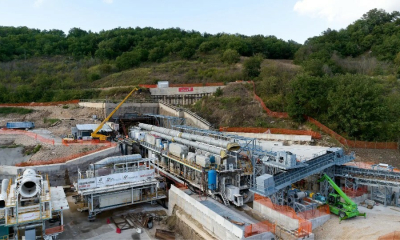
According to Péter Szijjártó's briefing in Budapest on Monday, soil preparation works are currently underway at the Paks expansion project. According to the Foreign Minister, construction permits have already been granted for several buildings, construction of equipment with a long production time has begun, and a German-American joint venture is working on the slab walling.
The Foreign Ministry's statement also revealed that, in addition to 94 Hungarian companies, American, French, German, Swedish and Austrian companies have subcontracts for the construction work. "I don't know if I need to repeat the countries and their geographical orientation," the minister underlined.
In his speech at the hearing of the Parliament's Committee on Sustainable Development, the Minister of State highlighted the safety of the Paks project as one of the most important issues. "I would like to assure you that everything that happens at Paks meets the highest standards of safety, security and environmental protection," he said.
He said that the two new units will be absolutely "Fukushima-proof", which means that the nuclear facility will be surrounded by a double reinforced concrete wall, a double-walled hermetic protection structure. "So it can withstand any external impact, even the most violent and explosive, or even a plane crash," he said.
65% of electricity generation in Hungary is now carbon neutral
The minister described as a complex issue how to produce electricity cheaply, safely, sustainably and in large quantities in a way that would allow for greater independence from the staggering price fluctuations on the international energy market. "Only nuclear energy can meet these four criteria. Nuclear energy is capable of producing large quantities of electricity cheaply, safely and without harming the environment," he said. "There is a huge debate about this in the European Union. The member states are also divided (...) We think that it would be worthwhile to keep these debates within the field of rationality. Now, this is the least of these debates, so it is mostly political-ideological issues that come up and rationality, unfortunately, therefore, plays less of a role".
He stressed that 65 percent of electricity production in Hungary is now carbon neutral, thanks to 80 percent nuclear energy. The Paks units are operating at 90-91 per cent capacity utilisation, fuel supply is continuous, and weather-dependent production methods can only meet a minimal part of demand during peak consumption periods, he said.
He also pointed out that the life cycle environmental footprint of nuclear power plants is no greater than that of other carbon-neutral technologies, and that nuclear reactors also have the best track record in terms of the amount of land that needs to be sacrificed to produce one megawatt of energy. He added that the Paks expansion will replace 17 million tonnes of carbon dioxide emissions and 3.5 billion cubic metres of natural gas imports per year. To give an idea of the magnitude of these figures, he noted that the entire Hungarian transport sector emits 12 million tonnes per year and that all domestic forest areas can absorb six million tonnes of carbon dioxide emissions per year.
Source : Link




Roadworks are taking place at 15 locations in Balatonfüred

SWIETELSKY is inspecting and repairing the surface defects on Main Road 25

Pécs, Gödöllő and Budapest: four SPAR stores have been refurbished – here’s which ones

They could reshape the historic city centre, transport in the suburbs and even a unique public park in Székesfehérvár

Rain gardens are coming to Budafok, with over 3,000 square metres of green space set to be developed

Four new bridges to be built in the heart of the former industrial city

Contemporary art deco in Csopakon

Safer driving on the motorways: new digital signs for the MKIF
-

 Bound track 2026. 10. 07.
Aurora beneath the Apennines – Another tunnel is being built on the Naples–Bari railway line
-
Road building 2026. 10. 13.
A consortium comprising STRABAG and Duna Aszfalt has been awarded the contract to build the North Macedonian motorway
-
What is being built? 2026. 10. 09.
One of Budapest’s oldest nurseries is being renovated whilst preserving its timber roof structure
-
Current at 2026. 10. 10.
„The focus will not be on Lean’s equipment, but on how we operate” – the ‘Lean in the Construction Industry’ conference in November