Industry news
Divers on board, concreting from Lake Balaton - This is how the busiest port on the Hungarian sea was renovated

The passenger ship harbour in Balatonfüred has been completely renovated. In the project implemented by Balatoni Hajózási Zrt., the specialists at STRABAG Generálépítő Kft. experts reinforced the structure of the access pier, replaced the public utilities running through the pier, and renovated the small boat harbour. The nearly 20-metre-long bridge between the shore and the pier was also modernised.

The start of the shipping season has imposed tight deadlines
What made the construction work special was not only the task, but also the specific organisational features. A constant challenge was to ensure access for construction traffic to the site via the popular Tagore promenade," Katalin Fekete told our portal. The STRABAG site manager added that an artificial ice rink opened when construction work started last December, which restricted access to the pier from the shore for construction vehicles until February.
In the spring, from mid-April, with the start of the shipping season, the passage of passengers through the port had to be ensured by demarcating the work area. From the beginning of June, the upper walkway of the pier had to be opened. This was also a complicating factor, especially as this summer the port of Balatonfüred handled the most traffic with more than 150,000 passengers.

Another challenge with the weight limit of the bridge
A further complication in the preparation of the organisation plans was the weight limit of the bridge between the pier and the shore, which had to be taken into account when replacing the utilities and pouring the concrete. The 28 elements of the utility tunnel were transported over the bridge by a special crane and then manually transported to the installation site in the 86-metre long working pit using rollers. The concreting was carried out by water and land. In the latter case, the concrete was pumped to the site through more than 100 metres of pipe.
Floating machines, working from water was the solution
Due to increasingly difficult organisational circumstances and the revision of the original design plans, there was a significant delay in the construction. In order to meet the deadlines and to work in parallel, the shore-based servicing of the worksite was not sufficient, so many operations were carried out from the water. The demolition debris was transported by barge and a large part of the concreting work was also carried out from the water.

Redesign after construction with new seawall technology
Prior to concreting the harbour, the condition of the existing seawall and bed was measured by sonar and additional diving and hand excavation. This revealed that the existing condition differed from the design plans. For this reason, the technical content had to be completely revised. This factor, in addition to the loss of time, meant that the originally planned technology had to be replaced by a solution never used before for a project of this scale in our country. The Truline PVC solution, developed and successfully used in the USA, was used to install reinforced concrete filled reed panels in the embankment.
Katalin Fekete said:
"The new seawall - with a plastic reed wall system that also serves as a remaining shutter - was built using TRULINE panels to create the new contour of the pier. The new load-bearing reinforced concrete slab with anchor and head beam was built on top of this in one piece."
The advantage of the system is that it is modular, meaning it can be easily adapted to the project and site conditions, and can be installed from water or land. The wall does not require any special maintenance, its strength is ensured by the interlocking PVC panels that encase and protect the reinforcing steel.
Concrete mixers sailed on a ferry scaled for a tanker
During the construction of a new seawall, concrete was repeatedly poured from the water. We learned about the background and preparation from the site manager:
"In consultation with shipping experts, we opted for a solution that would put the two concrete mixers and the 24-metre concrete pump on a ferry and then transport the concrete from the water to the reed panels from the deck. It is common knowledge in the area that one of the ferries on Lake Balaton has a deck sized for a 60-tonne tanker, so this vehicle transported the vehicles to the work site. In this case, the total weight transported was around 90-100 tonnes."
In one haul, 15 cubic metres of concrete could be placed on site. The vehicles came ashore from FRISSBETON's concrete plant in Veszprém and were ferried to the Tihany ferry.

Divers on a mission
"We have planned a paving cycle of 4 hours, including 1-1 hour for the ferry to and from Tihany ferry. And 2 hours for the concrete pouring," said Katalin Fekete.
Due to the time required for the concrete to be poured and the duration of the concrete placement, a curing delay was applied.
Concreting was carried out using an underwater concrete mix with a raised cement content. Concrete was delivered to the reed slabs by means of a concrete pump and concrete hose. During the work process, a concrete technician from STRABAG, a subsidiary of TPA Kft., was continuously on the ferry and monitored the quality of the concrete.
The architect also pointed out that the biggest challenge in concreting in a wet environment was the detection of possible defects. In dry conditions, the formwork is usually easy to check and seal, but under water it is difficult to detect defects, so divers were used to assist with critical work.

Concreting from ferry, land, floating machine
The dates for opening the port to traffic were fixed. The workflows were adapted accordingly. Due to the early opening, the upper walkway of the pier was prepared first. This was followed by the west side of the marina, then the east side, and the concreting of the steps and the planting of the cassettes.
The western side of the port was constructed in two phases from the water, the last phase from the land. A complicating factor here was that the floating equipment used for the hydraulic works could not fit between the new seawall and the pilings used to moor the passenger ships.
On the eastern side, the concrete was also laid from the shore using a floating machine.
37 tonnes of steel used in construction
A total of about 500 cubic metres of concrete and 30 tonnes of reinforcing steel were used for the overall renovation of the port. Four expansion units were constructed in the load-bearing slab on the pier arm, and a separate unit was also used to renovate the access bridge. The beams, anchors, railings, drainage and other structural elements involved the on-site transportation and installation of an additional 7 tonnes of steel.

Working in gusts of 130 km/h
Each living water has its own specific properties. On Lake Balaton, wind and waves can be a challenge for contractors, but low water levels are less common. Fortunately, neither of these phenomena had to be dealt with during the waterworks. However, during the onshore work, there were occasional major storms and gusts of up to 130 km/h.
Source: Link


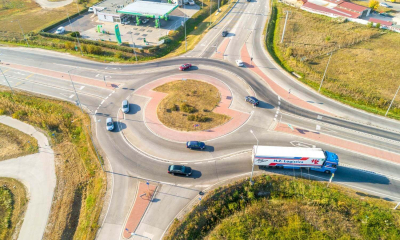


It’s time for a refurbishment: HEDO is carrying out work on one of Miskolc’s key transport routes

Four ‘1’s in a row: Esztergom’s transport headache has been resolved

The care home in Fertőd is to be refurbished

An innovative, distinctive PHOENIX Logistics Centre has been established in Győr: the Óbuda Group has reimagined the spaces for pharmaceutical logistics

Rain gardens are coming to Budafok, with over 3,000 square metres of green space set to be developed

Four new bridges to be built in the heart of the former industrial city

Contemporary art deco in Csopakon

Safer driving on the motorways: new digital signs for the MKIF
-

 Kirakat 2026. 10. 01.
A leading machinery distributor in the construction and haulage sectors is building a new service centre and extending its existing premises
-
Railway development 2026. 09. 29.
The railway line leading to the Hungarian border is also set to be upgraded as part of Croatia’s large-scale development programme
-
Industry news 2026. 10. 02.
Hungary has joined the single electricity market
-
Current at 2026. 09. 30.
It’s being built at full speed and could be the saviour of our domestic energy security – what is it?