
What is being built?
Once again, the chapel of Vértesszőlős can keep the cemetery quiet for a hundred years

The chapel of Vértesszőlős stands on top of a hill in the village cemetery, offering a beautiful view of the Által-ér valley. The pride of the cemetery – one of the most beautiful buildings in the village, according to kápolnák.hu – was built in 1903 with a donation from József Kubinger in honour of the risen Saviour. In its tower, framed by plastered walls and fitted to its brick-clad façade, the 38 kg St. Joseph bell, cast in 1903 at the Csepel Pump and Machine Factory, calls the faithful to mass.
Only minor repairs were carried out on the small chapel, which measures only 34 m2, until its 100th anniversary.
In 2003, thanks to the joint efforts of the local government, residents and the church, the exterior was renovated and the bell, which had been silent for two years, was repaired. To this day, it is still rung by hand, as we learned from the Vértesszőlős Local Council in its description of the building. As they write, the interior reconstruction was completed in 2005, when the statue of St. Joseph, patron saint of the dying, received from the parish of Bánhida, was placed in its final location on the facade of the chapel.

In the twenty years since its renovation, moisture damage and a lack of waterproofing beneath the masonry have caused severe damage to the façade and plinth plaster. Due to the leaks and continuous erosion, the condition of the building deteriorated and became life-threatening in some places, so renovation with modern and durable materials was essential for technical and safety reasons. To this end, the contractor chose Jenei Építő és Épületburkoló Kft. and Avers Kft. products from CEMIX Hungary Kft. products for the renovation.
"The key properties of CEMIX's advanced materials - load-bearing capacity, moisture resistance, vapour permeability and disinfection - have proved very useful in preserving the chapel"
- we learnt from József Jenei, CEO of Jenei Építő és Épületburkoló Kft.. Environmental consciousness was also an important aspect during the construction, which is why a lime plaster system was used on the building, which also binds part of the CO2 content of the environment during its solidification period.

Natural limestone on the facade
The construction started in May 2024 and was completed at the end of August 2024, at the request of the Roman Catholic Parish of Vértesszőlős
- the roof structure was renovated: lathing, shuttering, guttering and other tin structures were replaced,
- the exterior facade was plastered, painted and stuccoed in several layers,
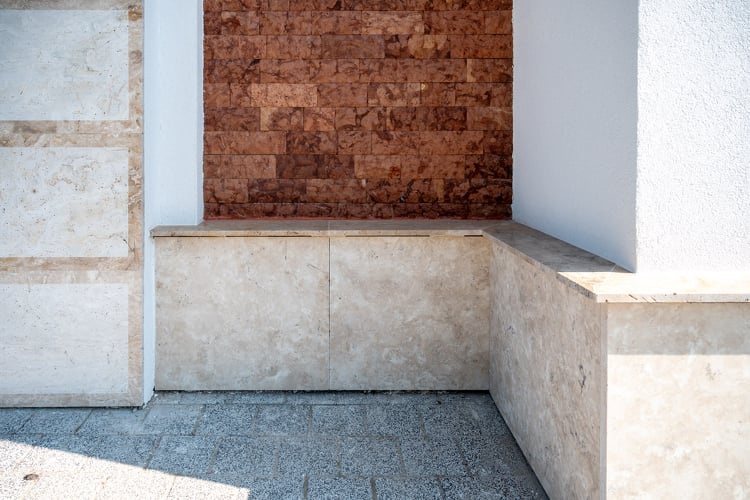
- the replacement of the plinth and the columns with limestone from the quarry, and the replacement of the clinker brickwork on the facades with red limestone from Tardos.
The installation of the cladding on natural limestone masonry, the replacement of the missing waterproofing by drainage and the use of breathable vapour permeable stone cladding for the plinth were of particular interest during the construction, that the 2733 SILICONOLA K1,5 textured colour render could not be applied directly on the lime render as required by CEMIX, so an intermediate layer of mortar (2110 Renti) was applied as a bonding bridge to receive the render.

Excellent materials, real help
We have already used CEMIX products for small projects and renovations and they have worked very well, so we decided to use their products again
- stressed József Jenei, adding that "their products are of high quality, especially their special materials are outstanding. Avers Kft. helped us to contact CEMIX. They helped us to get the products and advice on their use quickly and on time.
For summer work, it is particularly useful that CEMIX materials can withstand high temperatures and their open time is only slightly reduced by heat," added Gergely Bartus, regional project manager of CEMIX. As he pointed out:
"the tendency of plasters to crack is negligible thanks to improvements,
which has also greatly helped work efficiency here." As the project manager specifically pointed out, in stone bonding, the 8245 S1 FLEX adhesive held its own in terms of thickness, shrinkage, initial adhesion and load-bearing capacity.
CEMIX materials used
- EUROSAN VS sulphate-resistant squeegee for enhanced adhesion;
- SOCKELPUTZ plinth cement plaster, due to its increased load-bearing capacity;
- S1 FLEX flexible tile adhesive for surfaces subject to higher thermal fluctuations. Its non-slip properties and long open time make it suitable for bonding to existing tiles.
- MÉSZ GÚZ professional conservation of monuments. A rough surface, adhesion-enhancing scourer that promotes the adhesion of lime plaster. Prevents/reduces efflorescence and staining of natural masonry due to its Puccolane content. Its good vapour permeability and its disinfectant properties due to the lime binder make it suitable for renovation of old buildings and even for plastering new buildings.
- LIME BASE PLASTER is a favourite plaster for historic preservation because it contains no cement binders. Its lime binder helps to disinfect the entire cross-section of the plaster, while its puccolane content reduces efflorescence and increases its durability. It binds CO2 in the air during the setting process and is therefore recommended for environmentally conscious users.
- RENTI adhesive bridge and repair mortar is suitable for the renovation of monuments and old buildings due to its excellent adhesion, flexibility and vapour permeability, and for the coating of cracked surfaces due to its fibre reinforcement. It enhances adhesion and is therefore also suitable for the application of paint stains and painted surfaces.
- PUTZGRUND absorbency balancing primer. It balances the absorption capacity of the masonry, thus ensuring that the plaster can be worked properly. In the case of colouring renders, it allows homogeneous colour shades to be obtained. Provides good adhesion between the base plaster and the colouring plaster.
- SILICONOLA k 1,5 vapour permeable decorative blinds, which are also suitable for the renovation of monuments. Thanks to its silicone resin content, it is water-repellent and therefore less prone to fungal and algal growth. Dust on the surface is therefore more easily washed off by precipitation and meets the aesthetic requirements of the surface. A wide range of colours is available to provide a UV stable, durable finish.
- SILICONTOP facade paint. It has the same properties as 2733 SILICONOLA decorative coatings, but it protects the façade from environmental influences by forming a thinner layer.
Source : Link



The AKKO Invest may be expanded to include a designer of airport hotels

Drilling is also taking place beneath the railway: work on the Déli Körvasút project continues with the relocation of utility lines

The KBM call for entries is aimed at the cream of the crop of Hungarian architecture

Class HE-DO brought the summer to a close with a family sports day

Rain gardens are coming to Budafok, with over 3,000 square metres of green space set to be developed

Contemporary art deco in Csopakon

Four new bridges to be built in the heart of the former industrial city

Safer driving on the motorways: new digital signs for the MKIF
-

 Road building 2026. 08. 05.
The main road leading to a key tourist destination in Bihar is being upgraded using cold recycling technology
-
What is being built? 2026. 08. 06.
Paks II.: What does the new milestone for Unit 5 mean in the context of the review?
-
Climate-X 2026. 08. 05.
STRABAG is relieving the strain on the electricity system through plant shutdowns and reorganised production
-
Bound track 2026. 08. 03.
Work on the extension of Metro Line 3 is set to begin


