Current at
The date for the first concrete pour, a critical milestone in the Paks expansion, is now in sight

Work on the Paks expansion, which our newspaper has been covering with regular interviews and professional articles, is progressing well, announced Péter Szijjártó, Minister of Foreign Affairs and Trade, on Tuesday in Budapest. According to him, the first concrete could be poured by the end of the year, but the production of the melt trap and the reactor vessel are equally important milestones, the former of which has already been completed, while the latter will begin shortly.
Delivering the more than 700-tonne zone melt trap will be no small task
According to the ministry's statement, the minister said at a joint press conference with Alexei Likhachev, head of the Russian nuclear power company Roszatom, that the current schedule is to reach the crucial milestone of "first concrete" by the end of this year, but that the production of two massive nuclear devices, the so-called zone melting trap and the reactor vessel, is equally critical.
He welcomed the fact that the production of the former has been completed in Russia, so that its delivery could take place in the autumn, which will be no small operation, as it weighs more than 700 tonnes, the equivalent of about fifteen Airbus A320 passenger aircraft.
The other critical, long production tool is the reactor vessel itself, the production of which will start in April, he said. "So, for the two critical assets, one is ready and the other one is about to start production," he added.
About one and a half million metres of holes in the ground
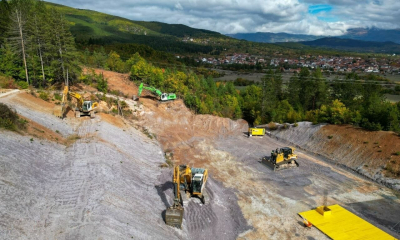
Szijjártó also pointed out that soil consolidation works are currently being carried out on an area of 17 hectares, which requires the drilling of 75,000 piles, of which eight thousand have already been drilled. He stressed that this work is being carried out by a German company and should be completed by the summer of next year. "There will be about one and a half million metres of boreholes in the ground. Now, if this work were done on a planet called Pluto, rather than on Earth, we could drill that many holes from the surface of Pluto to its core, just to get a sense of the scale," he said.
"I would like to inform you that work on the Paks project is progressing well and steadily, and we can continue to meet our plan to connect the two new units to the grid by the beginning of the next decade," he said.
An international project is implemented
The Minister then stressed that the recent European and global crises have demonstrated that those countries that can meet their energy needs themselves are safe. "So, in order to increase Hungary's energy security, we also need to increase our own energy production capacity," he said.
He pointed out that due to Hungary's geographical and natural conditions, this is possible primarily through the development of nuclear power generation capacity, and the Paks expansion will provide a significant part of the electricity needed to run the country in a cheap, safe and sustainable way.
He pointed out that the Paks expansion is a truly international project, as in addition to the Russian prime contractor, there are German, French, Austrian, Swedish and American players in the subcontracting chain. "Work on the Paks nuclear power plant project is progressing steadily, there is no obstacle to reaching the first concrete by the end of this year, and there is no obstacle to the two new units being connected to the Hungarian energy grid at the beginning of the next decade," he said.
Source : Link






Major Hungarian construction project in the Serbian capital – a specialised world exhibition is on the way

Roadworks are taking place at 15 locations in Balatonfüred

SWIETELSKY is inspecting and repairing the surface defects on Main Road 25

Pécs, Gödöllő and Budapest: four SPAR stores have been refurbished – here’s which ones

Rain gardens are coming to Budafok, with over 3,000 square metres of green space set to be developed

Four new bridges to be built in the heart of the former industrial city

Contemporary art deco in Csopakon

Safer driving on the motorways: new digital signs for the MKIF
-

 Road building 2026. 10. 13.
A consortium comprising STRABAG and Duna Aszfalt has been awarded the contract to build the North Macedonian motorway
-
What is being built? 2026. 10. 09.
One of Budapest’s oldest nurseries is being renovated whilst preserving its timber roof structure
-
Current at 2026. 10. 10.
„The focus will not be on Lean’s equipment, but on how we operate” – the ‘Lean in the Construction Industry’ conference in November
-
Bound track 2026. 10. 08.
Déli railway station is set to undergo a major refurbishment, paving the way for double-decker trains