Industry news
Csaba Fenyvesi: Participating in power plant construction is a gift from life

Engineer as solution provider
"When I was still in primary school, I read Gyula Verne's novel The Mysterious Island. The story, in which a group of people are stranded on a desert island, really struck me. Especially the character of the engineer who led the team and solved all the problems with his ingenuity. Somewhere from here, I wanted to be an engineer" - recalls Csaba Fenyvesi, who grew up in a village in the Baranja region of Hungary, as he recalls his memories of his career choice. He applied to nearby Pécs, where he graduated as a car mechanic at the Széchenyi István Secondary School and Technical College.
"There was a core of people who wanted to be military pilots. I was infected, but I couldn't be one because of my eyes, but I still had an interest in aeroplanes, so I applied to the BME to become an aeronautical designer. In the end, none of the aircraft he designed drew a stripe in the sky. He found challenges in another equally exciting field, nuclear energy.
Redesign
At the time he graduated, the job market was in serious decline, particularly in aviation. The military airfield in Tassar, where he had spent his training, had closed down, and his career in aviation ended before it could really begin. In parallel with his studies in transport engineering, he also studied product and design engineering at the Faculty of Mechanical Engineering. It was during his final exams that the job advertisement for the Paks Nuclear Power Plant came to his attention. They were looking for an employee for the External Technology Department. He read the job description, but, he says, understood little of it. "One thing that stuck with me was that they run diesel generators. What a generator did I only guessed, but I knew about diesel engines,"he says.
"I think it's a fundamental part of engineering that you have to change plans. There is no such thing as designing something and getting it right first time. There is always another aspect and it is not uncommon to have to change the whole initial assumptions and redesign. The finished work is a process, the result of an optimisation"
- vallja. As an example, he cites the MIG 29 aircraft, the prototype of which was built and tested by its designers, and then redesigned with the exception of the canopy. The fact that his original concept could not be realised and he had to switch from aircraft design to power plant operation was not a problem for him.

Excitement and values in everyday life
According to Csaba Fenyvesi, if you want to feel good, you have to find the value and excitement in everyday life, in your daily work. He calls the MVM Paksi Atomerőmű Zrt.'s External Technology Department one of the most beautiful departments, and not just out of politeness; his words really show his bias towards the field, which is a diverse one. He worked for five years as a technology engineer, then as a technology manager, and for ten years as a department head. The department's activities are wide-ranging, the most significant of which is operations. They are involved in the operation of mechanical systems, including diesel generators, chilled water systems, complete building services, ventilation systems, heating and cooling energy systems, district heating systems, fire water systems. It cites the link with the Danube as a huge task and a beautiful area. Their task was to monitor and optimise the thermal load of the river, to maximise the power plant's output, taking into account the Danube's wildlife and environmental standards.
"In January 2017, there was very severe icing. We managed to control this environmental problem, to ensure the continuous operation of the blocks, while we had to be outside the floating catcher day and night for 30 days, which required a lot of mental and physical effort and concentration. Another huge challenge was to guarantee the cooling of the units while maintaining nuclear safety standards and lowering the water level of the Danube. We have tested the methodology developed for this with 60-70 water experts. This involved the installation of 16 mobile pumps. Another challenge was to develop an economical solution to replace this system. Six months of dedicated work by 16 experts resulted in a proposed solution,"he recalls one of the major challenges. As he explains, when an engineering decision has to be made, they evaluate the situation using a statistical-mathematical method, carry out a lot of data analysis, build up a decision-making process in which subjective opinions are translated into objective values and results."Optimisation is the pinnacle of engineering work", he concludes. At the nuclear power plant, they had to search for the optimum in many processes, striving for the best efficiency, which is why they felt comfortable all the time.
"It was possible to find a new challenge day after day, year after year, and that's what kept me there for 26 years, alongside the enormous freedom I was given. I had very good managers, they always supported me, I could implement all my professional thoughts and ideas"
- says.
Looking for new challenges
When you feel that you've put everything into a project, into a job, you can't add any more, you have to move on. For Csaba Fenyvesi, an important leadership lesson was that problems cannot always be solved once and for all, especially those related to people. When you are confronted with it for the umpteenth time, you wonder whether someone else could solve it better. In the meantime, while evaluating these management experiences, he has learned another profession and started to work in energy auditing and energy systems efficiency. "I felt that I could find challenges in this, so the idea of changing and doing something new matured," he notes.
The professional left the free market, but almost immediately the opportunity came to join the builders of the new nuclear power plant. He didn't hesitate, as the design and construction of the new one was a major motivation for his youth. "If a person can be part of the construction of a nuclear power plant, it's a tremendous gift from life", he concludes.

In the Paks II project, as Chief Plant Preparation Engineer, he is responsible for developing processes related to operation and maintenance. You will need to plan the human and technical resources required for major repairs and maintenance, develop processes starting with who detects a failure when it occurs, how it is recorded, who is notified and how, including who assesses the event, how long it takes to rectify the failure and how the necessary spare parts are provided. The design of these processes is also an optimization process, which the chief engineer says is the best part of engineering. "I always wanted to design and build new things, but ended up working in operations at the nuclear power plant. But now I realise that operation and maintenance is a very important experience. I think that after graduating from university, every engineer should gain experience in this field, and once you understand how equipment and systems work, you should be free to design", he concludes.
The Paks II. colt team
The soul of a nuclear power plant is the staff, and as Csaba Fenyvesi, Chief Plant Preparation Engineer, is convinced, this will be the case with Paks II. Concrete and iron alone cannot function without an operating crew. Nuclear safety is only partially ensured by technology.
"I think it's the smaller part, the bigger part is the person who adds it. You have to build a team and you have to get professionals in that company who understand the seriousness of it and the risk of it, which of course can be managed. To do that you need very well trained staff who respect the technology and, very importantly, respect each other. That is the essence of it. This is what has been achieved at Paks I and what makes the Paks nuclear power plant successful. I am most proud of the team I have had the opportunity to work with. I am sure they will give their best, as will all the employees of Paks I. When people ask me if I am happy to live here in Paks next to a nuclear power plant, I think of them and I say with full confidence that I am."
- explains Csaba Fenyvesi.
As he adds, the term "colt team" is well known in the Paks I community. It means the team of professionals who were there when the power plant was built, full of drive and motivation. Perhaps they didn't really understand what they were building, they just suspected that it would be a huge project. "Life has proved them right. The concept of a team of foals has always fascinated me. I think being first somewhere is always a tremendous experience. I came to Paks II because I would like to be part of this beautiful task, I would like to be part of the Paks II colt team. If you get the opportunity, you should not miss it", he says.
Source : Link


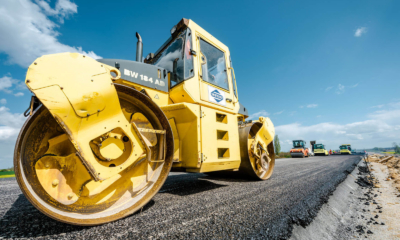


Roadworks are taking place at 15 locations in Balatonfüred

SWIETELSKY is inspecting and repairing the surface defects on Main Road 25

Pécs, Gödöllő and Budapest: four SPAR stores have been refurbished – here’s which ones

They could reshape the historic city centre, transport in the suburbs and even a unique public park in Székesfehérvár

Rain gardens are coming to Budafok, with over 3,000 square metres of green space set to be developed

Four new bridges to be built in the heart of the former industrial city

Contemporary art deco in Csopakon

Safer driving on the motorways: new digital signs for the MKIF
-

 Bound track 2026. 10. 07.
Aurora beneath the Apennines – Another tunnel is being built on the Naples–Bari railway line
-
Road building 2026. 10. 13.
A consortium comprising STRABAG and Duna Aszfalt has been awarded the contract to build the North Macedonian motorway
-
What is being built? 2026. 10. 09.
One of Budapest’s oldest nurseries is being renovated whilst preserving its timber roof structure
-
Current at 2026. 10. 10.
„The focus will not be on Lean’s equipment, but on how we operate” – the ‘Lean in the Construction Industry’ conference in November