
Road building
Mosonmagyaróvár's 700-year-old street gets a look worthy of its age

Mosonmagyaróvár, Mosonmagyaróvár, with a population of 34,000, is a true commercial and service centre, located near the Austrian-Slovak triple border. Almost equidistant from Pozsony and Győr, the city's economic weight is matched by its growing tourist appeal: the confluence of the Hanság, the Mosoni plain and the Szigetköz is home to a rich variety of wildlife, which makes the waters of the Lajta and the Mosoni-Duna, lined with gallery forests, particularly popular with water sports enthusiasts.
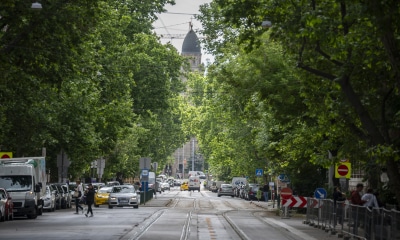
The town's significance dates back a long way: the castle built after the Tatar invasion – after numerous renovations, of course – still stands today; the high standard of living of its inhabitants is demonstrated by the fact that in the 14th and 15th centuries, multi-storey brick buildings were erected alongside the timber-framed and clay-plastered buildings, roughly in the same street layout as today. This is when the two busiest streets of Mosonmagyaróvár's historic city centre, Fő utca and Magyar utca, were formed, with smaller streets and squares in between. Tímár Street, which runs parallel to Magyar Street, now largely a pedestrian zone and home to the Christmas market, is part of the city centre of Mosonmagyaróvár and preserves the memory of the former craft industry. Although the surrounding streets have been well maintained for years, the renovation carried out by SWIETELSKY Magyarország Kft. was greatly needed.

Almost 200 metres of road to be paved
"The surrounding streets have already been repaved, so the reconstruction of the utilities made it necessary to replace the pavement of this street. The road construction works were preceded by the utility reconstruction works, and the work area was already available after the utilities had been installed"
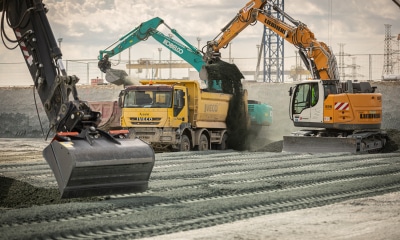
- presented the background of the work Krisztián Piczinger, regional manager. The renovation of a total area of 1623 m2 started on 14 May 2024 and is slowly coming to an end. This involved the detailed replacement of the road surface along the entire width and length of the street:
- demolition of pavements was carried out 450 m3 in quantity,
- excavation 440 m3 in quantity,
- construction of a sandy gravel bed 262 m3 in quantity;
- construction of the base course (218 m3 M22 mechanical stabilisation, 213 m3 Ckt base layer) and
- the construction of 479 metres of natural stone kerbs.
- The current paving surface is 1467 m2.

They may leave the scene shortly
The work is coming to an end, as paving work is already underway. As can be seen from the tasks carried out, the construction is progressing smoothly, with the only difficulty being the downtown environment: "access to the work site is only possible with small trucks, and it was not possible to store construction materials on the site", said Krisztián Piczinger, adding:
"We're still in the process of levelling the utility lines and installing the traffic signs once the paving is complete, but we'll have those done by August."

Source : Link







The STRABAG in Szombathely prevented the release of asbestos-containing dust using a special sealing layer

Stones of the past, solutions for the future – Saving the stone walls of the Citadel

The replacement of the expansion joints on the Erzsébet Bridge is continuing with the third phase

Up to 1,500 cubic metres of concrete are being poured in each phase of the Paks expansion

Hungary's biggest motorway upgrading programme is underway

Perhaps the world's most elegant McDonald's restaurant opens in Budapest

Szeged to become one of Europe's leading industrial centres with the construction of the BYD factory, the city strengthens its position with a worthy investment package

Viablokk porous concrete masonry element from a Hungarian factory, as a Hungarian product, is set to conquer the world
-

 Bound track 2026. 04. 10.
This is how they pulled out the ‘fang’ of the derailed railway section in Transdanubia – with photos
-
Bound track 2026. 04. 10.
The largest domestic railway development project to date is set to begin
-
Bound track 2026. 04. 10.
Planning can begin – the M2 line could be extended to Cinkota, and the HÉV lines could be upgraded
-
Industry news 2026. 04. 10.
Rubbish equivalent to the weight of nearly 2,000 cars has accumulated on the country’s motorways over the course of a year


