Bound track
Work on the embankment is already underway, and trains will soon be running again on the revitalised Transdanubian railway line

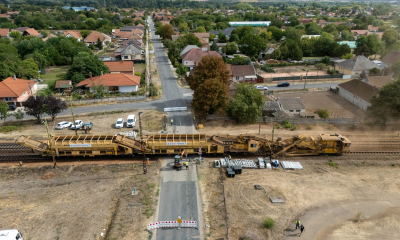
Construction of the embankment on Line 20 between Ajka and Veszprém has begun – announced the developer, MÁV Group, in a video on its social media page.
The replacement bus service is coming to an end
The 150-metre section in question had to be closed in December 2024 due to damage to the railway track. The restoration work is being carried out by Swietelsky Vasúttechnika Kft. on behalf of GYSEV Zrt. and MÁV Pályaműködtetési Zrt.. Most recently, during the phase following demolition and dewatering, we wrote about the project.
According to the latest post by MÁV
Rail services on this section will resume at the end of May, as the final stages of the project can now be carried out whilst trains continue to run. As a result, the replacement bus service on the Veszprém–Ajka line will soon be discontinued.
A layer of soil that had been causing problems for many decades has been removed
The developer has also released an on-site video in which János Dianis, technical inspector for the MÁV Pályaműködtetési Zrt. project, explained that the railway line, built 100 years ago, has been plagued by ongoing problems. He identified two main causes for the geotechnical issues that have persisted for decades:
- on the one hand, the subsoil contains water-sensitive clay soils;
- On the other hand, there is a significant amount of groundwater.

Accordingly, the two main objectives of the project are to collect and remove water entering the embankment body, and to remove the water-sensitive subsoil. Confirming what had been reported in earlier news items, he said that during the works they had found the slip plane along which the embankment had shifted. „This layer of soil has been removed, so it will no longer cause any problems,” the expert explained.
A significant amount of water was drained off during the first few days
It emerged from his comments that, beneath the demolished embankment, at a depth of a further 8–10 metres, some 150 gravel wells had been installed to collect groundwater. This water is collected in a reinforced concrete shaft and then pumped away. „In the first few days, these wells produced a flow of 5–6 cubic metres,” he said, highlighting their significance.

According to the video, construction of the embankment is already underway: „The embankment is being built using certified earth-filled material, in 25-centimetre layers,” he pointed out. „To improve stability, a secondary embankment is also being constructed alongside the main embankment.”
In summary, he said that the project is expected to stabilise the condition of the section by draining the water and constructing an embankment from high-quality earth-filled material, which will provide a long-term solution to the problem.
Source: Link







Reconstruction of the M1 motorway’s carriageway towards Győr can begin under the new traffic arrangements

Alpine engineering techniques are also being used to protect the railway in the Danube Bend

Instead of patchwork repairs – large-scale refurbishment work is under way on the dilapidated main roads in the Transdanubia region

The expansion joints on the Buda side of the Erzsébet Bridge were installed overnight

Four new bridges to be built in the heart of the former industrial city

Rain gardens are coming to Budafok, with over 3,000 square metres of green space set to be developed

Contemporary art deco in Csopakon

Safer driving on the motorways: new digital signs for the MKIF
-

 Current at 2026. 09. 09.
A first-hand look at a career in engineering – Duna Group Szabadegyetem is back
-
Climate-X 2026. 09. 09.
Nyíregyháza Spartacus FC goes green – four hundred solar panels to be installed on the stadium roof
-
Bound track 2026. 09. 15.
Nearly 50,000 people travel on it every day – the refurbishment of the Cegléd main line continues
-
Current at 2026. 09. 09.
Rental flats, Rákosrendező, decentralisation – important ideas were put forward on the Real Estate Beach Conference stage