Bound track
A new chapter in the Hungarian bridge-building industry – we explored the most exciting sections of the Southern Circular Railway

Articles and videos about the bridge sections being installed as part of the Southern Circular Railway extension have attracted considerable interest from our readers – just like the Gubacsi Road, or the Bartók Béla Road bridge, we reported on the developer’s Építési és Közlekedési Minisztérium press events. We therefore attempted to showcase the background to these highly spectacular construction phases in an on-site report, with the help of the main contractor V-Híd Zrt.. However, whilst touring the section between Szerémi út and Bartók Béla út, we came across so many interesting project elements that our article ended up covering a much broader scope than originally planned.

Railway bridge construction is taking place at a total of seven sites
During our conversation, we travelled along the section of the Southern Circular Railway between the Szerémi út bridge and the Bartók Béla út bridge, which is being expanded to three tracks, and in some places four. Our interview began at the visitor centre set up near the Szerémi út bridge, which aims to present the project to the public and interested parties.

„As part of the project, railway bridges are being built at a total of seven locations within Budapest’s densely built-up urban environment,” noted Dávid Jákli, project manager for V-Híd Zrt.. „In Pest, new bridges are being built at Gubacsi út and Soroksári út, and existing structures are also being replaced.”.

”Meanwhile, in Buda, bridge construction work is underway at the Dombóvári út slip road, on Budafoki út, Szerémi út, Fehérvári út and Bartók Béla út,” he listed, moving from east to west.

Installing a bridge in the city centre can be even more complex than a river project
According to him, with the exception of Soroksári út, bridge-slab-sliding technology is being used at all grade-separated junctions – a total of twelve structures. However, some bridges – such as those over Soroksári út, Fehérvári út and Bartók Béla út – are also being moved transversely to ensure the continuity of rail traffic.
„The use of a pusher allows the majority of the construction work to take place during the day, whilst road, tram, pedestrian and cycle traffic can continue uninterrupted beneath the bridges.”

He added that pushing is the preferred method of movement when it is impossible to work above the planned opening, or only with great difficulty. This is typically the case with the construction of river bridges, and also applies to the bridges in question here:
„It is no coincidence that our project team includes an expert with extensive experience in building bridges over rivers. The approach here is essentially the same, but our task is all the more difficult because managing public transport presents a far more complex challenge than managing shipping traffic.”
Continuous monitoring and a constant presence are required
The expert emphasised that moving a bridge is always a critical process, as a structure of enormous mass is placed in a temporarily unstable position. At such times, the structure is particularly vulnerable to factors such as wind, the sinking of supports or lateral sway. „This is precisely why a constant presence is required at every support point during the push, not only from those carrying out the operation but also from experts monitoring the structure’s behaviour,” explained Dávid Jákli. „A surveyor accompanies the movement throughout, and if necessary we also use a separate monitoring system so that, in the event of an unexpected situation, the bridge can be stopped immediately and secured safely.”

The overhead line support structures add a distinctive aesthetic touch
We had already discussed the details of the railway construction with Dávid Jákli on the railway embankment running alongside Szerémi Road: that is where we continued our interview. As we headed towards Fehérvári Road, the integrated structure running alongside the tracks caught our eye as one of the project’s most striking and unique features.

The first components to be used in our country will be the supports for the overhead catenary and the noise barriers.
The support structures that ensure the consistent aesthetic of the Southern Circular Railway will be built on both sides of the track and will meet every 20 metres.
The state-of-the-art production line speeds up the work considerably
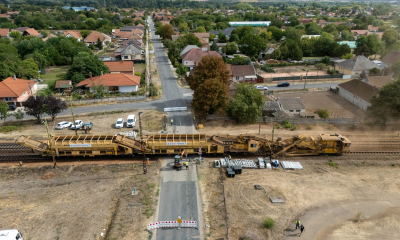
Perhaps the most valuable outcome of the site visit for us was that we were able to capture the high-performance railway machinery of the V-Híd Zrt. in action. When we were there, the approximately 350–400-metre-long train was dismantling the reinforced concrete sleepers and loading them onto railway wagons for transport. The train is also suitable for constructing reinforced concrete sleepers and can perform both functions simultaneously.

This machine fleet, representing the most advanced technology currently available, is of enormous significance: it can complete the demolition of a 2-kilometre stretch in just 3 days. The same work used to take nearly two weeks and require far more manpower with the previous technology.
The use of the track-laying machine enables high productivity without damaging the rails or sleepers. Whether during track renewal or the construction of new track, the SMD–80 machine, weighing approximately 210 tonnes, operates using state-of-the-art control systems. This ensures that the existing track geometry is maintained, whilst also allowing for level- and direction-controlled operation, in which the geometry can be adjusted in accordance with the design plans. The individual work processes are controlled by freely programmable electronic control units connected in series.
Spotlight on supporting vehicles
Our walk of around 1.2 kilometres ended at the bridge on Bartók Béla út, the construction of which is a highlight of the Southern Circular Railway project.
One of the interesting features of this project, which is based on solutions used for the first time in Hungary, is the transport junction to be bridged, which required a cantilever span of nearly 60 metres. „Because of this, very high forces were exerted on the temporary support jacks, and the use of the auxiliary structure employed for pushing – the jacking beam – was also significant,” said Dávid Jákli.
Another interesting feature is the bridge’s support structure system: a cable-stayed system, which is also a first for a railway bridge in Hungary. „This structure is not in itself suitable for pushing, so we had to use arch-supporting tugs capable of absorbing the compressive forces instead of the cables,” explained the project manager. „Ensuring their movement during the various phases of the pushing operation also posed a significant challenge.”

Another key issue was determining at how many points the bridge should be supported, and how these points could bear an equal load. „We had to keep a constant eye on the bridge, the auxiliary structures and the support elements as well. To do this, we needed a precise understanding of the entire process, the technical elements – such as how the jacks work – and the bridge’s behaviour in conjunction with the reaction forces. Interestingly, at one point during the forward movement, we lowered the end of the bridge, tilting the structure slightly backwards, which reduced the load on the mounting spout and the resulting stresses.”
They have learnt that nothing is impossible
The engineering challenges were compounded by the extreme conditions at the Bartók Béla út junction: they had to keep traffic flowing at one of the capital’s most critical junctions, whilst managing the construction work within a confined space.
It was no coincidence that the work was preceded by three months of consultation and planning: they had to take into account the requirements of the district, the capital, the BKK and the MÁV routes simultaneously at a junction where some eight routes and numerous modes of transport converge.

According to the engineer’s summary, this aspect of the Southern Circular Railway project offers significant technical benefits. „We have learnt that nothing is impossible. We have gained technical and construction experience that can be directly applied to future bridge-building projects in similarly complex urban environments,” he said.
He added that the project had demonstrated that it is possible to construct a bridge weighing over 1,000 tonnes right in the city centre, even with virtually no provision for temporary supports, whilst maintaining traffic flow throughout. „This was not merely a construction task, but a genuine feat of engineering that marks a new milestone in the Hungarian bridge-building industry.”
Source: Link







Reconstruction of the M1 motorway’s carriageway towards Győr can begin under the new traffic arrangements

Alpine engineering techniques are also being used to protect the railway in the Danube Bend

Instead of patchwork repairs – large-scale refurbishment work is under way on the dilapidated main roads in the Transdanubia region

The expansion joints on the Buda side of the Erzsébet Bridge were installed overnight

Four new bridges to be built in the heart of the former industrial city

Rain gardens are coming to Budafok, with over 3,000 square metres of green space set to be developed

Contemporary art deco in Csopakon

Safer driving on the motorways: new digital signs for the MKIF
-

 Current at 2026. 09. 09.
A first-hand look at a career in engineering – Duna Group Szabadegyetem is back
-
Bound track 2026. 09. 15.
Nearly 50,000 people travel on it every day – the refurbishment of the Cegléd main line continues
-
Climate-X 2026. 09. 09.
Nyíregyháza Spartacus FC goes green – four hundred solar panels to be installed on the stadium roof
-
Current at 2026. 09. 09.
Rental flats, Rákosrendező, decentralisation – important ideas were put forward on the Real Estate Beach Conference stage