What is being built?
The modern poultry processing plant in Szentes is being built at record speed

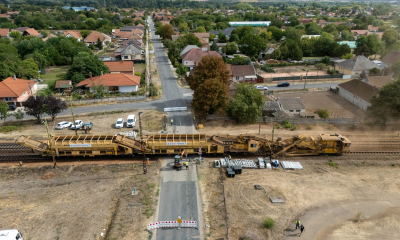
Hungerit Zrt., one of the oldest and most influential players in the domestic poultry processing sector, is undertaking a major development project in Szentes. As part of this greenfield development, covering an area of around 10 hectares, a production hall with a floor area of nearly 23,000 square metres and a total floor space of approximately 31,000 square metres is being built.

The aim of the project is to double the company’s current capacity and to ensure full compliance with modern technological, hygiene and animal welfare requirements. Through this investment, Hungerit will be able to further strengthen its position in the domestic and international poultry meat supply chain.
Shared implementation tasks, coordinated operation
The project is being carried out by the consortium comprising Market Építő Zrt. and INETON Kft., working in close cooperation. They share the preparatory and administrative tasks, and the tendering and supervision of the various specialist works have also been divided between them.
On-site construction is supervised by the chief site manager of Market: Market is responsible for the main building, whilst INETON oversees construction management for the external areas – including the energy building and the reception buildings. From the Market group of companies, Moratus Szerkezetépítő Kft., OKM Építőipari és Szolgáltató Kft., MRKT Padló Kft. and Lean Tech Mérnökiroda Kft. are also participating in the project.
Complex functions within a complex industrial facility
The project comprises a highly complex facility consisting of several units. The outdoor area will feature a passenger and goods entrance, as well as an energy building to supply the plant with power, providing heating and cooling, process water and compressed air.
The main building will house separate toilet facilities, offices and changing rooms, whilst the production areas will accommodate the entire poultry processing chain: from reception, through plucking and cutting, right through to packaging and storage. In addition, a number of support facilities – such as maintenance rooms, raw material stores and a knife-sharpening area – will also be provided.
The building’s design allows production management to oversee the processes, whilst the offices can be accessed without entering the high-hygiene areas. Due to the complex spatial relationships between the various technical rooms and the strict hygiene regulations, the building is considerably more complex than a conventional industrial hall.

Milestones and the intensive construction phase
The project reached the structural completion stage. Subsequently, by mid-December 2025, the main building had been made watertight and the industrial flooring had been completed. By mid-March 2026, the first sections of the building had been handed over for the installation of technical systems.
At this stage of the project, work is currently being carried out in parallel across a number of disciplines, including steel structure construction, sandwich panel installation, fitting of doors and windows, installation of high- and low-voltage systems, general building services, refrigeration technology, and external road and utility works.
On average, 450–500 people are working on site at any one time.
Lean: An Approach to Effective Coordination
The work of the various specialist teams and technology suppliers is coordinated using the Lean methodology. These weekly coordination meetings involve not only the subcontractors but also the client’s technology contractors.
Construction and the installation of technical systems are carried out in close collaboration:
First, the building is made suitable for the technology; this is followed by the installation of the supporting structures and fittings, and then the connection of the electrical and mechanical systems.
Specialised technical solutions for the food industry
The technical requirements called for a number of bespoke solutions. Equipment is delivered through sections of the façade left open in certain parts of the building; high-precision rail systems are built into the industrial flooring; and the entire structure has been designed to accommodate the technical loads.
A particular challenge is that the conveyor belts pass through fire compartments, which is why special fire-resistant seals, designed to work in conjunction with the technology, are used.
Due to food industry requirements, the production areas are constructed using sandwich panel cladding and stainless steel structures. A constant temperature of 2–8 °C is maintained in the processing areas; cleaning is facilitated by hot water systems at various temperatures, whilst the technology is supported by a high-capacity compressed air network.
Wastewater drainage is provided by sloped floors and stainless steel channels, whilst the production areas feature a 6-millimetre-thick, special synthetic resin floor coating that is resistant to physical and chemical stress. All built-in components – from doors to light fittings – must withstand medium-pressure chemical cleaning.

Ongoing planning and implementation in parallel
The project is being carried out under the design and build scheme, which means that design and construction are taking place in parallel. This poses a particular challenge for such a complex facility, as technological requirements are constantly changing and must be accommodated during the construction phase.
The contractor’s primary task is to propose optimised technical solutions based on an understanding of the technological processes, and to manage changes flexibly, even if this involves modifying structures that have already been completed.
Upcoming milestones and sustainability solutions
The next major milestone is the handover of the cutting area, which is expected in June 2026.
Trial operations are expected to begin by the end of the year, starting with dry testing followed by wet testing. This requires a building that is almost fully complete, as well as operational electrical, mechanical and cooling systems.
Sustainable operations are supported by a number of measures: the plant’s water supply is provided by boreholes and a water treatment system; in addition, a large-scale solar farm is to be built at a later stage, for which the site has already been prepared.
More than just an industrial hall
This project clearly demonstrates that the construction of a state-of-the-art food processing plant involves far more than simply building a conventional industrial hall. The structural completion stage is merely the starting point: this is followed by the specialised architectural design and the installation of large-scale mechanical and electrical systems.
Source: Link







One of Abony’s most important transport routes is to be redesigned

This is how flash floods on the vineyard-covered hills in the Pécs conurbation are being prevented

Order has been restored: production of the new Közlekedési Múzeum can now go ahead as originally planned

We took a look at how the refurbished Igazságügyi palota building turned out

Four new bridges to be built in the heart of the former industrial city

Rain gardens are coming to Budafok, with over 3,000 square metres of green space set to be developed

Contemporary art deco in Csopakon

Safer driving on the motorways: new digital signs for the MKIF
-

 Current at 2026. 09. 09.
A first-hand look at a career in engineering – Duna Group Szabadegyetem is back
-
Climate-X 2026. 09. 09.
Nyíregyháza Spartacus FC goes green – four hundred solar panels to be installed on the stadium roof
-
Bound track 2026. 09. 15.
Nearly 50,000 people travel on it every day – the refurbishment of the Cegléd main line continues
-
Current at 2026. 09. 09.
Rental flats, Rákosrendező, decentralisation – important ideas were put forward on the Real Estate Beach Conference stage