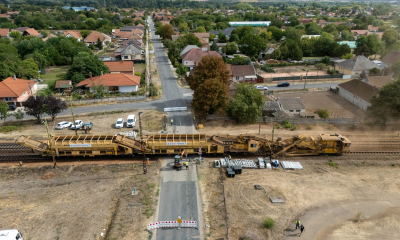
What is being built?
Stones of the past, solutions for the future – Saving the stone walls of the Citadel

Perched on the 235-metre-high plateau of Gellért Hill, the Citadella is not only one of Budapest’s best-known landmarks, but also a tangible testament to the city’s history. The fortress was built by the Habsburgs between 1851 and 1854, immediately following the suppression of the 1848–49 War of Independence. Emmanuel Zitta and Ferenc Kasselik were both involved in its design. By building the Citadel, the Vienna War Council sought not only to deter rebellious Pest, but also to create the first element of a fortification system encircling Pest-Buda to replace the outdated Buda Castle; however, this plan was ultimately abandoned due to a lack of funds.
The fortress continued to play an important – and often dark – role in history: it was used by German troops during the Second World War, and in 1956 it was occupied by Soviet troops, with the site playing a strategic role in controlling the city. After the fall of communism, it gradually became a tourist destination and is now one of Budapest’s most visited vantage points, with millions of tourists visiting Gellért Hill and the Citadel area every year. By the end of the 20th century, however, the condition of the fortress had deteriorated significantly, and it was partially closed to visitors for a long period.

Photo: Fortepan / Gyula Nagy
Preserving heritage value, ensuring modern usability
Following extensive preparatory work for the comprehensive renovation, the large-scale reconstruction project finally got underway in the spring of 2022. Its aim was not merely to preserve the building’s condition, but to reinterpret the entire site: whilst safeguarding its heritage value, the aim was to transform the area into an open, modern community space.
The project was commissioned by Citadella Asset Management and carried out by ZÁÉV Építőipari Zrt. and Market Építő Zrt. consortium, and the works were completed by March 2026. The scale of the project gives a good indication of the scope of the intervention:
Nearly 14,000 square metres of stonework were cleaned and restored, whilst a state-of-the-art drainage system was installed to protect the fortress walls.
One of the most striking aspects of the regeneration is the „opening up” of the fortress: the Citadel, which was previously closed off and had only a single entrance, can now be accessed at several points, thanks to new staircases and pedestrian links. In addition, contemporary architectural features have been introduced, such as the glass-structured footbridge, the water feature in the inner courtyard and the multi-level exhibition space.
The development is significant not only from an architectural perspective but also in terms of landscape architecture: the green space has been increased by 50 per cent to around 20,000 square metres, whilst tens of thousands of plants – shrubs, perennials and bulbous species – have been planted across the site. A 6,000-square-metre public park has been created in the Citadella’s inner courtyard, transforming the formerly enclosed fortress into a genuine community space.

The focus of the restoration: masonry renewal and long-term protection
What makes the current restoration project unique is that it essentially involves a comprehensive rehabilitation of the masonry. The Citadel’s structure, built from natural stone, has suffered significant damage over the past century and a half, meaning that in many sections not only repairs but also complete reconstruction were required. The works took place in several phases from January 2022 to March 2026, with restoration, replacement and re-masonry carried out in parallel.
One of the key players in the project was Pap Lajos Kőfaragó Kft., which carried out the external and internal stone restoration work, as well as the reconstruction of designated sections of wall. Based on structural assessments, entire sections of wall had to be dismantled and rebuilt in several places.
During the surveys, archaeologists and stone conservators precisely identified the areas that were to be preserved in their original condition – these included bullet marks and inscriptions carved by soldiers. In these areas, only surface restoration was carried out, whilst preserving the character of the marks. In some cases, individual stones had to be removed, documented and then re-installed elsewhere.
A particular challenge was the reconstruction of the approximately 30 m² anti-tank blast mark on the eastern section of the rondella: this was dismantled stone by stone, numbered, and then rebuilt in a new location in accordance with the original pattern.
Mapei solutions: from bricklaying to surface protection
Throughout the project, uniform, cement-free materials that are also suitable from a heritage conservation perspective were selected for all natural stone masonry structures. The Mape-Antique Allettamento and Mape-Antique Eco Rinzaffo. The Allettamento was used not only for bedding the stones but also for creating fillings, onto which layers of restoration mortar were later applied – its use amounted to approximately 600 tonnes.
As part of the system, they used the Mape-Antique Ecolastic spreadable insulation – Primer 3296 primer – which blended well with the colour scheme of the Sóskút stone. For repair and levelling work, Mapegrout 430 was also used, whilst for special fixing solutions Mapefix VE SF chemical anchors and, in smaller quantities, Mape-Antique Colabile natural hydraulic lime-based pourable mortar was used. To level and insulate the surfaces, Nivoplan levelling mortar was used, as it was important to separate the concrete structure from the Sóskút stone.

More than 600 tonnes of Mape-Antique Allettamento were used to restore the fortress’s entire wall
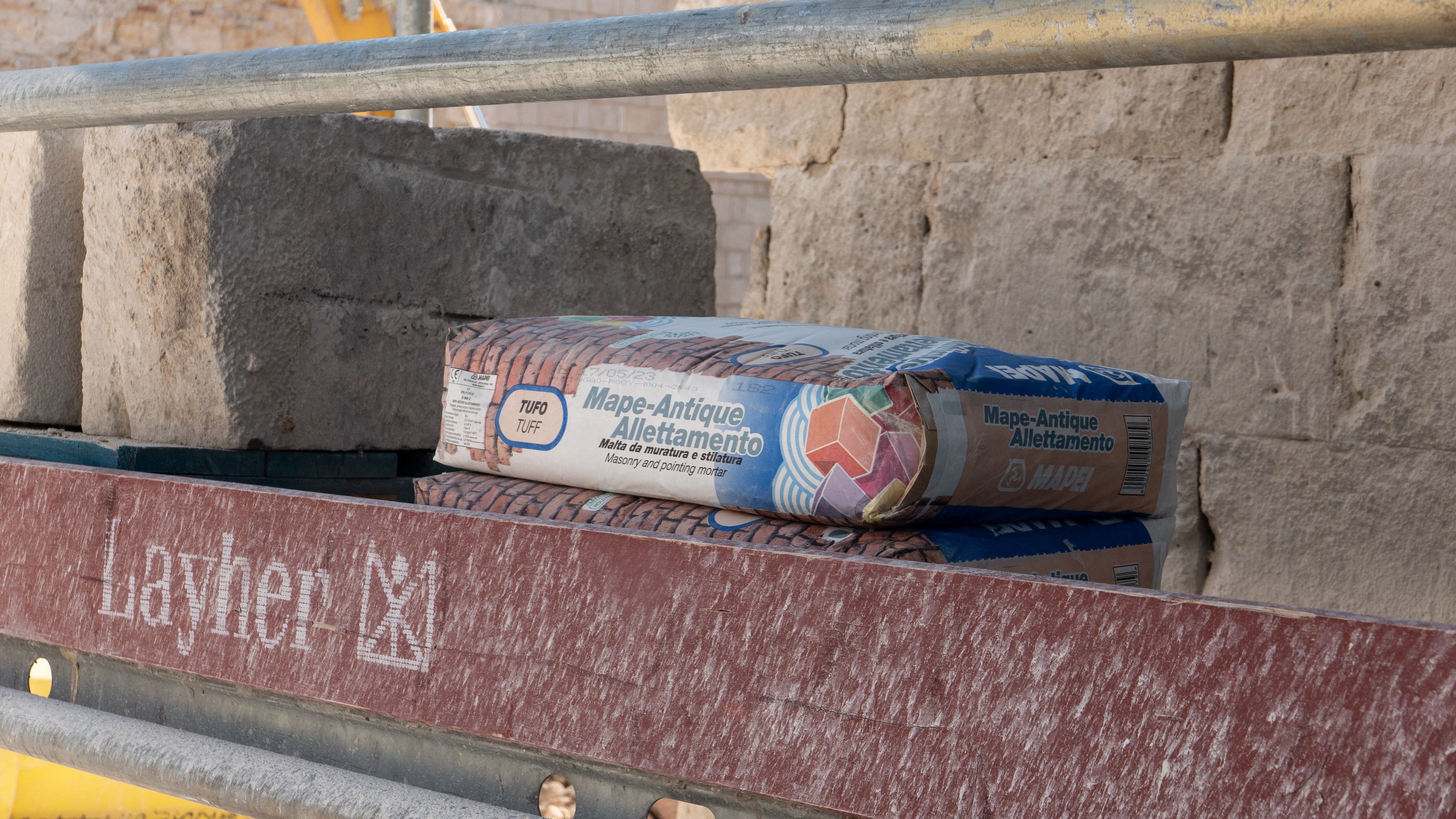

The Tufo colour variant of the Mape-Antique Allettamento matched the original colour of the brickwork perfectly

Using the Mape-Antique Rinzaffo during brickwork renovation

Using the Mape-Antique Rinzaffo during brickwork renovation

Using the Mape-Antique Rinzaffo during brickwork renovation

Mape-Antique Ecolastic cement-free waterproofing was used during the restoration of the coping stones
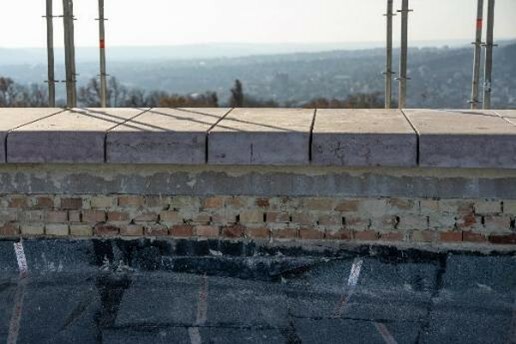
Mape-Antique Ecolastic cement-free waterproofing was used during the restoration of the coping stones
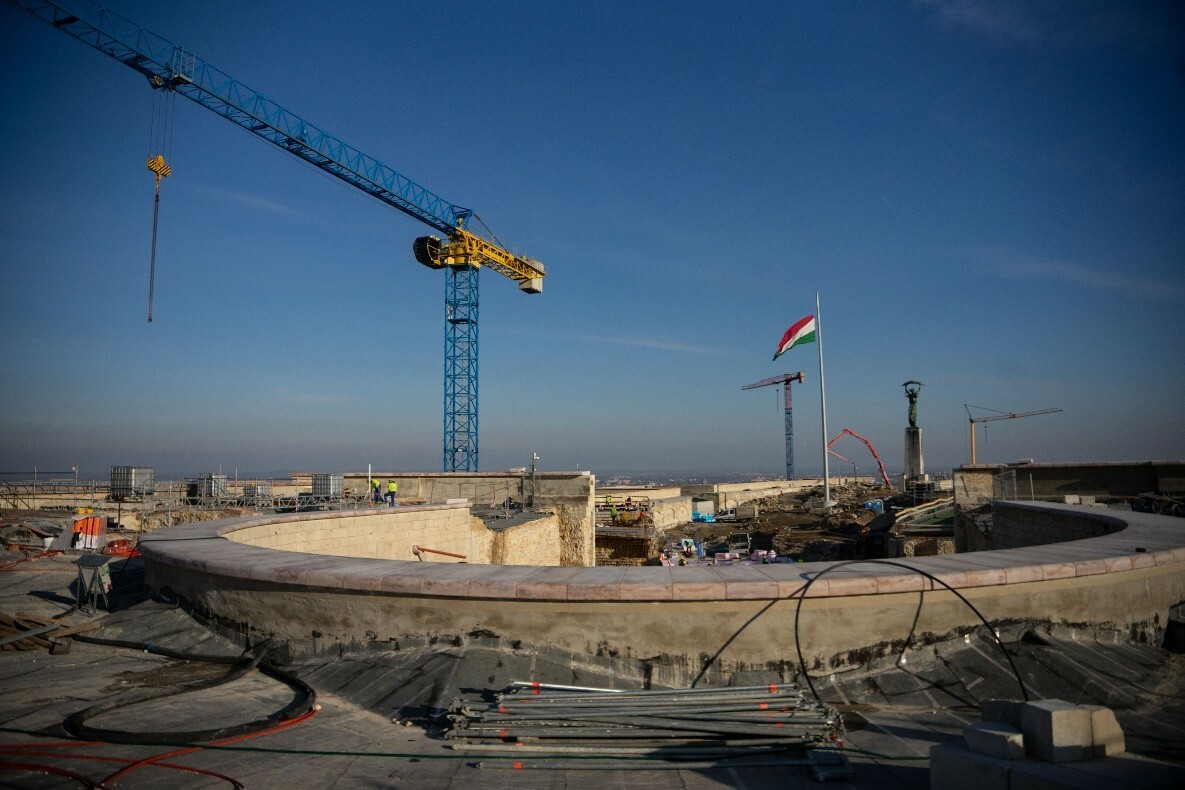
Mape-Antique Ecolastic cement-free waterproofing was used during the restoration of the coping stones
To complete the restoration work, the entire stone surface was treated with a water-repellent coating Antipluviol S and Antipluviol W impregnating agents, which provide long-term protection for masonry against moisture and weathering.
The reconstruction of the Citadel is therefore significant not only from an architectural and urban landscape perspective, but also in terms of its use of materials and construction methods: it is one of the finest examples in Hungary of the fusion of historical authenticity and modern building technology.
For Mapei, the restoration of the Citadel is a project of outstanding significance, as it has been able to play a part in the renovation of a monument of national importance that is one of Budapest’s most recognisable landmarks.
We are particularly proud that the company’s comprehensive system-based solutions were chosen for the complete restoration of the natural stone walls – from the masonry work and restoration right through to the impregnation.
The hundreds of tonnes of materials used not only reflect the scale of the project, but also the professional confidence that contractors and designers have placed in the Mapei products, which were developed specifically for the restoration of historic buildings. The fact that these materials simultaneously met strict technical and aesthetic requirements and contribute to the long-term preservation of the Citadel is clear professional validation for Mapei.
The concept behind the redevelopment goes beyond architectural renewal: according to the plans, this former symbol of oppression is set to become a „bastion of freedom”. This transformation builds both on the weight of the past and the needs of the present: a historic site is being reborn that not only serves as a reminder, but also aims to play an active role in the life of Budapest.
Watch the video filmed on location!
ADATOK
Reference name: Citadella
Work carried out using Mapei products: brickwork renovation
Venue: Budapest
Year of construction: 2022–2026
Investor: Citadella Vagyonkezelő Nonprofit Kft.
Architect: Art1st Design Stúdió Kft.
Main contractor: ZÁÉV Építőipari Zrt., MARKET Építő, Zrt.
Project management: ÉMI/ÉKM
Contractor: Pap Lajos Kőfaragó Kft.
Mapei contact persons: Károly Habling
Mapei partner dealer: Bau-Systeme 92 Kft., Új Ház Hofstädter
Photo: Homestage Film
RECLAIMED MAPEI PRODUCTS
Brickwork restoration: Mape-Antique Allettamento, Mape-Antique Rinzaffo, Mape-Antique Ecolastic, Mape-Antique Colabile, Primer 3296, Mapegrout 430, Nivoplan, Mapefix VE SF, Antipluviol W, Antipluviol S
Source: Link







Reconstruction of the M1 motorway’s carriageway towards Győr can begin under the new traffic arrangements

Alpine engineering techniques are also being used to protect the railway in the Danube Bend

Instead of patchwork repairs – large-scale refurbishment work is under way on the dilapidated main roads in the Transdanubia region

The expansion joints on the Buda side of the Erzsébet Bridge were installed overnight

Four new bridges to be built in the heart of the former industrial city

Rain gardens are coming to Budafok, with over 3,000 square metres of green space set to be developed

Contemporary art deco in Csopakon

Safer driving on the motorways: new digital signs for the MKIF
-

 Current at 2026. 09. 09.
A first-hand look at a career in engineering – Duna Group Szabadegyetem is back
-
Bound track 2026. 09. 15.
Nearly 50,000 people travel on it every day – the refurbishment of the Cegléd main line continues
-
Climate-X 2026. 09. 09.
Nyíregyháza Spartacus FC goes green – four hundred solar panels to be installed on the stadium roof
-
Current at 2026. 09. 09.
Rental flats, Rákosrendező, decentralisation – important ideas were put forward on the Real Estate Beach Conference stage