What is being built?
The replacement of the expansion joints on the Erzsébet Bridge is continuing with the third phase

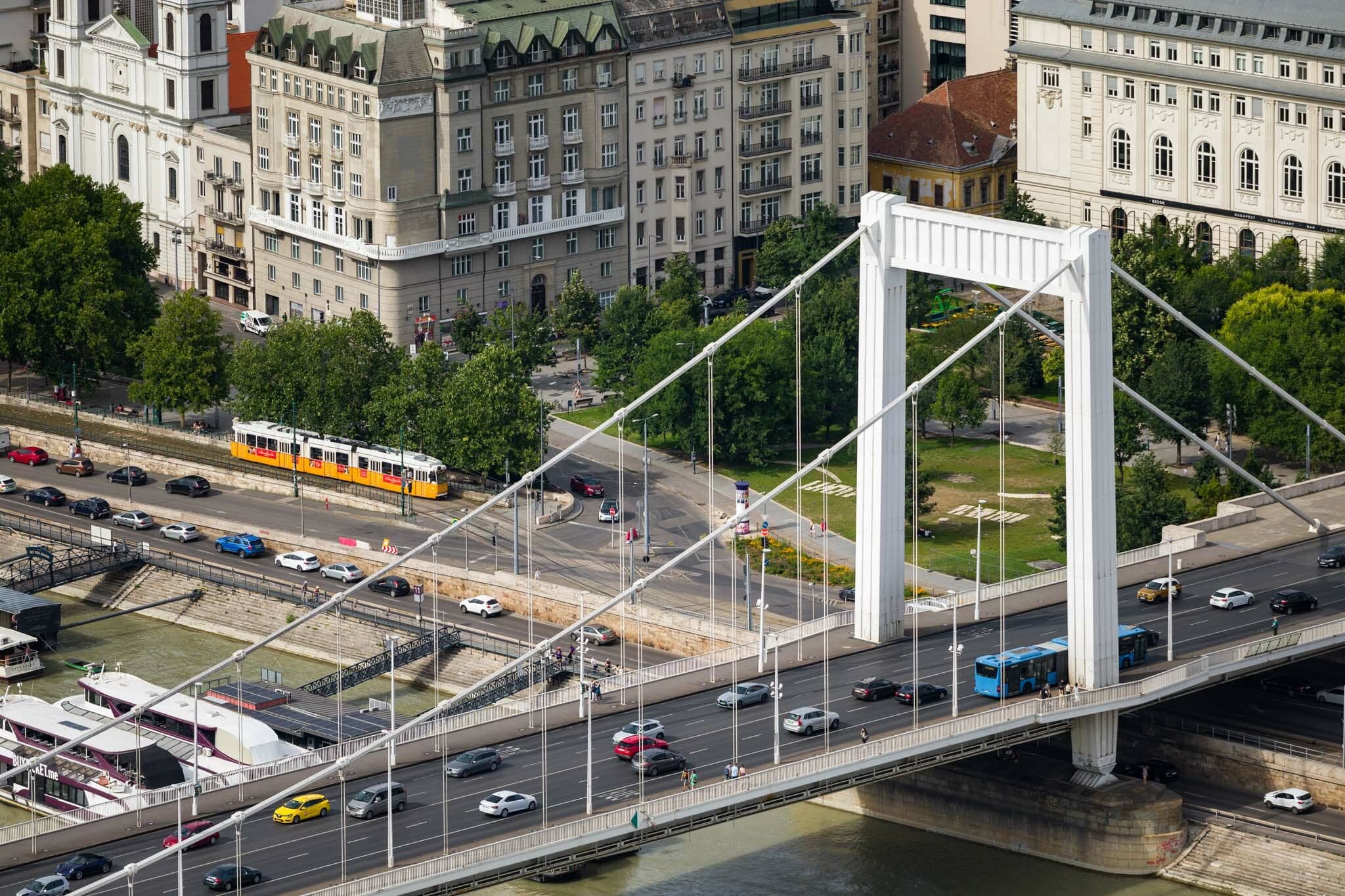
Opened in 1903, the Erzsébet Bridge was a world record-holder with a span of 290 metres. Although many considered it to be Budapest’s most beautiful bridge, the structure, which was destroyed during the Second World War, was rebuilt in 1964 not as a replica but as a modern cable-stayed bridge based on designs by Pál Sávoly.
A slender bridge with a beautiful arch and an ingenious design, brimming with true engineering marvels, was born at this time. Its graceful lines are made possible by the massive anchor blocks concealed within the Pest-side abutment, which still demonstrate the strength of Budapest’s modernist traditions today. Instead of the previous chains, the bridge’s support system, consisting of 61-61 cables, holds a braced steel structure that directly supports the deck. Although the new bridge has a greater load-bearing capacity, it required only half as much steel as the original.
We are in the midst of a maintenance year
A number of minor repairs and maintenance works have been carried out in the past on the bridge, which is now 62 years old (for example, major structural maintenance in 1997–98, and the refurbishment of the approach roads in 2004 and 2013), but the complete structural replacement of the expansion joint system is a key bridge maintenance task for the mid-2020s.
In 2025, the main expansion joints located at the bridgeheads along the main girders of the Erzsébet Bridge were replaced. During this work, the old, worn-out steel expansion joint profiles were replaced with a more modern structure capable of withstanding higher traffic loads, which also significantly reduced the noise levels caused by traffic crossing the bridge.
The Buda slip roads are next
According to the public procurement notice published recently public procurement notice indicates that the time has come to begin work on replacing the expansion joints at the Buda-side slip roads of the Erzsébet Bridge. On the Buda slip road of the Erzsébet Bridge (designated B-916), the expansion joints marked „B” (at the end of the branch leading to the Rudas Baths) and „C” (at the end of the branch leading towards Attila út (Krisztinaváros)) are a total of 16.8 metres in length. The expansion joints currently installed (PD85) are single-lamella structures (a synthetic rubber profile snapped into two steel profiles), with a movement capacity of ±40 mm. These require complete replacement with a modern and durable solution.
The contractor must complete all the work by 15 November 2026 at the latest, with particular emphasis on drainage. In addition to the expansion joints, a drainage channel must be incorporated into the transverse grooves formed in the insulation, from which water will be drained via the existing downpipes.
Source: Link



The southern bypass will also relieve Baja of future traffic congestion

Let’s not miss out on the buyer! Ákos Balla on down-to-earth property development

The Duna Group has been rolled out to large regional companies

STRABAG has acquired a bridge and utilities construction company in Romania

Hungary's biggest motorway upgrading programme is underway

Perhaps the world's most elegant McDonald's restaurant opens in Budapest

Szeged to become one of Europe's leading industrial centres with the construction of the BYD factory, the city strengthens its position with a worthy investment package

Viablokk porous concrete masonry element from a Hungarian factory, as a Hungarian product, is set to conquer the world
-

 Current at 2026. 05. 26.
Concrete could be the future of detached houses
-
Climate-X 2026. 05. 26.
Rain gardens are coming to Budafok, with over 3,000 square metres of green space set to be developed
-
Road building 2026. 05. 26.
This is how Venice’s old bicycle bridge was dismantled
-
Climate-X 2026. 05. 26.
Green Minimum and the life-cycle approach: the construction industry may be on the cusp of a regulatory shift