Bound track
This is how they pulled out the ‘fang’ of the derailed railway section in Transdanubia – with photos

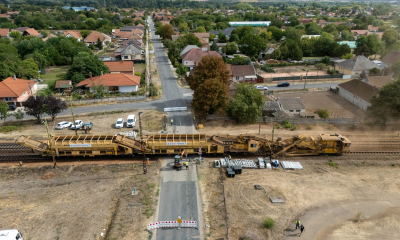
Repairs to the embankment on the section of railway line No. 20 between Veszprém and Ajka are already underway. The restoration of the 150-metre section, which was closed in December 2024, has begun under contracts GYSEV Zrt. and MÁV Pályaműködtetési Zrt. early February by Swietelsky Vasúttechnika Kft., and by in early March we were already able to report on the demolition of the embankment.

Well-organised execution sped up the earthworks
According to the summary sent to our newspaper, following the preparatory work, the project progressed with the replacement of the railway cables and their relocation to a new route. After the demolition of the existing overhead line pylons and the relocation of the cables, the demolition of the embankment began at the end of February, using a stepped design.

Thanks to the favourable weather and well-organised execution, the extensive earthworks were completed in just 10 days. This involved moving approximately 15,000 cubic metres of earth.
They have identified the cause of the embankment's slippage
The report highlighted that there had been no precedent for excavation and demolition work on this scale at this site since the railway line between Ajka and Veszprém was built over 100 years ago. During the demolition, a significant geotechnical problem—which had previously necessitated the closure of the track section—was also confirmed: a slip plane was found in the subsoil, which is a spatial surface where layers of soil loosened by moisture can easily shift relative to one another.
Investigations revealed that the waterlogged and moisture-sensitive clay layers had slipped over one another over the decades, leading to a slow displacement of the embankment in the long term. It is highly likely that this was also the cause of the movements observed in previous years.

In order to fully assess and address the situation, there was ongoing consultation with the client and the designer, and further excavation work was carried out, as a result of which all problematic soil layers uncovered during construction were removed.
This is how they remove the problematic groundwater from the site
This was followed by the start of the next major phase of the project: the installation of the drainage system, which is currently underway. The aim is to reduce the water content of the soil at a depth of around 8 metres beneath the embankment that was previously demolished.

During the project, 10–11-metre-deep shafts will be constructed at three sites, and nearly 150 gravel piles will be installed, which will be connected via directional drilling. The water collected in the shafts will be drained using a lift pump, thereby ensuring that the layer beneath the embankment can also be effectively dewatered.
Once the drainage system has been completed, work can begin on constructing the 8–9-metre-high embankment, which will be built up in layers and thoroughly compacted.
Source: Link







Reconstruction of the M1 motorway’s carriageway towards Győr can begin under the new traffic arrangements

Alpine engineering techniques are also being used to protect the railway in the Danube Bend

Instead of patchwork repairs – large-scale refurbishment work is under way on the dilapidated main roads in the Transdanubia region

The expansion joints on the Buda side of the Erzsébet Bridge were installed overnight

Four new bridges to be built in the heart of the former industrial city

Rain gardens are coming to Budafok, with over 3,000 square metres of green space set to be developed

Contemporary art deco in Csopakon

Safer driving on the motorways: new digital signs for the MKIF
-

 Current at 2026. 09. 09.
A first-hand look at a career in engineering – Duna Group Szabadegyetem is back
-
Climate-X 2026. 09. 09.
Nyíregyháza Spartacus FC goes green – four hundred solar panels to be installed on the stadium roof
-
Bound track 2026. 09. 15.
Nearly 50,000 people travel on it every day – the refurbishment of the Cegléd main line continues
-
Current at 2026. 09. 09.
Rental flats, Rákosrendező, decentralisation – important ideas were put forward on the Real Estate Beach Conference stage