Climate-X
A 100-metre road was built near Tata from 100 tonnes of waste

In our country, approximately 2 million tonnes of unusable waste is generated annually. This waste is not suitable for secondary use or energy recovery, so it mostly ends up in landfills. However, WLC technology – Waste Light Concrete – has made it possible to reuse this waste fraction. Near Tata, a pilot road section with a base layer containing plastic shredded material was constructed through the collaboration of Magyar Közút Nonprofit Zrt., Colas and Makrópa Kft..

A new opportunity for unusable waste
Károly Bus began research and development work on the utilisation of costly, non-recyclable waste more than two decades ago. The owner of the WLC patent told our portal:
„Among the types of waste that cannot be utilised in other ways, which we have targeted for utilisation, are: composite or painted plastics (e.g. polished bumpers), thermosetting plastics or plastics with flame retardant additives, which are used as casings for electrical devices.
Experiments and developments have reached a stage where the industrial application of WLC technology has become possible. Using this method, concrete can be produced from most types of waste, ground into particles smaller than 10 mm.
Made from concrete cigarette butts and leaves
The first tests of the WLC additive formula were conducted by Károly Bus in 2003. Four years later, he completed the patent for polystyrene concrete, and by 2015, he had produced approximately 150 different waste mixture samples and submitted the patent for waste concrete. At the same time, the practical use of these materials also began. In 2023, production, research and development, and utilisation were organised under a single brand name, resulting in the creation of WLC – Waste Light Concrete.

Today, there are nearly 400 concrete samples. The composition of the possible mixtures is extremely varied: light and heavy plastics, electronic waste, packaging and insulation materials, as well as wood, leaves, cigarette butts, glass and car tyres are among the ingredients. The key to WLC technology is an additive developed after extensive experimentation and testing, Krisztián Méhes told our portal.
The role of the additive is to create a stable, evenly distributed mixture from plastic waste that would otherwise separate when mixed with water and cement.
The managing director of Makrópa Kft. added that the emulsion and mixing formula offer a unique solution for the end use of waste in the form of walls, building elements, foundation concrete or road bases.

Teamwork
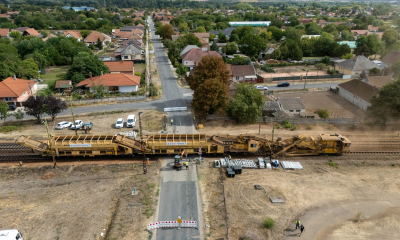
One important stage in the rollout of WLC technology is the 8119 main road near Tata. Here, with the professional and financial contribution of Magyar Közút Nonprofit Zrt., a 100-metre-long experimental section was established between km 55+820 and km 55+970, to which a further 50-metre control/reference section is connected. The project was carried out by Colas Út as a subcontractor, with the research and development process supported by Colas. The joint work began during the preparation of the tender and included laboratory tests, trial mixes and trial casting at the Betonsped Kft. mixing plant in Komárom. The tasks of Colas also included installation and on-site testing to ensure that the new technology was comparable in practice to traditional Ckt solutions in road construction.

Traditional mixers and machinery assisted in the construction
The preparation of waste materials does not require significant additional work. It is important that no aluminium powder or waste containing oily substances is added to the crushed material used for the road base. We learned from the contractor that the 0-10 mm plastic granules were transported to the mixer in 1 m³ big bags and filled into the designated fraction. No special machinery was required for either mixing or installation, the contractor informed our portal.

The experimental and control phases are compared.
The 100-metre test section was immediately followed by a 50-metre control section, allowing the behaviour of the two materials to be compared under identical conditions. The specialists at Colas Út constructed the two-lane, 8-metre-wide main road sections with the following parameters:
The experimental phase:
- 40 mm AC 11 wearing course (mF) asphalt wearing course
- 100 mm AC 22 binder (F) asphalt binder layer
- 200 mm base layer containing hydraulic binder and plastic granules
The control/reference section:
- 40 mm AC 11 wearing course (mF) asphalt wearing course
- 100 mm AC 22 binder (F) asphalt binder layer
- 200 mm CKT base layer

100 tonnes of plastic recycled in road base
During construction, two types of CKT were used on the section under investigation: traditional CKT and ÖkoCKT. (The latter is a more environmentally friendly version of traditional cement-bound load-bearing road base, in which some of the raw materials are replaced with secondary or industrial by-products.) The two materials were incorporated continuously, so the method was the same. Approximately 100 tonnes of plastic waste were used in the construction of the test road.

How has plastic changed the properties of concrete?
The expected mechanical properties of concrete are influenced by the properties of the waste materials used as raw materials. The lower the bulk density of the raw material (e.g. refrigerator insulation is used), the lower its compressive strength, but the better its thermal insulation properties, for example. Waste with a higher density is ideal for road base construction. During construction, Colas experts found that the density of the mixture decreased as the amount of plastic granulate increased. The weight of the finished mixture was approximately 70% of that of the traditional material. Based on Colas's measurements, the use of plastic did not significantly affect the strength. According to calculations by the company providing WLC technology, the use of waste in certain mixtures could replace 70% or even 100% of the gravel and sand. A 100-metre section of the experimental road contained 160 m³ of ÖkoCKT, which could replace 130-150 tonnes of gravel/sand.
Monitoring and long-term studies
The evaluation of the technology does not end with the handover of the test road. Makrópa Kft. has committed to conducting annual dynamic deflection measurements, asphalt unevenness measurements and visual surface inspections on both the trial and reference sections for a period of 60 months, i.e. five years. The aim is to determine how the WLC base behaves in the long term under traffic and environmental influences.

The surfaces built five years ago have not been damaged even under heavy loads.
WLC technology has previously been used on walls, concrete surfaces and in road construction. Károly Bus said of the experience so far: according to measurements, the surfaces are more solid and flexible than traditional ones, and have better water resistance and fire resistance.
„Despite significant truck traffic, there has been no displacement on our surfaces installed five years ago, while the same section is becoming unusable with standard road bases. The elasticity of the material exceeds that of traditional CKT, as its watertightness and uniform structure prevent it from sinking and cracking.”
WLC could transform waste management and the building materials market
The question arises: how might the success of this technology affect waste management? WLC is an accessible and simple solution that requires no investment to recycle millions of tonnes of waste streams per year, whether they originate from industrial sources or constitute the solid fraction of municipal waste.
The use of WLC technology can also reduce CO₂ emissions, as it would reduce the burden of mining, waste disposal and transport. The improved quality of road bases increases their service life and allows for multiple recycling, as they can be reground and recast on site.
The Tata test section is not only a technological experiment, but also an important opportunity to gain experience: it shows the conditions under which industrial waste can be incorporated into domestic road construction practices.
Source: Link








One of Abony’s most important transport routes is to be redesigned

This is how flash floods on the vineyard-covered hills in the Pécs conurbation are being prevented

Order has been restored: production of the new Közlekedési Múzeum can now go ahead as originally planned

We took a look at how the refurbished Igazságügyi palota building turned out

Four new bridges to be built in the heart of the former industrial city

Rain gardens are coming to Budafok, with over 3,000 square metres of green space set to be developed

Contemporary art deco in Csopakon

Safer driving on the motorways: new digital signs for the MKIF
-

 Current at 2026. 09. 09.
A first-hand look at a career in engineering – Duna Group Szabadegyetem is back
-
Climate-X 2026. 09. 09.
Nyíregyháza Spartacus FC goes green – four hundred solar panels to be installed on the stadium roof
-
Bound track 2026. 09. 15.
Nearly 50,000 people travel on it every day – the refurbishment of the Cegléd main line continues
-
Current at 2026. 09. 09.
Rental flats, Rákosrendező, decentralisation – important ideas were put forward on the Real Estate Beach Conference stage