Bound track
A Hungarian specialist in railway turnouts has won the MÁV billion-forint contract

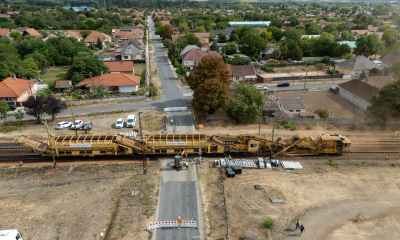
MÁV Pályaműködtetési Zrt. had previously entered into a framework agreement for the procurement of various types of simple and crossover turnouts required for railway track maintenance and repair work. Under the terms of the framework agreement, 32 sets are scheduled to be procured over a period of 12 months.
The public procurement procedure was divided into three parts
According to the notice published in the EU Public Procurement Bulletin, the railway company purchased, under the terms of the aforementioned framework agreement and in three separate lots, various simple and crossover points designed to enable trains to move from one track to another. In all three lots of the procedure, the Gyöngyös-based VAMAV Vasúti Berendezések Korlátolt Felelősségű Társaság was the successful tenderer.

The total value of the contracts exceeds 1.2 billion forints
According to the notice, the value of the first lot is 434.429 million forints, that of the second is 479.375 million forints, whilst the third contract is for 293.094 million forints. The total value of the three lots is therefore 1.206 billion forints. The contracts were concluded on separate dates: the first on 15 May, the second on 10 June, and the third on 26 June. The company has 120 days to fulfil the contracts.
The history of Hungarian elbow manufacturing also comes to the fore behind this order
The role of the VAMAV extends beyond this current procurement: the company’s history is closely intertwined with the history of domestic railway points manufacturing. The roots of Hungarian points manufacturing date back to the period when the Hungarian State Engineering Works was in operation, when railway points were manufactured at both the Budapest and Diósgyőr plants. An 1884 annual report already noted that the production of points had been relocated to Diósgyőr. Production continued in Diósgyőr right up until the end of the Second World War, after which, in 1951, points manufacturing was moved to Gyöngyös. Following this decision, a production plant – considered state-of-the-art at the time – was established in a region where industrial production had previously played no significant role.

The name has changed, but the profile remains the same
The Gyöngyös plant operated under several names over the following decades: in 1951 as the Points and Turnouts Factory, from 1954 as the MÁV Turnout Manufacturing Plant, and then, from 1968, as the MÁV Turnout Manufacturing Plant. The company was restructured in 1991 as a joint venture under the name VAMAV Vasúti Berendezések Korlátolt Felelősségű Társaság, with the Hungarian State Railways and the Austrian VAE GmbH holding a 50–50 per cent stake – according to the company’s website.
A domestic manufacturer may supply equipment for railway track maintenance
The activities of VAMAV Kft. are not limited to the manufacture of points and turnouts: the company is also involved in the design and manufacture of railway turnouts, crossings, track connections and other track structures. In addition, it offers innovations in the field of control mechanisms, locking devices and end-position sensors for switch operation, as well as in diagnostic and monitoring solutions. The Gyöngyös-based company is also a strategic partner to domestic railway companies and railway construction firms in operational and maintenance tasks.
Source: Link









One of Abony’s most important transport routes is to be redesigned

This is how flash floods on the vineyard-covered hills in the Pécs conurbation are being prevented

Order has been restored: production of the new Közlekedési Múzeum can now go ahead as originally planned

We took a look at how the refurbished Igazságügyi palota building turned out

Four new bridges to be built in the heart of the former industrial city

Rain gardens are coming to Budafok, with over 3,000 square metres of green space set to be developed

Contemporary art deco in Csopakon

Safer driving on the motorways: new digital signs for the MKIF
-

 Current at 2026. 09. 09.
A first-hand look at a career in engineering – Duna Group Szabadegyetem is back
-
Climate-X 2026. 09. 09.
Nyíregyháza Spartacus FC goes green – four hundred solar panels to be installed on the stadium roof
-
Bound track 2026. 09. 15.
Nearly 50,000 people travel on it every day – the refurbishment of the Cegléd main line continues
-
Current at 2026. 09. 09.
Rental flats, Rákosrendező, decentralisation – important ideas were put forward on the Real Estate Beach Conference stage