Bound track
With this investment, the Székesfehérvár–Balaton railway line will also take a step forward

Several sections of the Budapest–Nagykanizsa main line have been upgraded in recent years, but the section between Székesfehérvár and Lake Balaton was left out of these projects.
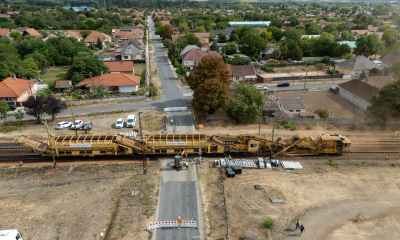
Following the Budapest Interconnected Tram Development Project, another fixed-track investment of national significance has come into focus following today’s announcement by Dávid Vitézy. The Minister for Transport and Investment stated on his Facebook page that a planning contract has been signed to prepare for a new railway project to develop the Szabadbattyán–Lepsény section of the Balaton railway line.
The aim of the project is to enable trains to travel at a speed of 160 kilometres per hour on two tracks along this section as well. The tender issued by MÁV Pályaműködtetési Zrt. was won by Ring Mérnökiroda with a contract value of 1.474 billion forints. The company is required to carry out a complex design task: from the decision-preparation study and the environmental impact assessment right through to the preparation of the detailed design and the obtaining of planning permission.

In his post, Dávid Vitézy pointed out that over the past nearly twenty years, several sections of the No. 30 main line – running from Budapest towards Nagykanizsa and Zagreb – have been rebuilt with EU funding between Kelenföld and Balatonszentgyörgy, whilst a second track has also been laid in some sections along the shores of Lake Balaton. However, the section between Székesfehérvár and Lake Balaton was omitted from these projects, and work to rectify this may now begin. (Our newspaper has reported on the renovation of the Szántód–Balatonszentgyörgy and Fonyód–Kaposvár line sections in numerous articles, which were completed in June 2018 – Ed.)
As part of this new investment project, a second track is being prepared between Szabadbattyán and Lepsény; in addition, plans for accessible platforms are being drawn up for the Polgárdi-Tekerespuszta stop and Kiscséripuszta station. The project will also include the installation of a Level 2 ETCS train control system between Székesfehérvár and Lepsény, as this is a prerequisite for speeds of 160 km/h.
„On this section alone, the increased speed will only save a few minutes, but if trains can travel at 160 almost all the way from Nagytétény to Lepsény, that will result in a significant reduction in journey time,” the minister pointed out.
Dávid Vitézy emphasised, however, that: the real benefit will be that the timetable can be more stable on the double-track line, track capacity will also increase somewhat, and more trains will be able to run to Siófok, as the disruption-prone single-track section – which is currently the main constraint on capacity on the Lake Balaton line – will be shorter overall.
In the report, he also revealed that, as part of a separate planning exercise, preparations for a new, short railway link from Lepsény to Balatonakarattya are due to begin shortly. „This will make the northern shore of Lake Balaton noticeably quicker to reach than the current winding route, which can only be travelled at 80 km/h,” he pointed out. He emphasised that trains travelling to both the northern and southern shores will be able to share the new line – designed for speeds of 160 km/h – as far as Lepsény, which will significantly reduce journey times for rail travel between the southern and northern shores.
Source: Link










One of Abony’s most important transport routes is to be redesigned

This is how flash floods on the vineyard-covered hills in the Pécs conurbation are being prevented

Order has been restored: production of the new Közlekedési Múzeum can now go ahead as originally planned

We took a look at how the refurbished Igazságügyi palota building turned out

Four new bridges to be built in the heart of the former industrial city

Rain gardens are coming to Budafok, with over 3,000 square metres of green space set to be developed

Contemporary art deco in Csopakon

Safer driving on the motorways: new digital signs for the MKIF
-

 Current at 2026. 09. 09.
A first-hand look at a career in engineering – Duna Group Szabadegyetem is back
-
Climate-X 2026. 09. 09.
Nyíregyháza Spartacus FC goes green – four hundred solar panels to be installed on the stadium roof
-
Bound track 2026. 09. 15.
Nearly 50,000 people travel on it every day – the refurbishment of the Cegléd main line continues
-
Current at 2026. 09. 09.
Rental flats, Rákosrendező, decentralisation – important ideas were put forward on the Real Estate Beach Conference stage