
Bound track
Following its 180th anniversary, the country’s oldest railway line has taken a step forward

The country’s oldest railway line celebrated its 180th anniversary five days ago alongside the MÁV: now, attention is turning to it following the completion of renovation works. The Budapest–Vác line (No. 70), one of the busiest railway corridors, as well as the No. 71 line running via Veresegyház to Vác, both resumed normal services on 20 July.
They built three level crossings
According to a social media post by Zsolt Hegyi, CEO of MÁV, the national programme aimed at eliminating speed limit signs has once again taken a step forward.
„On Line 70, at Rákospalota–Újpest station, we replaced points set No. 1, rebuilt the associated section of track, and carried out maintenance work on the ballast and overhead lines, thereby removing the speed restriction in place here,” reported the manager. „On Line 71, meanwhile, we took advantage of the track closure to tidy up the area around the track and rebuilt three level crossings, making passage through these level crossings more comfortable”
- he added.

He emphasised that the impact of the works will be felt on both lines: transport will become more reliable and punctuality may improve.
They are also monitoring those lines where a deterioration is expected in the near future
He specifically mentioned that the replacement of the points forms part of the new nationwide points renewal programme, MÁV. „Points are critical components of the railway track: their condition fundamentally affects the quality of service, and worn-out points often lead to the formation of slow signals. That is why, over the coming years, we will be systematically replacing ageing points on the busiest lines and at the busiest stations,” explained Zsolt Hegyi.
He explained that resources are also being allocated in good time to those sections of track where, given their current condition, more serious faults or the emergence of further slow-speed warnings are expected in the coming years.
Source: Link

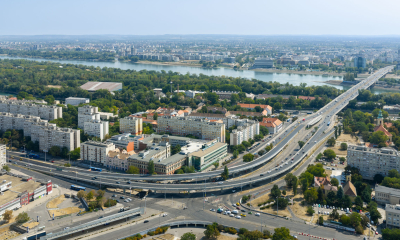


Last-minute preparations before handover – This is how the refurbishment of the Flórián Square flyover came to an end

The 25,000-square-metre training centre at the Ludovika Campus, complete with a fire station and halls of residence, has been completed

A 184-kilometre road, a 362-metre bridge – A close-up look at road construction in Africa

A new co-CEO has joined KÉSZ Csoporth

Rain gardens are coming to Budafok, with over 3,000 square metres of green space set to be developed

Contemporary art deco in Csopakon

Hungary's biggest motorway upgrading programme is underway

Perhaps the world's most elegant McDonald's restaurant opens in Budapest
-

 What is being built? 2026. 07. 27.
Construction of Phase VIII of the Somfa Liget residential estate is underway using hybrid construction methods, prefabricated elements and the LEAN organisation model
-
Water management 2026. 07. 27.
Szeged is getting rid of its asbestos-cement and cast-iron pipes
-
What is being built? 2026. 08. 06.
Paks II.: What does the new milestone for Unit 5 mean in the context of the review?
-
Road building 2026. 08. 05.
The main road leading to a key tourist destination in Bihar is being upgraded using cold recycling technology


