Current at
The M5 motorway is in tatters – can the M6 save the day?

A photo of a lorry that had overturned on the M5 recently made the rounds in the Hungarian press: due to the vehicle crashing near Újhartyán, a full road closure in the direction of Szeged was in place until midday. A day earlier, on 12 May, oncoming traffic was hit by a similar shock: three lorries collided near Inárcs, resulting in the closure of the entire width of the affected motorway section in the direction of Budapest. Unfortunately, the weekend of that week was not without accidents either: on 16 May, there was a complete road closure towards Szeged in the Kistelek area due to a motorbike accident.

Where the daily battle with traffic is relentless
However, there is no need to mention recent accidents to those who use the M5 motorway on a daily or weekly basis: it is common knowledge that, due to regular traffic jams, it is worth allowing for an extra 0.5 to 1 hour on top of the planned journey time. The congestion on the motorway is mainly caused by lorries and migrant workers arriving from the Balkans and Turkey: they currently have no other high-speed alternative for travelling through Hungary.
Adding to this is the heavy traffic at the Röszke motorway border crossing (known as Horgos on the Serbian side) – which is also a Schengen border crossing. Daily traffic at the crossing, which links the Serbian A1 and Hungarian M5 motorways, can reach 30–40,000 vehicles at peak times, also causing traffic jams stretching for several kilometres.

By comparison, only the nearby Tompa border crossing (known as Kelebia on the Serbian side) could serve as an alternative, given its capacity for freight traffic: however, attempts to divert traffic there are in vain, as drivers are forced onto a two-lane road after turning off the Serbian A1 motorway towards Subotica on this route, and must continue on a two-lane road for a considerable distance on the Hungarian side as well.
What could be the solution?
Given the above, it is no surprise that several alternatives for relieving congestion on the M5 have already been suggested in the domestic press. What could be the solution to reducing traffic on this motorway, which, judging by reports of accidents, has become a death trap?

We have probably never been as close to the answer as we are now, thanks to a road-building project that has recently begun in Serbia.
The construction of the motorway known as the ‘Smile of Vojvodina’, however, not only opens up new avenues for alleviating congestion on the M5 and at Röszke, but could also give new purpose to the M6 motorway, which is currently one of Hungary’s least-used motorways.
The M5 carries more than twice as much traffic as the M6!
To understand both the problem and the possible solution, it is worth starting with the fact that in 2022, on the section of the M5 motorway near Budapest, an average of 76,000 vehicles passed through each day; and even in the Szeged area, the figure was 44,000 on the M5. In contrast, in the same year, on the M6 motorway’s approach to the capital, only 35,000 vehicles per day; whilst at the same time, in the Szekszárd and Paks areas, the figure was just 13,000. According to this, the congested south-eastern motorway is coping with more than twice as much traffic as our southern motorway, which has significant spare capacity!

Another telling statistic is that, according to data from the Hungarian Central Statistical Office (KSH) for 2022, there were an average of 14.1 accidents per 100 kilometres on motorways longer than 100 kilometres:
The highest proportion (21.7%) was on the M5, and the lowest (4.0%) on the M6.
As one possible solution for diverting traffic between the two motorways representing these extremes, the extension of the M9 motorway – which currently runs only between the M6 and the 51 main road and includes the Szekszárd Danube bridge, also known as the Szent László Bridge – has emerged. This would involve, on the one hand, the 60-kilometre section would need to be built on a new route, and in another project a new Tompa border crossing point with the associated 7-kilometre access road.
What has given Subotica a major boost is still not enough for international transit
The viability of this alternative is demonstrated by the fact that planning for the shorter section began in 2024, as our newspaper also reported; whilst planning for the longer section is underway, according to available government data with a deadline of next summer.

However, from an international perspective, this version would be less suitable for the role of a transport corridor. This is because there is still a 24-kilometre dual-carriageway section between the Tompa border crossing and the Serbian A1 motorway: the Subotica bypass, opened in 2020 (which took nearly 30 years to build (!) – ed.) represents a significant step forward for the city and through traffic, but does not yet provide a high-speed link between the Serbian motorway and the Hungarian border. Nevertheless, according to earlier press reports, the Serbian government plans to upgrade the route, which was built as a semi-motorway, into a full-fledged motorway.
The M8 alone can make a big difference to the M5
Another option for relieving traffic on the M5 is the M8 expressway between Kecskemét and Dunaújváros, as well as the section between Dunaújváros and the M7, which, according to government project data, have had detailed designs and building permits in place since last year.

This section can, of course, only alleviate congestion on the M5 north of Kecskemét, but this is precisely where most of the problems lie: negative traffic reports most often concern the section of the M5 near the capital and the southern sections of the M0. A major factor in this is that freight and passenger traffic arriving on the M44 from Romania significantly increases the number of vehicles on the M5 (as can be seen from the data above). However, as the M8 is to be built as a continuation of the M44 – as described in the project for the mega-junction being built on the M5 near Kecskemét – this traffic impact may be mitigated. In one scenario (without going into the longer-term plans for the M8 in this article – ed.), it could provide an alternative for vehicles travelling in an east-west direction, as it will open up a link to the Transdanubia region and the Adriatic region by connecting to the M7.
An escape route would be provided for the most critical sections of the M0 and M5 motorways
At the same time, in the event of a major traffic disruption, the Kecskemét–Dunaújváros section of the M8, when used in conjunction with the M6, could even serve as an alternative route to Budapest.
The section of the M0 motorway between the M5 and M6 is typically the most prone to heavy traffic congestion; however, the planned M8 and the M6 will make it possible to bypass this critical stretch.
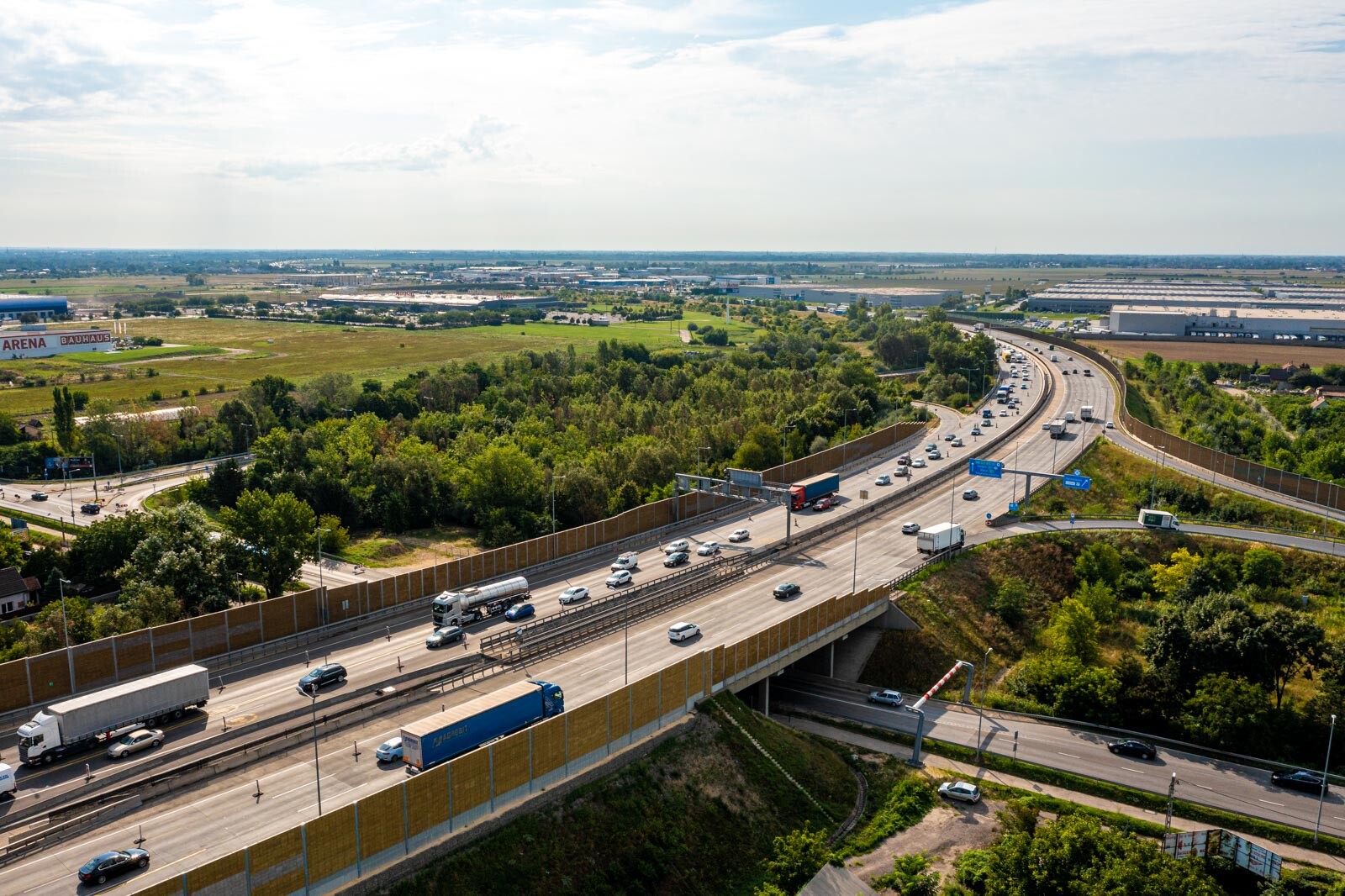
This alternative route from Kecskemét via the Pentele Bridge covers a total of 123 km to the M6-M0 junction, i.e. the western section of the M0. Given the recent traffic congestion on the M5, this route, taking around 70 minutes, may well be a better option than the 73-kilometre route between Kecskemét and the western terminus of the M0, which passes through the busiest sections of the M5 and M0.
Traffic from the Balkans could be connected directly to the M6 motorway without passing via the M5
The construction of the transport corridor spanning the Hercegszántó border could also provide a major boost to resolving the chronic problems on the M5 motorway; of the options under consideration, this appears to be the closest to becoming a reality.
The Hungarian components of this project – the expressway being built in the Mohács area and the plans to upgrade Route 51 – were already known, but this version actually gained momentum this March with the launch of the project known as the Smile of Vojvodina.
As part of this latest development, our southern neighbour is constructing an east-west expressway corridor between the Hungarian and Romanian borders, crossing the A1 motorway. The resulting Serbian motorway link
- supplemented by the upgrading of the Hercegszántó crossing – for which a contractor has now been appointed (see below) –,
- by widening the southernmost section of the A51 to four lanes,
- as well as the expressway being built between the M6 and the 51 at the Danube bridge in Mohács
It could bring about a significant shift in transit traffic between the Balkans and Western Europe, thereby eliminating the significant imbalance between the M5 and M6 motorways.

This is crucial because it would allow transit traffic coming from the Balkans to connect directly to the M6 motorway without having to use the M5. As this option does not appear unfeasible in terms of the status and scale of the necessary projects, we set out below a detailed account of the elements still required for its implementation.
First step: linking Transdanubia with the Great Plain at Mohács
One of the key elements of the potential new corridor is the construction of the Danube bridge at Mohács and the associated expressway. As part of this, a 28.8-kilometre-long expressway will be built between Csátalja, situated along the M6 motorway and the 51 main road, by widening the 57 main road and connecting it to the 51 main road, which will also include the new 756-metre-long Danube bridge.
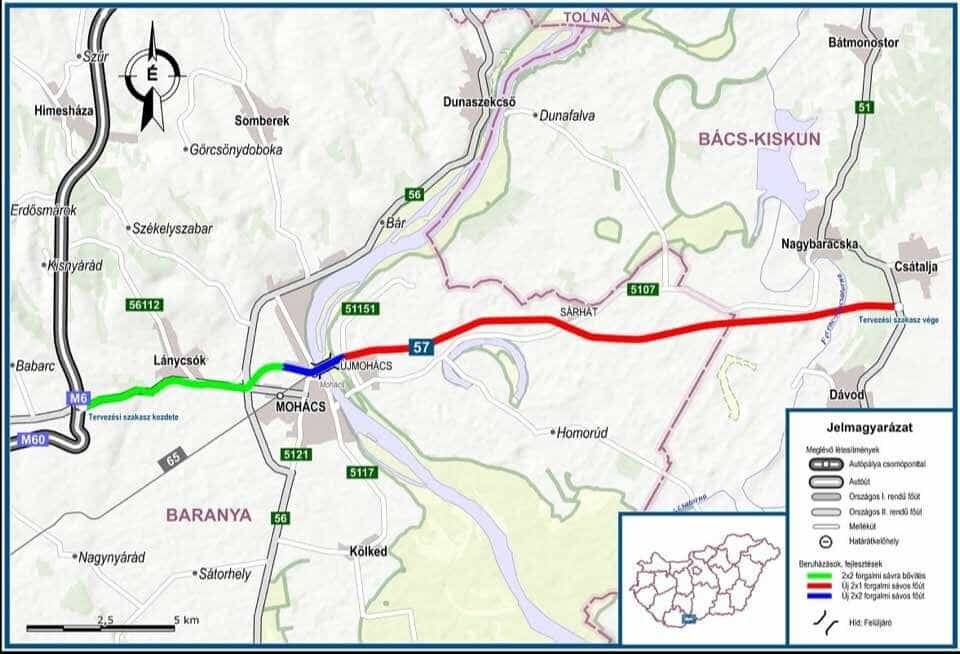
From the perspective of a potential international corridor, it is significant that this project October 2024 and, furthermore, on the Transdanubian section – between the M6 and the Busó roundabout in Mohács – the client and main contractor are already preparing for the technical handover, due to take place at the end of May.
Route 51 can provide the link to the border between Csátalja and Hercegszántó
The next critical point is the development of the 51 main road: preparations are currently underway for the approximately 28-kilometre section between Baja and Hercegszántó, on the Serbian border (of which the stretch between Csátalja and the Serbian border is approximately 12 km – Ed.) according to public data. According to the schedule, the design work is to be completed by next autumn.

According to the project’s plans, the work will involve partly widening Main Road 51 and partly constructing the expressway along a new route. Thanks to the latter, Baja, Bátmonostor, Nagybaracska, Csátalja, Dávod and Hercegszántó will also benefit from bypasses. Of these, Csátalja is of particular importance because it is there that the connection of the Mohács expressway corridor, as detailed above, to the four-lane Route 51 can be realised.
Hercegszántó could become an international transit hub
The transit corridor in question requires a border crossing point between Serbia and Hungary that is suitable for handling international freight traffic. The project to (further) develop the Hercegszántó border crossing meets this requirement; moreover, thanks to a successfully concluded conditional public procurement process, the contractor was already selected in April.
The aim of the project is to enable the crossing to handle the traffic on the transport corridor, which is being expanded to four lanes. To this end, as part of the project
- New traffic lanes are being built to accommodate, among other things, bus traffic, heavy goods vehicles and oversized vehicles,
- parking facilities are being provided, including for heavy goods vehicles carrying dangerous goods,
- Following the demolition of the old buildings, a new main building will be constructed, together with the necessary ancillary buildings.
It is important to note that the border crossing must be constructed with a 2×2+1 lane configuration to meet high-speed traffic requirements. However, as the upgrade of Route 51 is expected to take place at a later date, the contractor must also provide a connection back to the current 2×1 lane configuration at the border crossing.
Serbia is planning a new motorway stretching nearly 200 kilometres
On the Serbian side, the basis for the new alternative corridor could be the „Smile of Vojvodina” project, which has been mentioned several times and which earned its name in the Serbian press due to the ‘smile’ shape it forms on the map.
Under the development announced in 2023, a semi-circular expressway link will be built stretching from Béreg, on the opposite side of Hercegszántó, all the way to Szerbcserény on the Serbian-Romanian border.
The 186-kilometre-long corridor will run perpendicular to the A1 motorway, Serbia’s most important expressway. Starting in the west, the new motorway will run close to the towns of Béreg, Zombor, Kúla, Verbász, Szenttamás, Óbecse, Törökbecse, Nagykikinda and Szerbcsernye, in that order.

Just how much joy can the Smile of Vojvodina bring?
As the first concrete step in the project announced three years ago, a contract was signed in March this year for the preparation of the full design for the 94.2-kilometre section between Béreg and Szenttamás (which will connect the expressway to the A1), as well as for the construction of the road section connecting the Béreg border crossing with Sombor.
The latter 22.8-kilometre (Béreg–Sombor) section is expected to be completed within two years, according to a statement made by President Aleksandar Vučić in March.
In line with the Hercegszántó project described above, the development of the Béregi exit point is also a key step for the Serbs. According to a statement made in 2023 by Goran Vesić, the Serbian Minister for Construction stated in 2023 that „Béreg will become a major and important border crossing, even larger than Horgos.”
Although the Serbian minister’s words reveal a clear strategic vision for transport, the key question in the coming years will be whether these investments – which are at different stages and are not necessarily linked at present – will actually coalesce into a single international corridor. If so, the map of transit traffic between the Balkans and Western Europe could undergo a significant reshuffle for the first time in a long while.
Source: Link







Reconstruction of the M1 motorway’s carriageway towards Győr can begin under the new traffic arrangements

Alpine engineering techniques are also being used to protect the railway in the Danube Bend

Instead of patchwork repairs – large-scale refurbishment work is under way on the dilapidated main roads in the Transdanubia region

The expansion joints on the Buda side of the Erzsébet Bridge were installed overnight

Four new bridges to be built in the heart of the former industrial city

Rain gardens are coming to Budafok, with over 3,000 square metres of green space set to be developed

Contemporary art deco in Csopakon

Safer driving on the motorways: new digital signs for the MKIF
-

 Current at 2026. 09. 09.
A first-hand look at a career in engineering – Duna Group Szabadegyetem is back
-
Climate-X 2026. 09. 09.
Nyíregyháza Spartacus FC goes green – four hundred solar panels to be installed on the stadium roof
-
Bound track 2026. 09. 15.
Nearly 50,000 people travel on it every day – the refurbishment of the Cegléd main line continues
-
Current at 2026. 09. 09.
Rental flats, Rákosrendező, decentralisation – important ideas were put forward on the Real Estate Beach Conference stage