Bound track
Plans are in place to stabilise the embankment along a critical section of the Lake Balaton railway line

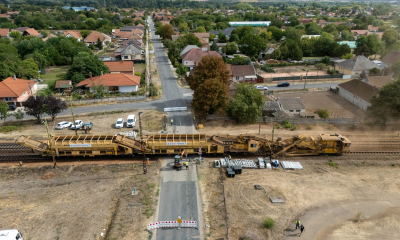
The MÁV Track Operation Zrt. conditional public procurement procedure launched to plan the necessary works on the Csajág–Balatonkenese section of the Börgönd–Szabadbattyán–Tapolca railway line (No. 29). The project concerns the section of track between km 343 and km 350; tenders are invited until 30 March 2026.
The successful tenderer is responsible for preparing all documentation specified in the full design brief, including all necessary plans and tender documents, as well as for conducting any necessary planning permission procedures. The work covers all relevant disciplines and includes the comprehensive development of technical solutions.

Focus on slopes, retaining walls and drainage
The design task focuses on stabilising the embankments along the railway line. The primary objective is to reinforce the sections not covered by geocell protection, as well as to assess the condition of the entire right-hand embankment and determine the necessary measures.
The project involves identifying the causes of damage to the gabion retaining wall and ensuring its long-term stability, as well as restoring the scour and the eroded slope at section 345+51. In addition, the safe drainage of rainwater all the way to the receiving watercourse must be ensured, and any deficiencies in the surface and subsurface drainage systems must be identified and rectified.
As part of the preliminary design, the condition of a retaining wall 3.5–4 metres high is also being assessed, whilst another task involves reducing the risk of landslides on the embankment running alongside the railway, which is up to 20 metres high in places. To this end, detailed geotechnical and hydraulic engineering plans are being drawn up, alongside investigations into the deterioration processes and soil mechanics tests.

The water could be channelled to Lake Balaton
Designers must determine the size of the entire catchment area, the drainage conditions and the volume of water to be drained. They must also examine the route along which the drainage can be implemented all the way to Lake Balaton.
The public procurement contract also includes optional tasks. These include the design of railway track reconstruction should drainage issues make this necessary. In connection with this, the design of telecommunications, power supply and safety equipment (TEB) is also included as a separate option.
An additional optional item is the procurement of any necessary permits and approvals, should these be required for the implementation of these optional works.

A problem that has persisted for over a century on the shores of Lake Balaton
According to a summary in the trade journal Sínek Világa, the Szabadbattyán–Tapolca railway line was opened to traffic in July 1909 as a transport route along the northern shore of Lake Balaton. The soils forming the eastern shore of Lake Balaton are largely characterised by loess. This has caused serious maintenance problems on both the southern and northern railway lines on several occasions.
Following the opening of the railway line, in May 1914 a serious railway accident occurred between Balatonkenese and Balatonfűzfő stations due to the movement of a loess wall. The railway track slid into Lake Balaton along with the shifting loess wall.
The movement of the loess had not yet ceased, so in the 1960s a new track alignment had to be constructed across almost the entire section, encroaching on the lake’s waters. The track stabilised along this section, but between Csajág and Balatonkenese stations, this slow creeping movement still had to be taken into account.
Due to the ongoing erosion of the embankment, this section of the railway line continues to require close attention.
Source: B LinkB










One of Abony’s most important transport routes is to be redesigned

This is how flash floods on the vineyard-covered hills in the Pécs conurbation are being prevented

Order has been restored: production of the new Közlekedési Múzeum can now go ahead as originally planned

We took a look at how the refurbished Igazságügyi palota building turned out

Four new bridges to be built in the heart of the former industrial city

Rain gardens are coming to Budafok, with over 3,000 square metres of green space set to be developed

Contemporary art deco in Csopakon

Safer driving on the motorways: new digital signs for the MKIF
-

 Current at 2026. 09. 09.
A first-hand look at a career in engineering – Duna Group Szabadegyetem is back
-
Climate-X 2026. 09. 09.
Nyíregyháza Spartacus FC goes green – four hundred solar panels to be installed on the stadium roof
-
Bound track 2026. 09. 15.
Nearly 50,000 people travel on it every day – the refurbishment of the Cegléd main line continues
-
Current at 2026. 09. 09.
Rental flats, Rákosrendező, decentralisation – important ideas were put forward on the Real Estate Beach Conference stage