Road building
Flórián Square: large machines were used to grind up the asphalt on the bridge deck

It has been barely a week and a half since the southern bridge at Flórián Square was closed on 1 March, and since then, work has been progressing steadily according to plan. For the time being, the contractor is mainly carrying out demolition work; it was a spectacular process to see how the asphalt on the bridge deck was first scraped off with heavy machinery, according to a statement by the investor Budapesti Közlekedési Központ (BKK). Following this, experts are now conducting a detailed assessment of the condition of the bridge deck so that, based on the results, they can choose the safest and most appropriate technical solution.

The large-scale bridge renovation project in North Buda, which is being carried out by KM Építő Kft. has been carried out, has been reported on several times in our magazine here. The construction plans were prepared by FŐMTERV Mérnöki Tervező Zrt.. Thanks to the information provided by BKK, we can now give details of the work carried out so far:
- the old asphalt pavement was lifted: 10-12 centimetres of rolled asphalt was removed from the southern flyover across its entire width;
- removed the waterproofing of the reinforced concrete track slab, and
- machines were used to clean the surface of the trackbed in preparation for further work.

Detailed assessment of the extent of the damage
After the milling work was completed, the defects of the reinforced concrete track slab became visible. Salt-contaminated water flowing through the damaged insulation damaged the track slab in several places, and in these places the upper ironwork was also corroded. The condition of the track slab, the depth and extent of the damage, is being assessed by the designers and engineers working on the renovation, who will use instruments to measure any salt contamination and determine exactly what repairs are needed.

Repairing the traces of decades of intensive use
The Flórián Square flyovers were last renovated in 2002-2003. They need to be modernised to ensure their safe use for decades to come. Dirt and moisture have affected the bridge mainly at the thermal expansion (dilatation) joints, around the piers and along the roadway curbs.
During the investment, the experts
- the road surface will be replaced;
- correcting defects in the reinforced concrete slab;
- the insulation will be renewed over its entire width, eliminating the cause of the leaks above the pillars;
- a new reinforced concrete kerb will be built, on which a new, safer guardrail will be installed;
- a new expansion structure and anchorage will be installed at both ends of the bridges;
- repairing defects in the drainage system, the stone pavements of the bridge piers and the concrete surfaces of the piers, head beams and abutments, and
- special attention is also paid to the integrity of archaeological finds.

Overhaul of over 40-year-old flyovers has become unavoidable
The technical condition of the structure has made it necessary to renovate the Flórián Square flyovers. The modernisation, which will take almost a year, aims to ensure that the road section, which plays a significant role in the transport of the capital and the agglomeration, can be used safely for decades to come.

The technical condition of the flyovers has deteriorated significantly since their last upgrade: they are damaged by dirt and moisture, the structure is soaking around the piers, causing the reinforcing steel to rust and the concrete surfaces to deteriorate. BKK stresses in its statement that, as the investor and the capital's transport manager, it will do its utmost to continue to serve the needs of users as best it can during the renovation, which is expected to last until spring 2026, while at the same time providing the necessary space for work.
Source: Link

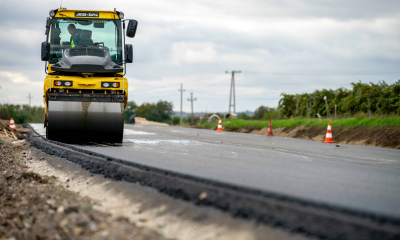




It’s time for a refurbishment: HEDO is carrying out work on one of Miskolc’s key transport routes

Four ‘1’s in a row: Esztergom’s transport headache has been resolved

The care home in Fertőd is to be refurbished

An innovative, distinctive PHOENIX Logistics Centre has been established in Győr: the Óbuda Group has reimagined the spaces for pharmaceutical logistics

Rain gardens are coming to Budafok, with over 3,000 square metres of green space set to be developed

Four new bridges to be built in the heart of the former industrial city

Contemporary art deco in Csopakon

Safer driving on the motorways: new digital signs for the MKIF
-

 Kirakat 2026. 10. 01.
A leading machinery distributor in the construction and haulage sectors is building a new service centre and extending its existing premises
-
Railway development 2026. 09. 29.
The railway line leading to the Hungarian border is also set to be upgraded as part of Croatia’s large-scale development programme
-
Current at 2026. 09. 30.
It’s being built at full speed and could be the saviour of our domestic energy security – what is it?
-
Industry news 2026. 10. 02.
Hungary has joined the single electricity market