
Railway development
Romania’s most complex infrastructure project can go ahead

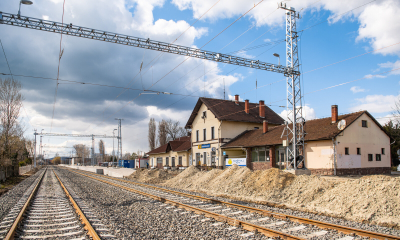
A comprehensive refurbishment of the approximately 113-kilometre-long, double-track, electrified railway line has been underway since 2020 between Brașov, with a population of 208,000, and Sighișoara, with a population of 24,000. This is one of Romania’s most complex infrastructure projects, as this section of the Main Line 300 is a key element of the TEN-T trans-European network – specifically, the Rhine–Danube and the Baltic Sea–Black Sea–Aegean Sea corridors – yet the project faces numerous challenges – ranging from topographical conditions to financing. The modernisation will eliminate a critical bottleneck on European rail corridors and will also strengthen Romania’s links with the international network.

New funding could give the project a further boost
The total investment will cost 2.25 billion euros, and its implementation is now being supported by Európai Beruházási Bank (EBB) is currently providing €630 million in funding.
The aim is to achieve a travelling speed of 160 km/h for passenger trains and 120 km/h for freight trains, which far exceeds the capabilities of the current track – built as far back as the 19th century, running alongside river valleys and full of tight curves.
Consequently, radical engineering work was required in the hilly and mountainous terrain. Due to the large curve radii required for the new speed, dozens of new railway bridges and steel and prestressed reinforced concrete viaducts are being built over the tributaries of the Olt and Küküllő rivers and across the deep valleys, fundamentally reshaping the railway geometry of the region.

Two tunnels are needed
Construction is taking place in three stages: on the two outlying, gentler sections – the Brașov–Apáca and Kaca–Sighișoara sections – the Alstom–Aktor–Arcada consortium is making good progress with the embankment and structural works, and certain sections have already been opened to traffic.
The greatest challenge, however, is the central mountain section between Apáca and Kaca, where a completely new route is being built.
Here, two large-scale twin tunnels are being constructed using TBM shields: the Ürmösi tunnel will be approximately 6.9 kilometres long, whilst the Homoródi tunnel will be approximately 5.1 kilometres long. Although the works are significantly behind schedule due to the transport and assembly of the TBMs at the site, bureaucratic difficulties and geological conditions, full completion is currently expected by the end of the decade, in 2029.
The whole region will feel the difference once it’s finished
Once it has been handed over, the line’s capacity, journey time efficiency and safety will increase dramatically. The railway line will enable the safe and reliable operation of up to 29 passenger trains and 22 freight trains per day, which could ensure that 4 million passengers and 6 million tonnes of freight reach their destinations more quickly each year. The modernised infrastructure will not only provide a competitive alternative for passenger transport, but will also significantly facilitate the environmentally friendly shift of freight transport from road to rail.
Source: Link




Seven railway stations around Lake Balaton are to be refurbished

It will be easier to reach the southern cellars in Villány

The cream of three industries in one place: the HOMEINFO Építőipari, Faipari és Kertépítő Mester Workshow is coming!

Duna Aszfalt paid more than 10 billion forints in interest to state-owned banks

Rain gardens are coming to Budafok, with over 3,000 square metres of green space set to be developed

Contemporary art deco in Csopakon

Four new bridges to be built in the heart of the former industrial city

Safer driving on the motorways: new digital signs for the MKIF
-

 What is being built? 2026. 08. 06.
Paks II.: What does the new milestone for Unit 5 mean in the context of the review?
-
Industry news 2026. 08. 06.
Four giant cables are linking the electricity grids of Spain and France beneath the seabed
-
Bound track 2026. 08. 17.
New pedestrian crossings and a junction with traffic lights are being built in Angyalföld
-
What is being built? 2026. 08. 06.
The development of the road and utility networks for the logistics base near Liszt Ferenc Airport has been completed


