Current at
How sustainability becomes the driving force behind a hotel

Hotel Gerardus, a 19-month project of the Diocese of Szeged-Csanád, has been awarded the LEED Silver certification.The hotel in Szeged, inaugurated last August, was implemented under the management of Óbuda Group, while the company was also present as a sustainability consultant from the preparation of the project until the post-consecration period. The general contractor for the project was Market Építő Zrt..
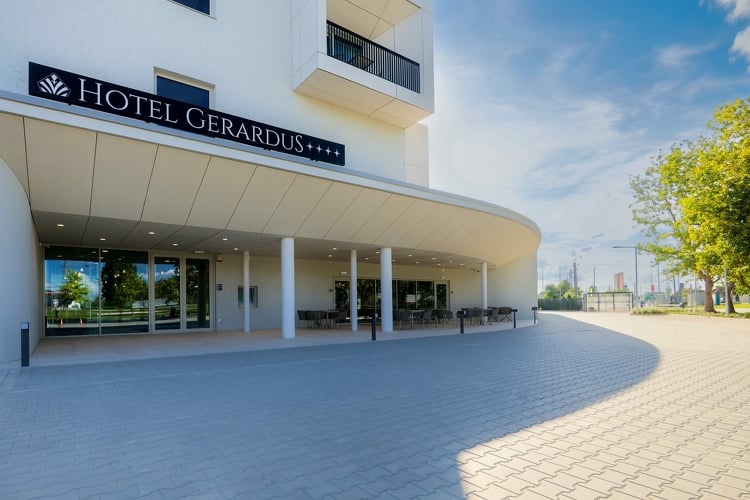
Sustainability ratings are still rare among hotels in Hungary - currently only four new-build hotels in Hungary have a LEED rating. We talked to three key players in the development about the most interesting details of the project at the four-star, 50-room hotel.
On the investor side, Dr. László Kiss-Rigó, Bishop of Szeged-Czanád; Adám Müller, Project Director of Óbuda Group, was asked to present the project manager's perspective; while Barnabás Herényi, Sustainability Team Leader of Óbuda Group, gave details about the LEED certification itself.
In addition to the hundreds of football fans, event participants also use the
László Kiss-Rigó said that the hotel was built as part of the St. Gellért Forum, a sports complex in Szeged, which covers an area of almost 10 hectares and also houses a stadium with 8,200 seats. "We designed the complex to be a venue for cultural, family and community events in addition to sports. In addition to the stadium, the complex also includes various sports fields, a multifunctional hall and an amphitheatre, as well as a gym and a playground."

He said that the Szent Gellért Forum is regularly used not only by 300 students of the Szeged-Csanád Grosics Football Academy, but also by participants of various events. He added that, in the spirit of sustainability, a solar park was also built on the site, which started operating in May this year.
The bishop stated that the design of the hotel had been an integral part of the concept described above from the very beginning, so that guests could be accommodated in an environment that matched the standards of the Forum. He also mentioned that sport plays a prominent role in the hotel's operating strategy. „Already the opening of the Szent Gellért Forum in 2019, several foreign football clubs expressed their interest in coming to us for training camps, so after the hotel's opening, the complex will now be able to meet this demand as well.”.
In the year since the project was handed over, the investment has been a success and the feedback from guests has been positive.
In addition to various clubs and sports associations, national teams of all ages also come to the hotel and its sports complex. The Turkish top football team Trabzonspor will soon be coming for an extended training camp,"
Even within the constraints of the framework, sophisticated solutions were found
An important objective of the development was to bring all actors from the designer to the operator into the project as soon as possible. The investment was implemented under the Design & Build construction: "We contracted the main contractor Market Építő Zrt. for the completed permit designs, and the preparation of the final designs was carried out with the participation and input of all project participants," said Adam Müller. "The early involvement of the operator was an important element to ensure that the investor would end up with a building that they could operate according to their own habits and expectations."

He mentioned the interior design process as an example of constructive cooperation. "During the project, both the designers and the interior designer adapted well to the constraints and the budget, and within this framework they created sophisticated solutions."
Soon after the treaty was signed, war broke out
The project management team paid close attention to the construction process, striving to ensure that the project met both the client's and the designer's expectations as well as possible, and was delivered on time and within budget. "It should be added that the routine and adequate experience of the main contractor, Market Építő Zrt.'s professionals, also contributed to the successful and timely completion of the project," said Adam Müller.
The contractor also managed well the effects of the Russian-Ukrainian war that broke out two months after the project contract was signed. "There were times when, due to the high price volatility, insulation materials had to be procured well in advance and stored on site, which caused organisational difficulties. Among other things, the project schedule was not compromised because of this foresight. At the same time, we needed a project team pulling in the same direction to manage this well together." - added the project director.
The presence of the operations team also helped a lot
"It is always a great advantage if the operator is involved in the project from the very beginning, and this is what happened here, as the investor involved the team from the beginning," said Ádám Müller. "And they were actively involved from design to implementation, so the house could be tailored to the user."

Another important factor, Adam Müller added:
"Throughout the process of obtaining the sustainability certification, the investor supported the project, stressed its importance and proactively participated in the coordination and decision-making process."
Focus on protecting creation through sustainability measures
László Kiss-Rigó emphasized that the hotel project was a close cooperation between the designer, the contractor and the contractor, and they are very satisfied with the result as investors.
An important background to the certification is that the convention centre and stadium previously built in the complex are both LEED Silver certified, as is now the hotel itself. "The joint work on the hotel was another stage in many years of cooperation," said László Kiss-Rigó.
He stressed that, in hindsight, he is very pleased that the decision to obtain the qualifications was taken as an investor.
"This is important not only because sustainability has become a trend, but also because of the basic approach of our diocese. We see this as a way of protecting creation, being responsible users of nature in accordance with the Creator's will, and this fits perfectly with what the LEED certification means."
The qualification objectives must be defined
Barnabas Herényi also gave us details of Óbuda Group's role as sustainability advisor. "First, we helped set the certification targets and define the exact technical content needed to achieve them." The targets set for the certification included water efficiency of sanitary ware, preparation of construction waste for recycling, but also careful commissioning and control of the building's energy and water consumption systems.
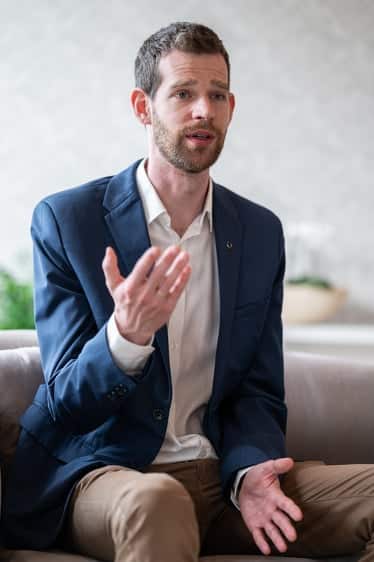
However, the entire rating process was also managed by Óbuda Group, with an external third party, the US Green Business Certification Inc., deciding on the rating.
The LEED helps you break out of the patterns
In the interview, we also went over the basics of the LEED Silver sustainability rating: Barnabás Herényi said that LEED is the most widely used green building rating system in the world.
"It defines and assesses sustainability as a complex entity, while its criteria go well beyond energy efficiency. It extends to land use, sustainable transport, water efficiency, materials use and waste management, among others."
He stressed that many of the criteria are already met by the choice of the location of the project: "For example, the accessibility of the site to public transport and services, or the fact that the project is being built on an already built-up area, so that green areas are not lost."
Barnabás Herényi drew attention to a lesser known aspect of sustainability. "For sustainability, it is also very important that a construction project breaks out of the usual patterns," the sustainability team leader of Óbuda Group pointed out.
"Normally, someone will prepare the design programme and then someone will design the building completely independently. Then a contractor is hired, again without having had a say in the earlier phases of the project, and finally someone takes over the building to run it," he said, describing the classic process. "By contrast, LEED envisages involving stakeholders in the design from the very beginning and letting them represent their point of view throughout. This saves a lot of money and energy."

Adam Müller added that the qualification process does not end with the completion of the project. "After the project was closed, the documentation was compiled and ready for submission. And after the submission, we received several more rounds of questions from the US organisation, which we had to answer in order to issue the certification."
Had to wait for actual data to qualify
Energy issues have been a key focus in achieving the LEED certification. The hotel is largely heated by the thermal well located in the St Gellért Forum area, but the same renewable energy also provides part of the heating needs for the sports fields, the stadium and the event centre.
As the buildings of the St. Gellért Forum, which have been previously handed over, are also certified LEED Silver, the certification body was careful not to double count the positive impact of the thermal resource in the scheme. "For this reason, it was a key requirement to determine how much of the renewable energy produced by the well actually reaches the hotel, as this was the only amount that could be taken into account in the certification," said Barnabás Herényi. "In the end, we were able to determine the amount of renewable energy actually used by the hotel based on the consumption, outdoor temperature and hotel occupancy data measured by the installed meters, as well as other operator experience."
The above calculation had to wait until actual operational experience and data were available. This has led to a relatively long certification process, but also shows the rigour of the certification: after the project was closed in August last year, the hotel was only awarded the LEED Silver certification in April this year.
Outstandingly high recycling rates were recorded
The overall result showed that the heating needs of the building are largely covered by renewable energy sources. Barnabás Herényi pointed out that the use of thermal wells not only significantly reduces the environmental impact, but also the costs.

The Szeged project is also exemplary in another sustainability aspect:
"The recycling of construction waste generated during construction was also exceptionally high, exceeding 90%. This is a direction to follow as it serves the transition to a circular economy."
Sustainability does not stop at environmental impacts
Although the hotel project has achieved excellent results on these two points, Barnabás Herényi pointed out that in order to achieve the LEED Silver rating, it had to perform in all the relevant areas. "This includes the water efficiency of the irrigation system and equipment, the thermal insulation of the materials chosen, the green roof of the building, or the fact that the green surface vegetation has a very low irrigation requirement."
Although few people know it, sustainability for the LEED rating does not stop at environmental impacts.
"At least as important is that the users of the building feel comfortable in it: this includes indoor air quality, thermal and visual comfort, among other things," Barnabas Herényi told us.
The art of constant balancing
Ádám Müller pointed out that the close cooperation emphasized several times during the interview was also of paramount importance during the project management, because in some cases compromises were necessary to meet the LEED requirements. "An example is light pollution, where LEED requires that no more than a specified luminous flux should cross the site boundary. This had to be taken into account for both the logo and outdoor lighting. It is obviously in the interest of the investor that the logo should be as bright and visible as possible, so in this case too we had to find solutions that would serve the interests of the investor but also meet the requirements of the certification."

In conclusion, Barnabás Herényi added that it is not uncommon for sustainability considerations themselves to clash with each other. "If, for example, we increase the amount of fresh air blown in, improving air quality, the energy values deteriorate. But if we want to improve energetics, we may have to compromise on other areas of sustainability. Hence, sustainability management is a complex optimisation process aimed at finding the right balance."
Source : Link








The first municipal thermal power station in Transylvania is under construction

A huge brush was driven through the Sopron tunnel on the M85 – with video

The town centre on the banks of the Tisza is being regenerated

The Market has fulfilled its promise: it has delivered the 10,000 tonnes of natural stone offered for the raising of the bottom sill at Paks

Rain gardens are coming to Budafok, with over 3,000 square metres of green space set to be developed

Contemporary art deco in Csopakon

Four new bridges to be built in the heart of the former industrial city

Safer driving on the motorways: new digital signs for the MKIF
-

 Industry news 2026. 08. 18.
Students were introduced to the high-tech construction industry at BME’s field camp in Göd
-
Bound track 2026. 08. 17.
New pedestrian crossings and a junction with traffic lights are being built in Angyalföld
-
What is being built? 2026. 08. 18.
Hungary’s new McDonald’s restaurant has moved into a modernist listed building in the centre of Budapest
-
What is being built? 2026. 08. 18.
New paving, a playground and visitor facilities are being planned for the Várkör area in Pannonhalma