Current at
The Paks II project attracted him to Paks

Róbert Bohus carried on his parents' legacy when he graduated from the Ybl Miklós Technical College of Civil Engineering with a degree in civil engineering, as his grandfather worked as a design engineer and his father as a chemical engineering technician. "I was good at physics, mathematics and freehand drawing"," he says, explaining why he chose engineering, adding that he had already learned project management and scheduling in the subject of organisation at the college. He spent his summer internship at the construction of a plant at the refinery in Hundred Halombatta, and from there he worked almost directly for the Danube Petroleum Company, where he joined the investment department in 1991, first as a technical inspector and then as a project manager. In total, he worked for thirty-three years on the project, in the last years as project portfolio manager.
Between 1998 and 2000, he participated in a Phare programme of the BME, the University of Economics and Business and the French ESSEC, and obtained a diploma in real estate management. It was here that he was introduced to the economic and financial aspects of projects, which, in addition to his engineering skills, were essential for his work as a project manager.
From this period, he fondly recalls the years 1998-2000, when he was involved in the construction of the MOL2000 fueling stations. Under his coordination, tanker filling stations and rail filling stations were built all over the country, but his favourite project was the MOL Austria logistics base in Korneuburg, where an old, disused site was completely renovated from the ground up.
Róbert Bohus believes that problems are a natural part of any investment, and he sees the beauty of project management in working with the right people to solve them."It's a team effort, a team to hold together, to manage, to drive to the goal, and for that open and honest communication and problem-solving thinking are essential" - he summarises his guiding principles.
When he was managing an investment project in Pécs, he would drive along Route 6 and watch the Paks Nuclear Power Plant – which he considered a tremendous engineering feat – and learned about its expansion from newspapers and television. The project had been a constant topic of discussion among his colleagues in recent years, as it was the largest investment in the region and had an impact on the local labour market. In March this year, he joined the team of nuclear power plant builders at the invitation of a former manager, Paks II. Zrt..

There are many similarities and at least as many differences between his previous and current work. According to Róbert Bohus, the corporate environment is similar, and as a programme element officer in Paks he mainly coordinates the construction of certain buildings and structures. "We also built a fire barracks in Tiszaújváros, for example, because of the expansion of MOL Petrolkémia, and now this is one of the many tasks here, too, he adds. He is taking on three different areas at once: network connectivity, nuclear security and defence facilities programme elements. The ability to continue working with foreign partners also played a big role in his decision. In his previous jobs, he has learnt the importance of taking on experience from abroad, working with foreign experts and learning international practices to develop our knowledge and skills.
Although he is not responsible for the nuclear field, as an engineer he is fascinated by the complexity of nuclear energy and nuclear power plants. "There's a reason why people say 'It's not nuclear physics' to the simple things," he says. Asked who makes a good programme manager, he says the profession requires a high degree of flexibility, a willingness to compromise and a high dose of creativity, while of course adhering to a set of rules in a fast-changing environment. For him, the first moment of encounter is the most exciting moment in a project or programme element. Once it's done, he's ready to move on to the next project at the handover ceremony.

Source : Link


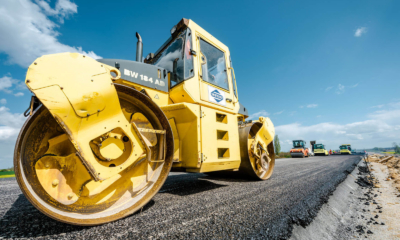


Roadworks are taking place at 15 locations in Balatonfüred

SWIETELSKY is inspecting and repairing the surface defects on Main Road 25

Pécs, Gödöllő and Budapest: four SPAR stores have been refurbished – here’s which ones

They could reshape the historic city centre, transport in the suburbs and even a unique public park in Székesfehérvár

Rain gardens are coming to Budafok, with over 3,000 square metres of green space set to be developed

Four new bridges to be built in the heart of the former industrial city

Contemporary art deco in Csopakon

Safer driving on the motorways: new digital signs for the MKIF
-

 Bound track 2026. 10. 07.
Aurora beneath the Apennines – Another tunnel is being built on the Naples–Bari railway line
-
Road building 2026. 10. 13.
A consortium comprising STRABAG and Duna Aszfalt has been awarded the contract to build the North Macedonian motorway
-
What is being built? 2026. 10. 09.
One of Budapest’s oldest nurseries is being renovated whilst preserving its timber roof structure
-
Current at 2026. 10. 10.
„The focus will not be on Lean’s equipment, but on how we operate” – the ‘Lean in the Construction Industry’ conference in November