Industry news
From mine to finished buildings - a unique company model in the domestic construction industry

At the Mining Conference of the Hungarian Chamber of Engineering, Márton Koprás, Investment Director of Bayer Construct Zrt. presented the milestones of the unique business model in Hungary. The 100% Hungarian-owned company has two main areas of operation: Hungary and Transylvania. From a former structural engineering profile, Bayer Construct has gradually grown to the point where today its gravel quarries serve the company's concrete factories, which provide raw materials for its prefabrication plants, from where the products are delivered to the project sites.
Keeping the property development process in-house allows resources to be reallocated when needed, construction schedules to be met, effective in-house communication and the high quality that Bayer Construct represents.

Photos by Mihály Erdei/magyarepitok.hu
At Bayer Construct, they believe in prefabricated construction
Speaking at the conference in Soskút, the director explained that the company believes in prefabricated construction, a technology that reduces the need for on-site work to a fraction of the cost while maintaining high quality. The concrete walls, slabs and beams are made using raw materials extracted from the group's mines. The new trend is to build complete bathrooms and fitted bathrooms at the same time as the structural works.

Two gravel pits serve the concrete factories
The growing demand for concrete in the construction industry has encouraged the group to enter the mining industry to supply raw materials for its concrete factories and to build up this business. Bayer Construct's concrete factories in two locations in Hungary are supplied with raw materials from the gravel quarries in Kishunlacház and Irtándi, which are operated as subsidiaries. Márton Koprás said: in 2021, the new quarries were built from scratch on the site of arable land.

Environmentally responsible mining
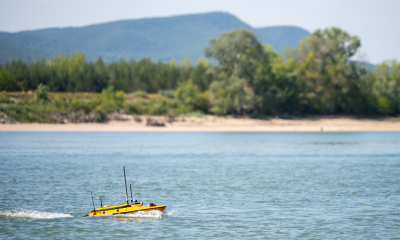
About the technology used in the two mines, the director said:Artándon the suction dredger works at a depth of 25-26 metres, the material is spun on a dewatering wheel and conveyed to the shore on conveyor belts, where it is washed and sorted and then used in factories less than five kilometres away.
In Kiskunlacháza the thinner gravel layer means that dredgers do not have to work deeper than 20 metres. One of the prides of this plant is the Fiebig suction dredger, specially built for this mine in Germany. The machine is almost entirely automated and powered by electricity.
From the dewatering wheel mounted on the boat, the earth moist material is transferred to the shaking table and then to the water conveyor. The extracted mineral is dewatered and reaches the shore, where a conveyor belt, also electrically driven, transports the raw material to the depot.
From the depth of the water, the gravel is transported to the classifier without releasing any pollutants, where it is washed through the machine and sieved into different fractions. The quarry products have a wide range of uses, from concrete as a raw material to road and utility construction, gardens and parks.

Photo by Mihály Erdei/magyarepitok.hu
Ten million year old mineral wealth
A mine visit to the Salskút unit was also organised for the participants of the miners' conference. Tamás Demeter, manager of Kvarchomok Kft., presented the history of the mine and the recent technological developments.
The mineral wealth of the sóskút mine is sand with a grain size of 0.1-1.0 mm, formed and deposited in the Pannonian river delta (a stage of the Miocene period 23.03-5.333 million years ago). The high-purity, rounded-grained mineral, which contains no organic sediment, was discovered in the 1920s and was once mined in underground workings. Since the 1970s, the mineral wealth extracted by surface extraction has been exploited on an industrial scale. Kvarchomok Kft. was acquired by Bayer Construct Zrt. in the early 2020s, following the retirement of its previous owners.

The mineral wealth of the Salskút mine is enough for decades
The stock, says Tamás Demeter, is several million tonnes, of which 50-60 thousand tonnes are sold every year. The managing director of Kvarchomok Kft. added that 12 hectares are extracted with the help of a crawler excavator. With the current annual output, the mine will provide sand for the construction industry for about 20 years, with the potential to expand by another 50 hectares or so.
The sand extraction is followed by a gravel separation process, and then, in the sand washing plant section, the bentonite clay is separated from the sand by water washing - countercurrent floatation. The washed sand is sent to the drying drum in the natural gas plant, where it is screened and stored in closed silos until sale. The sand is sold in bulk or in 25 kg or 1 tonne big-bags.

Environmentally conscious capacity building
The Kvarchomok Kft. has built a new sand washing plant section, which has achieved a tenfold increase in capacity and higher quality of washed sand production. The latter factor also holds the potential for market expansion. The investment has also reduced the need for live labour at the mine, replacing the previous three-shift production, which is now sufficient to work eight hours a day.
In the development of the mine, it was important to reduce the environmental impact, so the transport of sand by truck was replaced by transport by conveyor belt (rubber belt).
From transport to water filtration, sand from Salskút is used
Due to the fineness and production costs of the Sorskút sand, it cannot be used in conventional concrete products. The 80-100 thousand tonnes of quartz sand extracted annually is used as a raw material for the production of tile adhesives and grouts, as well as for the production of substrate levelling compounds. The rounded grains of sand are also used for filtering drinking and industrial water and in swimming pool equipment. In transport, sand from Salskút also helps to brake vehicles on rails.
Source : Link








The town centre on the banks of the Tisza is being regenerated

The Market has fulfilled its promise: it has delivered the 10,000 tonnes of natural stone offered for the raising of the bottom sill at Paks

The construction industry is both vast and marvellous – the Duna Group Szabadegyetem has been launched

ESG is now a business issue for suppliers in the construction industry too

Rain gardens are coming to Budafok, with over 3,000 square metres of green space set to be developed

Contemporary art deco in Csopakon

Four new bridges to be built in the heart of the former industrial city

Safer driving on the motorways: new digital signs for the MKIF
-

 Industry news 2026. 08. 18.
Students were introduced to the high-tech construction industry at BME’s field camp in Göd
-
Bound track 2026. 08. 17.
New pedestrian crossings and a junction with traffic lights are being built in Angyalföld
-
What is being built? 2026. 08. 18.
Hungary’s new McDonald’s restaurant has moved into a modernist listed building in the centre of Budapest
-
What is being built? 2026. 08. 18.
New paving, a playground and visitor facilities are being planned for the Várkör area in Pannonhalma