
Industry news
Another award for the museum building inspired by the Cardinal's mantle

By ZÁÉV Építőipari Zrt. – Konkrét Stúdió Architecture Kft. and TSPC Engineering Office – a plaque commemorating this prestigious award was unveiled today on the wall of the building. The museum had previously won the 2023 House of the Year public award and also received a special award from the Media Architecture Awards.

The Mindszentyneum commemorates its namesake, who between 1919 and 1944, in addition to serving the parishioners of Zalaegerszeg as a parish priest, was an active participant in the social life of the town and the surrounding area. An exhibition on the life of the Cardinal, Archbishop of Esztergom and Prince Primate of Zalažerszeg was held on the first floor of the museum. The exhibition presents not only the late archpriest's ecclesiastical career, but also Mindszenty as a man. The museum's other permanent exhibition is dedicated to the persecution of the church by the communist dictatorship.

The building won the prestigious award in the twenty-fourth edition of the Construction Excellence Award competition, founded by the Board of Trustees of the Construction Excellence Award Foundation (ECA), Építési Vállalkozók Országos Szakszövetsége (ÉVOSZ) and the Building Science Association, and later joined by seven other professional organisations. Today's ceremony included the inauguration of the award plaque.

Mindszentyneum is the first Building of Excellence building in the city
Jenő Kontra, member of the Jury of the Master of Architecture Award of the Foundation, in his welcome speech praised the thoughtfulness of the design and the high quality of the execution, which is in line with the noble content of the interior. He stressed the museum's complex mission, both in the local cultural life, with the exhibition of archaeological remains, and at national level, as a valuable and outstanding part of national memory, presenting the Cardinal's life story. Jenő Kontra emphasised the institution's niche role and the undeniable martyrdom and martyrdom of Mindszenty.
"The Cardinal stood up not only for human rights, but for more than that, under both dictatorships. He fought for justice."
József Dormán, deputy general manager of ZÁÉV, presented the technical parameters of the building in detail. Among other things, the five-storey building, 12 metres 12 centimetres high, was constructed with 5,860 cubic metres of excavated earth, 492 tonnes of reinforcing steel and 4,000 cubic metres of concrete. The representative of the company emphasized that they are proud to have been the first winner of the Construction Industry Award of Merit in Zalaegerszeg, the 18th award in the history of ZÁÉV.

"The value of this award is particularly enhanced by the fact that it is donated by the profession to the profession" - said Gábor Kovács, the honorary chief notary of the city of Zalaegerszeg, in his speech of welcome and thanks to all the project's contributors.
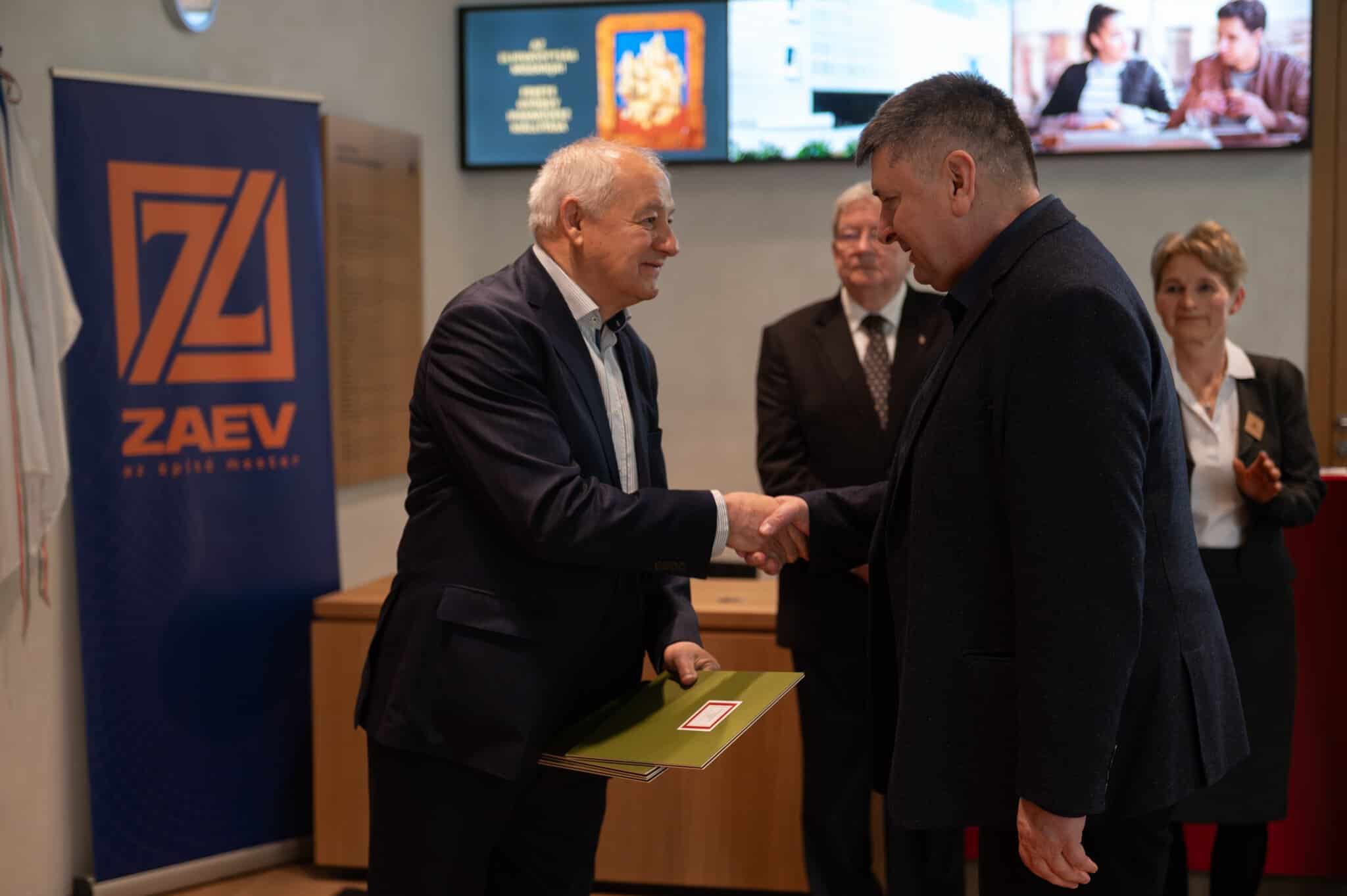
At the ceremony, the award founders presented the certificates of recognition to the representatives of the designers, the contractor and the subcontractors ZALA-ELEKTRO Épületvillamossági, Szerelő és Szolgáltató Kft., Kozma Kft., Éptak '95 Kft..

A modern building at the service of preserving the past
The greenfield project ZÁÉV, a building of more than 1200 square metres with a basement + three floors and an attic, provides a suitable environment for temporary exhibitions, cultural programmes, museum education and restoration work, in addition to permanent exhibitions. It is built on a reinforced concrete slab foundation, with a slotted wall work pit boundary, a load-bearing reinforced concrete pillar frame, monolithic and precast reinforced concrete wall beams, and a monolithic reinforced concrete flat slab floor.

The façade bears the message of Mindszenty's cardinal's mantle
The external design of the façade carries a number of messages. The specially coated aluminium slats act as a semi-permeable membrane, both blocking and allowing light and noise to filter in and prying eyes to peer into the purist interior. A communiqué issued by TSPC on the occasion of the inauguration makes it clear that the building's cloak is a reflection of Mindszenty's silk and lace cardinal's cloak. As they put it, it also symbolizes that "Mindszenty undertook to defend the Church, even at the cost of his life."

More than an exhibition space: the Mindszentyneum educates and saves value
On the ground floor there is a foyer, ticket office and gift shop, as well as two smaller sectional rooms and an event space for 120 people. The first and second floors house the permanent exhibition, film projection and museum education rooms. The attic is used for temporary exhibitions. The museum also has a surface car park for 99 cars and 3 buses.

| Mindszenty, the builder |
|---|
| Mindszenty was a student at the Premontrian gymnasium in Szombathely, and after completing his theological studies, he was ordained a priest in 1915. He was transferred to Zalaegerszeg, where he served the church and the community as a religious teacher and then as a parish priest from 1921. Thanks to his involvement, the Franciscan church and convent, the motherhouse of the Sisters of Notre-Dame and the teacher training college and school were built in the town. The parish priest has created a charity home for the needy. He was also involved in the creation of the Göcseji Museum. In his diocese, he had 19 new churches, seven parish buildings, nine places of worship and 12 schools built. In 1944 he was appointed Bishop of Veszprém, protesting against the deportation of Jews. After the World War he protested against the establishment of the proletarian dictatorship, and in 1948 he was arrested again on trumped-up charges, tortured and sentenced to life imprisonment. He was released from prison during the 1956 revolution and fled to the American embassy to escape the Soviet troops who crushed the resistance, and in 1971 he was allowed to leave for Vienna with the Pope's help. For four years until his death, he served Hungarians around the world, strengthening them in their faith and Hungarianness. In 1991, in Esztergom, a huge crowd accompanied him on his final journey to his final resting place. |
Source : Link







The STRABAG in Szombathely prevented the release of asbestos-containing dust using a special sealing layer

Stones of the past, solutions for the future – Saving the stone walls of the Citadel

The replacement of the expansion joints on the Erzsébet Bridge is continuing with the third phase

Up to 1,500 cubic metres of concrete are being poured in each phase of the Paks expansion

Hungary's biggest motorway upgrading programme is underway

Perhaps the world's most elegant McDonald's restaurant opens in Budapest

Szeged to become one of Europe's leading industrial centres with the construction of the BYD factory, the city strengthens its position with a worthy investment package

Viablokk porous concrete masonry element from a Hungarian factory, as a Hungarian product, is set to conquer the world
-

 Bound track 2026. 04. 10.
This is how they pulled out the ‘fang’ of the derailed railway section in Transdanubia – with photos
-
Bound track 2026. 04. 10.
Planning can begin – the M2 line could be extended to Cinkota, and the HÉV lines could be upgraded
-
Bound track 2026. 04. 10.
The largest domestic railway development project to date is set to begin
-
Industry news 2026. 04. 10.
Rubbish equivalent to the weight of nearly 2,000 cars has accumulated on the country’s motorways over the course of a year


