
What is being built?
Nearly 5700 soil clods hold up the slipped bank at the Tisza

A ceremony was held to mark the completion and inauguration of the reinforced Tisza barrier in the Tiszavárkony area. The National Directorate General for Water Management has published a detailed report on the project, which was carried out in a scenic bend of the Tisza, but in a location that is both hydraulically and geomorphologically unfavourable.

The Tisza is flooded
In October 2019, the experts of the Central Tisza Water Management Directorate (KÖTIVIZIG) detected a significant bank slip on the outer curve of the river bend at the high bank protection line at Tiszavárkony.

Significant fluctuations in water levels in recent years have accelerated the deterioration of the dam, over a stretch of about 500 metres. The process has become so severe that it has threatened the inhabitants of Tiszavárkony, Tiszajenő, Vezseny and Jászkarajenő, which are located in the floodplain. The KÖTIVIZIG ordered a point flood protection alert level III from February 2020 on the indicated section.

The preparation and planning of the restoration work was carried out by the OVF and VIZITERV Eniron Kft.. The construction was started in April 2023 by Békés Drén Kft., which was selected at the end of the public procurement procedure. The reinforcement of the main defence line was hampered and delayed by the prolonged flood that began at the end of 2023, which inundated the work area for months.
The deep layer of material caused the beach movement
The source of the problem has been identified. Soil mechanics explorations revealed that the main cause of the shoreline movements was soft clay at depths of 11-12 metres.
The experts chose three types of technical intervention among the proposed solutions.
A new technological solution in our country
A total of 5,697 georods, each 17.7 metres long, were pressed into the ground. This can best be thought of as a downward-facing wire brush with nearly 5,700 bristles of hairs reaching down into the depths.
The special feature of the project is that this technological process was new in domestic application.
A 500 m long horizontal reinforced concrete plateau had to be constructed on the slope, from which 15 cm diameter georods (soil nails) were injected into the sub-base layer, for a total length of 91580 fm. This method shortened the construction time and provided a definitive solution for stabilising the beach.

Three different mechanical methods have been used to tackle coastal degradation
In addition, bank protection solutions with stone armouring, stone spraying and Reno-matrac construction have been developed in the embankment. These have been used to stabilise the moving, slip-affected shoreline, providing adequate protection against continued bank erosion due to adverse curving parameters.
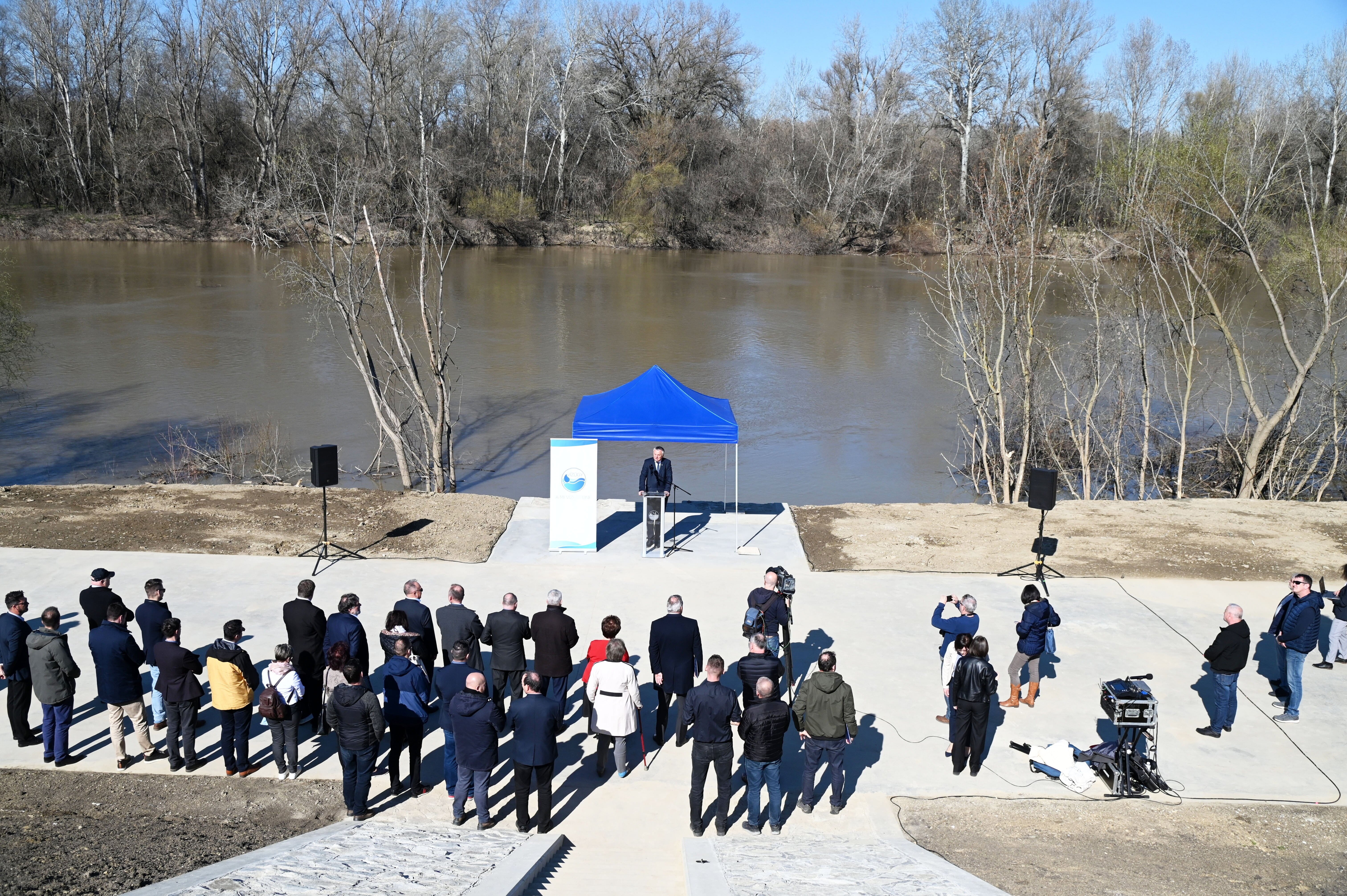
The new dam will also serve community and tourism purposes
The project has significantly improved the safety of Tiszavárkony, and a new promenade has been built on the waterfront, which serves community and tourist purposes.
The ceremony was attended by Mária Kállai, Member of Parliament of the region, V. Zsolt Németh, Minister of State for Water Management at the Ministry of Energy, István Láng, Head of the National Water Directorate General, Attila Lovas, Director of KÖTIVIZIG, and Sándor Barkász, Managing Director of the contractor Békés Drén Kft..
Source : Link







The STRABAG in Szombathely prevented the release of asbestos-containing dust using a special sealing layer

Stones of the past, solutions for the future – Saving the stone walls of the Citadel

The replacement of the expansion joints on the Erzsébet Bridge is continuing with the third phase

Up to 1,500 cubic metres of concrete are being poured in each phase of the Paks expansion

Hungary's biggest motorway upgrading programme is underway

Perhaps the world's most elegant McDonald's restaurant opens in Budapest

Szeged to become one of Europe's leading industrial centres with the construction of the BYD factory, the city strengthens its position with a worthy investment package

Viablokk porous concrete masonry element from a Hungarian factory, as a Hungarian product, is set to conquer the world
-

 Bound track 2026. 04. 10.
This is how they pulled out the ‘fang’ of the derailed railway section in Transdanubia – with photos
-
Bound track 2026. 04. 10.
Planning can begin – the M2 line could be extended to Cinkota, and the HÉV lines could be upgraded
-
Bound track 2026. 04. 10.
The largest domestic railway development project to date is set to begin
-
Industry news 2026. 04. 10.
Rubbish equivalent to the weight of nearly 2,000 cars has accumulated on the country’s motorways over the course of a year


