Road building
Romania’s notorious A1 tunnel has been broken through – the section of track between Marzsina and Holgya could be completed soon

A decade and a half
The history of the Lugos–Déva motorway, which forms part of the A1 motorway in southern Transylvania, stretches back more than 15 years and has become one of the most notorious ordeals in Romanian infrastructure development. The first construction contracts were signed between 2011 and 2013. Section 1 (Lugos–Bozsur) was completed relatively quickly and opened as early as December 2013.
On Section 2 (Bozsur–Marzsina–Holgya), the original plans had envisaged deep cuttings and a surface route. However, during the course of the project, the environmental authorities and the European Union stipulated that a continuous ecological corridor must be provided to protect the migration of local large carnivores (primarily bears and wolves). This required bored tunnels, but the Romanian road operator (CNAIR) and the Italian contractor at the time (Salini Impregilo) were unable to agree on the technical specifications and costs. The contract was eventually partially terminated in 2017, leaving the section between Marzsina and Holgya – approximately 9–13 kilometres long – as a huge, gaping „hole”.
Although Sections 3 and 4 were finally opened to traffic in 2019 and 2020, following years of disputes, rectifications and political scandals, the public procurement processes for the missing Marzsina–Holgya section repeatedly failed. The tendering processes were marred by procedural errors, invalid bids and withdrawals. The situation was finally resolved when the project was included in the EU Recovery Fund (PNRR), and in the autumn of 2022, the design and construction contract was successfully signed with the Romanian UMB and Bosnian EuroAsfalt consortia.

The ground is shaking beneath 350 pieces of machinery
Actual construction work began in 2024, and the project has now reached an important milestone: both tubes of what is currently the country’s longest motorway tunnel have been fully excavated. Known as the missing link in the Lugos–Déva motorway, Tunnel No. 2 consists of two parallel tubes, one 1,985 metres long and the other 1,825 metres long; the breakthrough required two years of intensive work
In the mountainous terrain, a consortium comprising the Romanian company UMB Spedition and the Bosnian company EuroAsfalt carried out the work 24 hours a day across ten work sites, using the Austrian mining method (NATM), with around 900 workers and 350 pieces of machinery.
The project is now more than 75 per cent complete in terms of structural works, and the construction of the internal concrete lining of the galleries is currently progressing at a rate of 20 metres per day. Work is also proceeding at full speed above ground: the contractor has set up a prefabrication plant on site to produce the 328 bridge girders required for the valley bridges and flyovers, whilst on several sections they have already begun laying the binder course, i.e. the first layer of asphalt.

The road to Sibiu is opening
According to the plans, the concreting of the tunnels will be completed by the end of the year, after which the installation and testing of the safety and surveillance systems can begin.
The value of the investment is approximately 1.82 billion lei net (approx. 126 billion forints). The section is expected to be handed over in the first half of next year, thereby closing the notorious gap in the A1 motorway – a stretch often referred to colloquially as the „bear tunnels”. Once the section is opened to traffic, the entire stretch of more than 360 kilometres between Bojca, south of Sibiu, and Nagylak on the Hungarian border will be passable by motorway without interruption, thus providing a direct motorway link between Romania’s inland regions and Hungary.
Source: Link

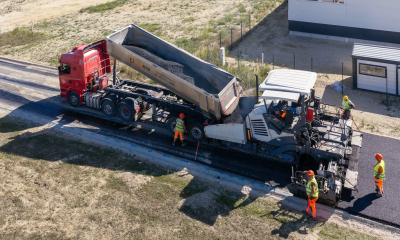


The STRABAG project is constructing a road network designed to handle industrial freight traffic in Ajka

They would not only modernise the debreceni Nagyállomást, but also develop it into a modern transport hub

The Market Csoport brings together all its development expertise under one roof

From the heating plant to the library – solar panels are to be installed on eight local authority buildings in Kiskunfélegyháza

Rain gardens are coming to Budafok, with over 3,000 square metres of green space set to be developed

Contemporary art deco in Csopakon

Four new bridges to be built in the heart of the former industrial city

Safer driving on the motorways: new digital signs for the MKIF
-

 Bound track 2026. 08. 17.
New pedestrian crossings and a junction with traffic lights are being built in Angyalföld
-
Industry news 2026. 08. 18.
Students were introduced to the high-tech construction industry at BME’s field camp in Göd
-
What is being built? 2026. 08. 18.
Hungary’s new McDonald’s restaurant has moved into a modernist listed building in the centre of Budapest
-
Current at 2026. 08. 17.
A historic landscape where every stone has a story to tell – the English Garden in Tata is being restored