Water management
A ring of water may surround Debrecen

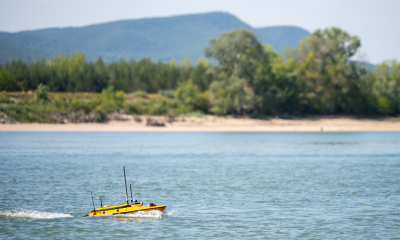
Debrecen's large-scale water management project can continue with phase II of the Civaqua programme. The details of the investment were presented by Zsolt V. Németh, State Secretary for Water Management at the Ministry of Energy, and László Papp, Mayor of Debrecen. The CIVAQUA programme is a continuation of a water development project that began 40 years ago. The 1976 plans were dusted off in the 2000s and the current version of CIVAQUA was developed in detail. The essence of the project is that, with the help of CIVAQUA, water from the Tisza will be transported from the Eastern Main Canal through an underground pipeline all the way to Debrecen.

The first phase of this enormous investment first phase of this huge investment project for the utilisation of the river water in Debrecen included the construction of pumping stations and a 13 km long pipeline. The water flows through this to a 3,000 cubic metre equalising reservoir. The riverbed was widened at Klastrompart in Jószai, and the Vezér Street reservoir was constructed.
The investment would also ensure water replenishment for the Great Forest.
According to the latest announcement, the Civaqua project may continue next year, enabling water from the Eastern Main Canal to reach the northern and eastern areas of Debrecen. To this end, a 13.5-kilometre-long gravity pipeline system would be built to transport water from the high-point equalising reservoir built in 2023 to the Debrecen-Pallag area, into the Pallagi Canal. From there, the water would be distributed in two directions via a water distribution facility to ensure the water supply of Nagyerdő, as well as via Kondoros and Cserei-ér towards the Fancsikai reservoirs.
A connecting channel may also be built alongside the restoration of the lakes surrounding the city.
This necessitated the comprehensive development of the latter channels and the creation of a new connecting channel. Additional EU funding would be used to renovate the Vekeri and Erdőspusztai lakes near the city and to replenish the Fancsikai reservoir.

Debrecen seeks new sources of funding to tackle water management challenges
Since the water needs to be transported to higher ground, the city has entered into an agreement with the government to develop a network with investments from TIVIZIG and OPUS TITÁSZ. A solar park is also part of the long-term plans, for which a government decision has been made, amounting to 3.575 billion forints. The city council will soon decide whether to apply for an additional 5 billion forints in development funding under the Civaqua Plusz programme, KEHOP Plusz. The aim of this is to enable municipalities to manage water management challenges, and this project could include the rehabilitation of Lake Vekeri and the Tócóvölgyi Ecopark.
The total cost of the project is more than 40 billion
Funding for the second phase of the Civaqua programme is secured by the recently signed grant agreement based on a government decision made in 2024. With the involvement of European Union funds, this will enable the launch of the project, whose total cost exceeds 40 billion forints.
Source: Link










The town centre on the banks of the Tisza is being regenerated

The Market has fulfilled its promise: it has delivered the 10,000 tonnes of natural stone offered for the raising of the bottom sill at Paks

The construction industry is both vast and marvellous – the Duna Group Szabadegyetem has been launched

ESG is now a business issue for suppliers in the construction industry too

Rain gardens are coming to Budafok, with over 3,000 square metres of green space set to be developed

Contemporary art deco in Csopakon

Four new bridges to be built in the heart of the former industrial city

Safer driving on the motorways: new digital signs for the MKIF
-

 Industry news 2026. 08. 18.
Students were introduced to the high-tech construction industry at BME’s field camp in Göd
-
Bound track 2026. 08. 17.
New pedestrian crossings and a junction with traffic lights are being built in Angyalföld
-
What is being built? 2026. 08. 18.
Hungary’s new McDonald’s restaurant has moved into a modernist listed building in the centre of Budapest
-
What is being built? 2026. 08. 18.
New paving, a playground and visitor facilities are being planned for the Várkör area in Pannonhalma