Current at
Innovations of the present, challenges of the future - digital inclusion in the Proptech focus

One of the most monumental architectural undertakings of the 21st century, the NEON project (building energy efficiency programme), was also presented at the annual flagship event of the real estate and construction industry, the Proptech Innovation NOW conference. At the event, which took place on 16 May at the Budapest Music Centre, more than 270 participants listened to presentations by over 70 international and domestic professional speakers, according to the Buildext website.
AR, VR, BIM, AI
Visitors to the conference could listen to presentations or participate in workshops in three halls, while various companies demonstrated their state-of-the-art solutions in the convention centre lobby.
“We are no longer building plans, but virtual buildings that we can take to the construction site or put into operation using a standard phone camera,” said Csaba Livják, founder and CEO of Buildext Kft., holding a tablet running the augmented reality application of the web project platform of the software development company Dalux.
After three clicks, in a matter of seconds, it loaded the floor plan of the Budapest Music Center, the planned interior design, and then showed the systems running in the wall, based on the visitor's position, via the phone's camera.

Design today goes beyond drawings
This is the next phase in the digitalisation of the construction industry. Designers are no longer just responsible for design, but are now acting as digital integrators, building digital replicas of buildings in virtual space, connected to a web-based project platform, enabling faster and more efficient communication, information access and change tracking during design, construction and operation.
The designer is no longer only responsible for producing the "drawings" until the plans are delivered, but also keeps the information model of the building alive as a digital integrator for the lifetime of the building. He builds it during the design phase, keeps track of changes during construction and fills it with information, and then ensures that it remains up-to-date for the next 20 years.
This is the basic idea and it is coupled with endless new services, possibilities and synergies, ranging from AR solutions on phones instead of paper-based designs, to VR and mixed reality glasses, simulations, IoT sensor integration and digital twin technologies.
The result is a new world
With augmented reality, construction of facilities will be reduced by months, the number of conflicts will be reduced to a fraction, and construction and operation costs will be reduced by 20-30%.
A vivid example was given during one of the presentations of a masonry structure that was almost impossible to build using ordinary methods, where the master builder was assisted by Hololens mixed reality glasses, which allowed him to see both reality and what he had to build.

Those who lag behind, drop out
The solutions are there, the infrastructure is in place, and digitisation solutions are guiding projects from early needs assessment through design and implementation. Yet, a recurring theme in the presentations is that industry players are often reluctant to implement new solutions - either because of the resources required or simply because they lack the necessary know-how.
"My goal is to accelerate the digital transformation of the real estate market" - emphasized the main organizer Zoltán Kalmar in his opening speech, and added - "This conference is an important milestone to bring the construction industry and the real estate market closer together". After four previous conferences, you would think that it is difficult to come up with new things, but Zoltán said that their fifth event has a strong message and purpose. As the motto of the conference, "innovations of today, challenges of tomorrow", suggests, the innovations are already here, but we need to find and seize the opportunities.

Photo by Balázs Glódi
"Industries operate at a different pace," said Csaba Livják, CEO of BuildEXT. "I was a construction manager. I see and know the so-called analogue construction industry well. But the world has evolved and in the last few years a digital and even a virtual construction industry has emerged, which, like in other countries, is inevitably making its way in our country." Csaba not only discussed the potential of the BIM, but also spoke about the advantages of the advance and rapid adaptation of artificial intelligence tools.
Digital catch-up needed
Artificial intelligence is now as much a buzzword as digitalisation, which has many meanings, but its use is changing the way we work so rapidly that it seems that market players who are hesitant or even reluctant to adopt it are already at a disadvantage. The conference gave illustrative examples of the teething problems of the construction industry, how common and impossible it is to build a complex or large project with traditional tools, but fortunately also examples of how to do it well.
This is the innovative and forward-looking direction taken by the State's digital strategy for the construction sector and the BIM investment law, which was made mandatory, and which was later presented by State Secretary Regő Lánszki.
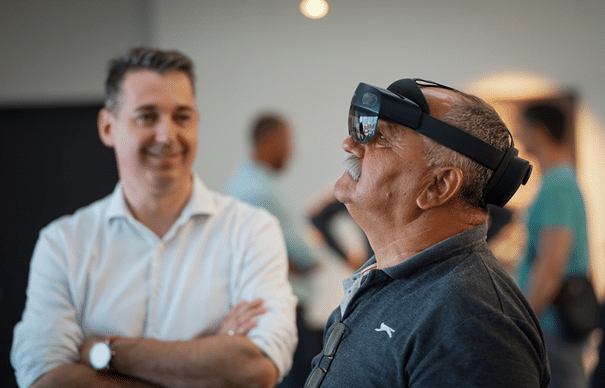
Photo: BuildEXT
The involvement of public actors is also needed to bring industries together. Regő Lánszki, Secretary of State for Architecture Építési és Közlekedési Minisztérium, underlined this in his presentation at the Proptech Innovation Now conference: "Hungary needs to catch up with the digital frontrunners, and there is still room for improvement, because we are ranked 22nd out of the 27 member states in the European Union's Digital Economy and Society Index... Research suggests that in the next decades, the automation of the digital transition will threaten the jobs of nearly half of Hungarian workers."
The Minister stressed that although the digital literacy of the population is not outstanding in Hungary, the real deterrent is businesses.Digital catch-up is therefore of elementary economic interest.
One of the most interesting participants of the lecture series was Fahad Al Tomaihy, founder of Tayaqan in Saudi Arabia, who spoke about the line project, the Saudi super city, a 170-kilometre long, 200-metre wide and 800-metre high smart metropolis dreamed up in the desert, and its reality. "In its digital twin form, the whole city already exists," he said, standing under a giant Unreal Engine logo. "It just needs to be implemented. There are a lot of companies working on this, if you look at the NEON project webpage that takes care of the The Line, you'll see that we've broken it up into a bunch of subprojects"
The aim of The Line is to build a completely self-sustaining, zero-emission city, the usefulness of which is a matter of debate. What is certain, however, is that such an ambitious project would bring countless construction solutions, which have only been hinted at so far, within reach. And although this was undoubtedly the most astonishing production of the day-long event, fortunately there is no question that the achievements of modern architecture are only available to super-rich entrepreneurs or rulers in distant countries.
Further details and photos from the conference are available on the Buildext website.
Source : Link







The town centre on the banks of the Tisza is being regenerated

The Market has fulfilled its promise: it has delivered the 10,000 tonnes of natural stone offered for the raising of the bottom sill at Paks

The construction industry is both vast and marvellous – the Duna Group Szabadegyetem has been launched

ESG is now a business issue for suppliers in the construction industry too

Rain gardens are coming to Budafok, with over 3,000 square metres of green space set to be developed

Contemporary art deco in Csopakon

Four new bridges to be built in the heart of the former industrial city

Safer driving on the motorways: new digital signs for the MKIF
-

 Industry news 2026. 08. 18.
Students were introduced to the high-tech construction industry at BME’s field camp in Göd
-
Bound track 2026. 08. 17.
New pedestrian crossings and a junction with traffic lights are being built in Angyalföld
-
What is being built? 2026. 08. 18.
Hungary’s new McDonald’s restaurant has moved into a modernist listed building in the centre of Budapest
-
What is being built? 2026. 08. 18.
New paving, a playground and visitor facilities are being planned for the Várkör area in Pannonhalma