
Road building
M1 extension: the 44-year-old bridges are being demolished, whilst traffic is being diverted to the section of the motorway that has already been completed

The M1 motorway extension is entering another spectacular phase: whilst the demolition of the old structures has already begun, this autumn the track reconstruction will also gain fresh momentum in the autumn. The details were shared by MKIF Magyar Koncessziós Infrastruktúra Fejlesztő Zrt. in a Facebook post.
Demolition work on the old flyovers has begun in the Nagyegyháza area. The 44-year-old, 47.4-metre-long flyover – the section leading towards Budapest – was cut into six pieces and lifted out by crane in sections weighing approximately 43–44 tonnes each. Diamond wire cutting technology was used for the demolition.
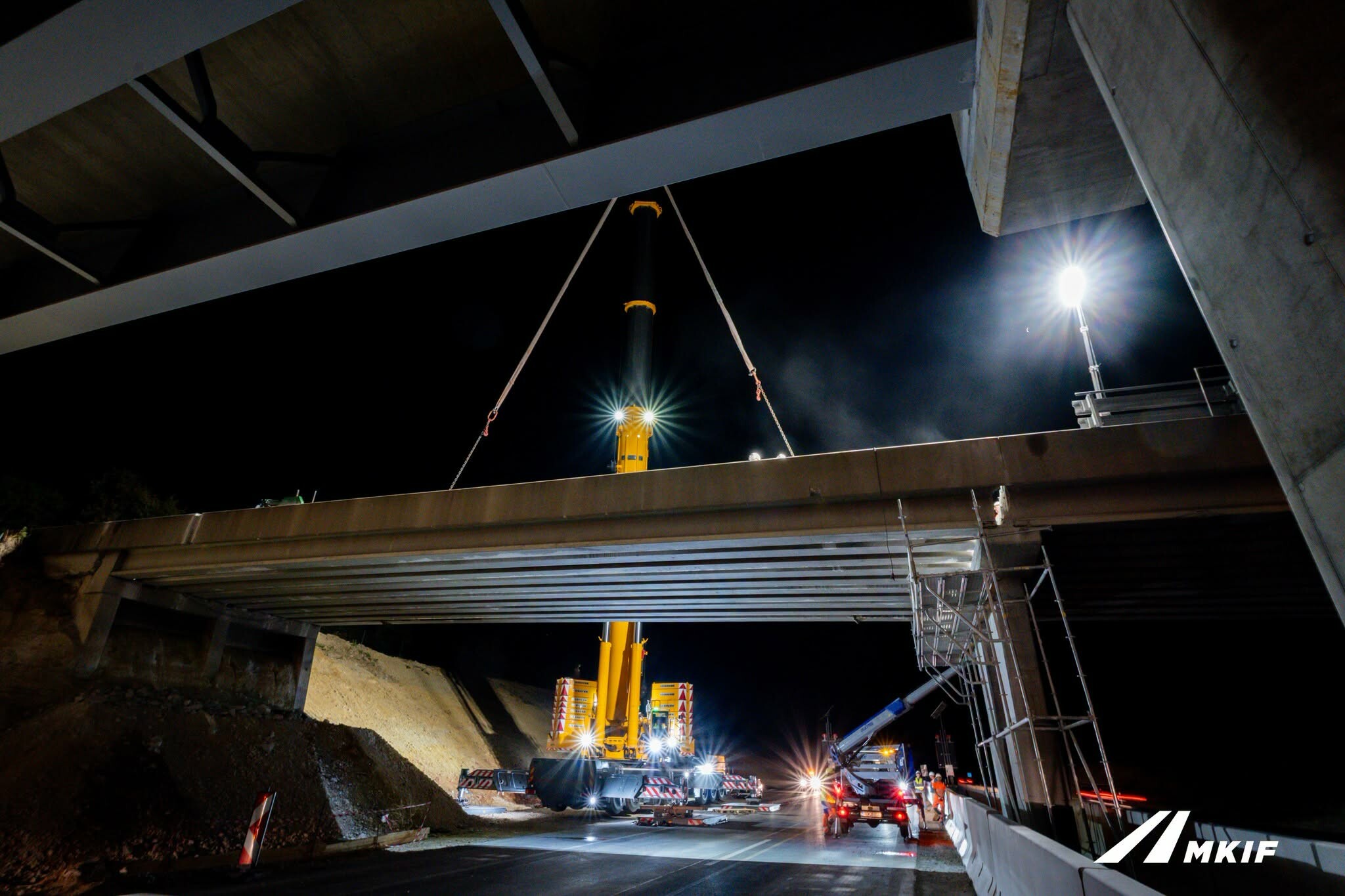
First they’ll divert the traffic, then they’ll dismantle the track
According to information from MKIF, a new phase of works will begin this autumn: in several stages, traffic heading for both the capital and Győr will be diverted onto the already widened side of the track heading towards Budapest. This means that there will continue to be two lanes in each direction, with the two directions of traffic separated by concrete barriers.
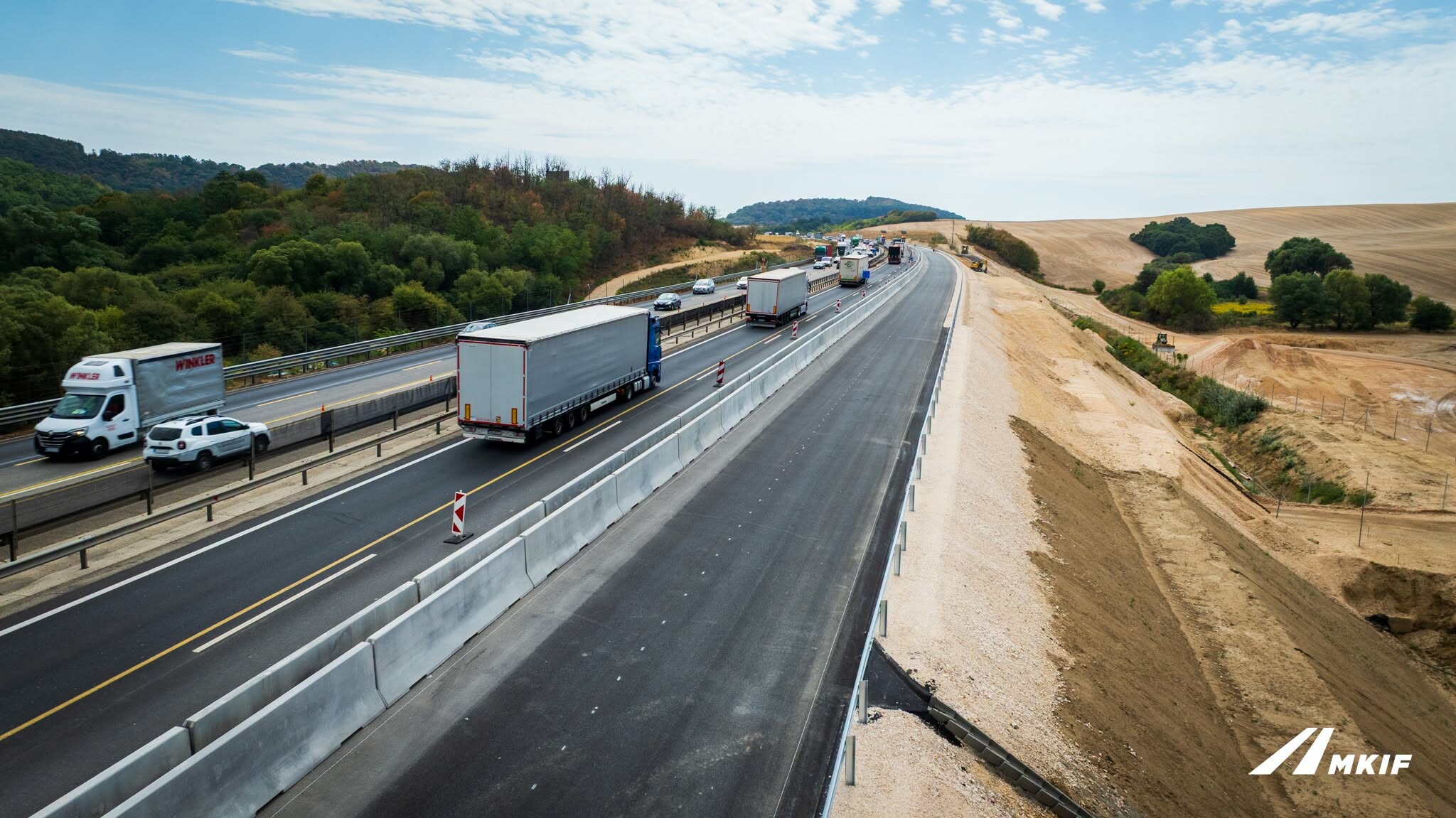
At the same time, work will begin on dismantling the track side heading towards Győr. The existing track structure will be removed to a depth of approximately 100–120 centimetres, after which it will be rebuilt using a new structure.
The new track will have an asphalt surface that is one and a half times thicker than before, 32 centimetres thick.
Furthermore, instead of a hydraulically bound base course, a base course made of crushed stone with a continuous grain size distribution is laid beneath the surface course. This design results in what is known as a ‘flexible pavement structure’, which, according to the developer, enables a road surface with high load-bearing capacity and greater long-term durability.
The 2×2-lane carriageway will remain in place even during the expansion works
One of the most important considerations in the development of the M1 is that two-lane traffic in both directions towards Budapest and Győr should be maintained throughout the entire duration of the works.
This is, of course, carried out subject to speed limits, and the traffic management arrangements change as the various stages of the works progress. Traffic management and the precise coordination of the individual work processes therefore play a key role during the construction work.
Where possible, a significant proportion of the work is carried out from the service roads alongside the track and from the work sites. Operational tasks are, where possible, scheduled for night-time periods when traffic is lighter, so that the works cause as little disruption as possible to traffic on the main line.

72 works of art need to be restored
The extension of the M1 motorway covers a total stretch of approximately 78 kilometres. As part of the project, 72 existing underpasses and overpasses will be rebuilt, as the new, wider carriageway would not fit beneath or above the existing structures.
As part of the development:
- 11 existing junctions are being upgraded;
- Four new grade-separated junctions will be constructed;
- Six leisure centres are to be completely rebuilt, whilst the other rest areas are being expanded and modernised;
- About 300 new truck parking spaces is established;
- Developments are also underway to create family-friendly rest areas;
- 2 engineering sites – In Bicske and Komárom – expansion and modernisation are taking place;
- 7 sub-nodes at level 7 will be converted into a roundabout;
- They are constructing state-of-the-art drainage and water storage systems.
Noise protection is also undergoing significant changes: under the new system, both the length and height of the noise barriers will increase. Noise barriers will be installed along a section nine times longer than at present, covering a total area twelve times greater than at present.
The investor, MKIF, has submitted a separate application relating to the M1 extension: information website has also been launched. The site provides up-to-date traffic information in 13 languages, including restrictions at junctions and rest areas, a map showing traffic patterns, and details of emergency lay-bys.
Source: Link









M1 extension: the 44-year-old bridges are being demolished, whilst traffic is being diverted to the section of the motorway that has already been completed

Previous plans are being dusted off, and a decision may finally be made on who will design the next sections of the cycle route along the Rákos Stream

187 new parking spaces will ease congestion around the Nyíregyháza Stadium

The roadworks in Újpest have reached the halfway point: a new phase of works is set to begin on István út and Pozsonyi utca

Rain gardens are coming to Budafok, with over 3,000 square metres of green space set to be developed

Contemporary art deco in Csopakon

Four new bridges to be built in the heart of the former industrial city

Hungary's biggest motorway upgrading programme is underway
-

 What is being built? 2026. 07. 27.
Construction of Phase VIII of the Somfa Liget residential estate is underway using hybrid construction methods, prefabricated elements and the LEAN organisation model
-
Water management 2026. 07. 27.
Szeged is getting rid of its asbestos-cement and cast-iron pipes
-
Road building 2026. 08. 05.
The main road leading to a key tourist destination in Bihar is being upgraded using cold recycling technology
-
What is being built? 2026. 08. 06.
Paks II.: What does the new milestone for Unit 5 mean in the context of the review?


