
Bound track
7000 tonnes of stone replaced - major maintenance at Keleti station

The MÁV Group and the V-Híd are working hard to renovate the track network at Keleti Railway Station. Passenger trains have been temporarily replaced by track maintenance and work machines and railway vehicles, while hundreds of specialists have taken the place of passengers.

Track renewal from the ground up
A major project has been launched to upgrade the ballast, in addition to maintenance of tracks, switches and overhead lines, and may even include the complete rebuilding of two platforms. The press visit was given by Tibor Szilágyi, MÁV Pályaműködtetési Zrt.'s Director General for Development and Investment, who said that 30 of the 50 sidings at the station are currently being renovated.
"We wanted to replace a number of sleepers, most of which we have already replaced"
- pointed out the Director General, stressing that "we are facing very big logistical problems. This is mainly due to the fact that we want to do a lot of things that involve many different disciplines, but colleagues cannot work on the same section at the same time.
"Understandably, it is not possible for someone to repair a track while replacing another sleeper or overhead line in the same place. That's why we have a track-level schedule, in which we determine for each hour which brigade has what to do. We don't stop at weekends, we work every hour of every day to get it done by 20 September."
At night, MÁV's technicians - mainly their colleagues responsible for the overhead line - work, while during the day it is mainly the track maintenance staff.

No need to shut down the whole station in case of a fault
Huge areas of the station, with a variety of tasks, are the bulk of the work, but new clocks have also been installed in the area used by passengers, and the platforms on tracks 1 and 2 are being completely rebuilt: there are more than 90 shafts in these, so cleaning them up and putting new paving on them is a big job. Where possible, they will also be cleaned up, but as the whole station is a listed building, major intervention would only be possible with the involvement of the Heritage Department, which is not in the current tight timeframe.
It will be possible to disconnect the overhead contact lines of the tracks in groups after the renovation. This will be possible by means of staggering, so that if there is a problem with the lines, the whole station will not have to be shut down.
Wherever possible, Hungarian materials are used in the renovation, and where this is not possible, they also try to buy from Central European suppliers.
"Engine changes and gearbox part changes are taking place in the detours," said Tibor Szilágyi. We have been able to replace them completely in several detours in the last 12 days. The reason for this is that the Keleti is very busy: it is not only for arriving trains, but also for maintenance units that use the sidings to store trains." Because of the wear and tear on the siding, slow signals were previously introduced, with a maximum speed limit of 20 km/h in many places.

Trains can run more frequently
"We want to eliminate this everywhere," he said. Our plan is to allow speeds of 40 to 60 km/h, and even 80 km/h on the access sections. The priority is to prevent trains from being unable to turn around on time because of the poor state of the track.
The elimination of slow signals will allow a much more robust schedule to be set. The capacity of the station, and therefore the traffic pattern, will not change, but trains will be able to follow each other more closely, which is a big advantage."
The East will be closed until 20 September and the work will be completed by that date. 200-400 people a day are working around the clock to make this happen.

7000 tonnes of crushed stone to be replaced
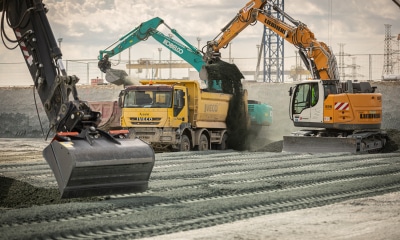
Perhaps their most spectacular work at the moment is sieving. The MÁV bed screening machine sorts the crushed stone under the tracks. The crushed stone provides both longitudinal and transverse rigidity to the track - this is the reason why the track and the concrete sleepers do not shift.
"There is a heavy load here, which is chipping the ground, which is contaminated, which is also getting muddy because of the weather. The consequence of this is that the stiffness of the track wears off after a while, so the stone stock under the track needs to be constantly renewed and updated"
- the Director-General informed. The screening machine, which will work continuously according to schedule until next week, will remove the fragmented, muddy stones and replace them with new ones. Whatever is still usable will be put back as evenly as possible.
"At the Eastern Railway Station, approximately 60% of stones need to be replaced, that's 7000 tonnes of stones," we learned.
Source : Link







The STRABAG in Szombathely prevented the release of asbestos-containing dust using a special sealing layer

Stones of the past, solutions for the future – Saving the stone walls of the Citadel

The replacement of the expansion joints on the Erzsébet Bridge is continuing with the third phase

Up to 1,500 cubic metres of concrete are being poured in each phase of the Paks expansion

Hungary's biggest motorway upgrading programme is underway

Perhaps the world's most elegant McDonald's restaurant opens in Budapest

Szeged to become one of Europe's leading industrial centres with the construction of the BYD factory, the city strengthens its position with a worthy investment package

Viablokk porous concrete masonry element from a Hungarian factory, as a Hungarian product, is set to conquer the world
-

 Bound track 2026. 04. 10.
This is how they pulled out the ‘fang’ of the derailed railway section in Transdanubia – with photos
-
Bound track 2026. 04. 10.
Planning can begin – the M2 line could be extended to Cinkota, and the HÉV lines could be upgraded
-
Bound track 2026. 04. 10.
The largest domestic railway development project to date is set to begin
-
Industry news 2026. 04. 10.
Rubbish equivalent to the weight of nearly 2,000 cars has accumulated on the country’s motorways over the course of a year


