Bound track
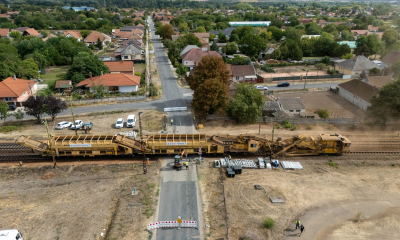
The GYSEV’s new IC trains, which are over a hundred metres long, will be maintained at this workshop

The expansion of the domestic passenger rolling stock could lead to significant progress in rail transport in the near future:
- According to the 2024 announcement, GYSEV will expand its fleet with 11 FLIRT-type IC multiple units from 2027;
- At the same time, thanks to the funding agreement concluded with the EU, our country will have the opportunity to procure at least 35 new IC trains.
The aforementioned project has now taken a step forward: GYSEV has announced who will be designing the motor train maintenance workshop in Szombathely, which will provide the technical infrastructure for the rolling stock development in question. According to publicly available data, ArchiNEST Építész és Mérnökiroda Kft. will draw up the plans for a net contract value of 300 million forints.
They are being built for motor trains over a hundred metres long
As we noted in our previous article, a thermally insulated workshop hall with a net floor area of approximately 5,300 m² needs to be prepared, which will also include an office.
At the same time, the development also involves significant railway infrastructure construction:
At least 3,500 running metres of track equipped with overhead lines will be built – including, amongst other things, a three-track maintenance and repair shed and a single-track washing shed. The shed must be capable of servicing at least three electric multiple units, each 106 metres long, simultaneously.
The successful bidder must also design the new centre’s road access, internal road network, paving and car parks.
The first trains in the new fleet could be in service by the end of next year
As regards the multiple units for the GYSEV project, the car bodies are being manufactured at the Stadler plant in Szolnok. The first trainsets are expected to arrive in the last quarter of 2027, and the IC multiple-unit fleet will be complete in the first quarter of 2028.
The trains will be gradually introduced into service on the Sopron–Budapest and Szombathely–Budapest routes from the end of 2027. These energy-efficient trains, built to the latest international standards, will be capable of speeds of 160 km/h.
Under the other fleet renewal project mentioned in our article, Hungary may procure at least 35 vehicles with EU funding; according to the latest press reports, these will be double-decker trains. They are expected to operate on the Budapest–Debrecen–Nyíregyháza–Miskolc, Budapest–Szeged and Budapest–Pécs routes. According to the announced timetable, the public procurement process could begin as early as 2026, and the first trains could appear on Hungarian tracks as early as 2029.
The significance of these projects for the domestic rail sector is clearly illustrated by the fact that the last time new InterCity multiple units were procured in Hungary was 31 years ago.
Source: Link









The Buda interchange could also be extended northwards

A railway bridge will link the sections of the Tokaj-kör route: cycling infrastructure development in the wine region continues

Many people from the capital are also choosing it as their new home: four buildings are being constructed in Gárdony using a special foundation system

One of Abony’s most important transport routes is to be redesigned

Four new bridges to be built in the heart of the former industrial city

Rain gardens are coming to Budafok, with over 3,000 square metres of green space set to be developed

Contemporary art deco in Csopakon

Safer driving on the motorways: new digital signs for the MKIF
-

 Current at 2026. 09. 09.
A first-hand look at a career in engineering – Duna Group Szabadegyetem is back
-
Climate-X 2026. 09. 09.
Nyíregyháza Spartacus FC goes green – four hundred solar panels to be installed on the stadium roof
-
Bound track 2026. 09. 15.
Nearly 50,000 people travel on it every day – the refurbishment of the Cegléd main line continues
-
Current at 2026. 09. 09.
Rental flats, Rákosrendező, decentralisation – important ideas were put forward on the Real Estate Beach Conference stage