What is being built?
An award-winning steel bridge spans the M7 motorway: Velence’s new landmark was built without piers

2026.
On 6 May 2026, the new bridge spanning the M7 motorway at the Velence rest area opened to pedestrians and cyclists. The developer MKIF Magyar Koncessziós Infrastruktúra Fejlesztő Zrt. Pályán vagyunk! In his podcast, he revealed details that the general public had not yet heard. As a guest on the „InnoWay” segment, Norbert Mányoki, Construction Director, began by discussing the background to the construction of the new bridge.
The technical condition of the reinforced concrete footbridge, built in 1967, has gradually deteriorated over the past decades. Although the structure had previously undergone several renovations and reinforcement works, due to structural problems and the planned expansion of the M7 motorway, it was no longer economically viable to preserve it. Use of the bridge had to be restricted; no more than ten people were allowed on it at any one time; furthermore, the cross-section of the 2×3+ITS lanes to be constructed as part of the motorway expansion would not have fit beneath the original structure.
The project therefore represented not merely a refurbishment, but a complete change of approach.

An 80-metre span without intermediate supports
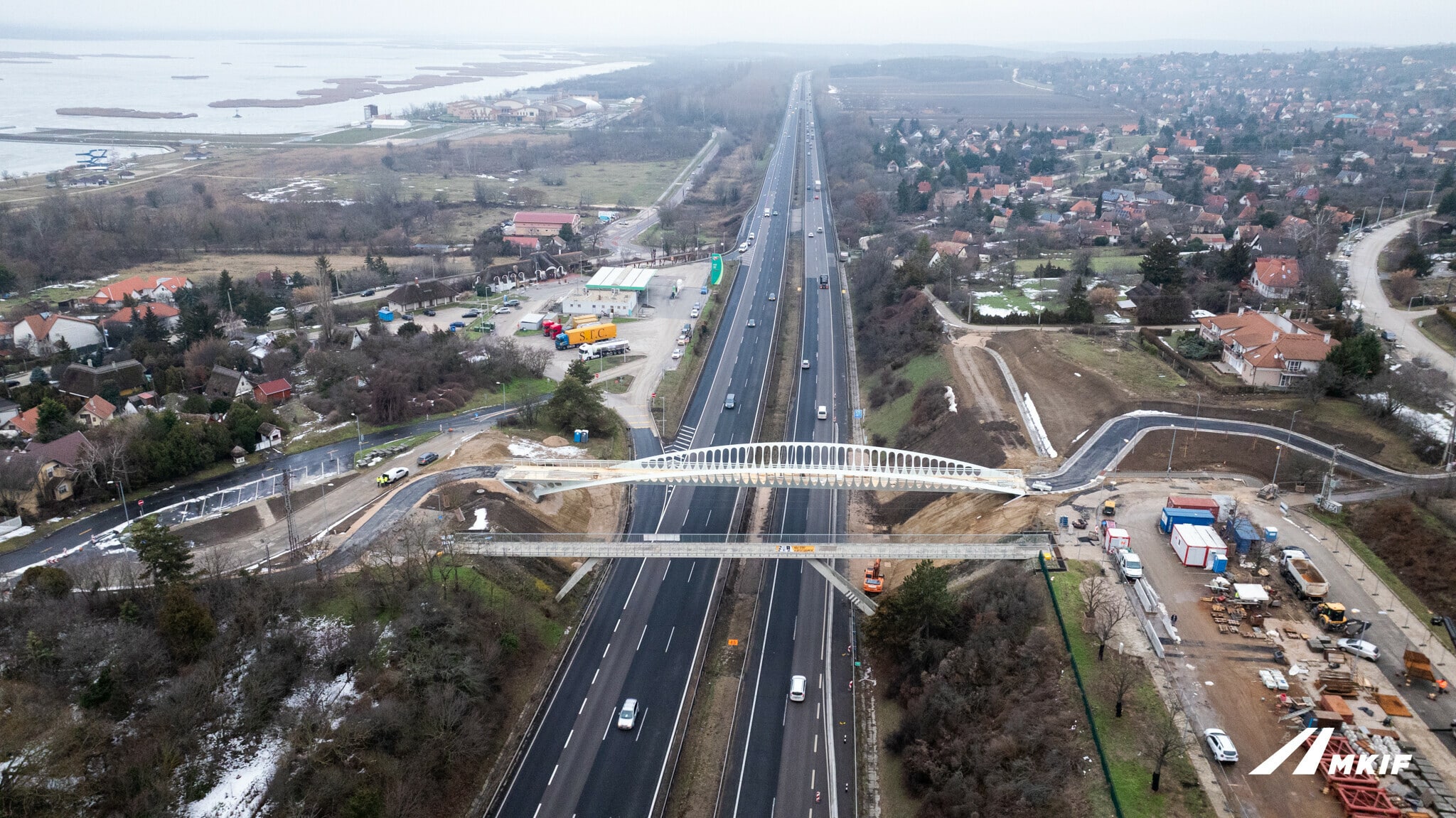
One of the greatest engineering achievements of the new bridge is that it spans a distance of 80 metres without a single intermediate pier, thereby enhancing road safety and ensuring the possibility of future motorway developments.
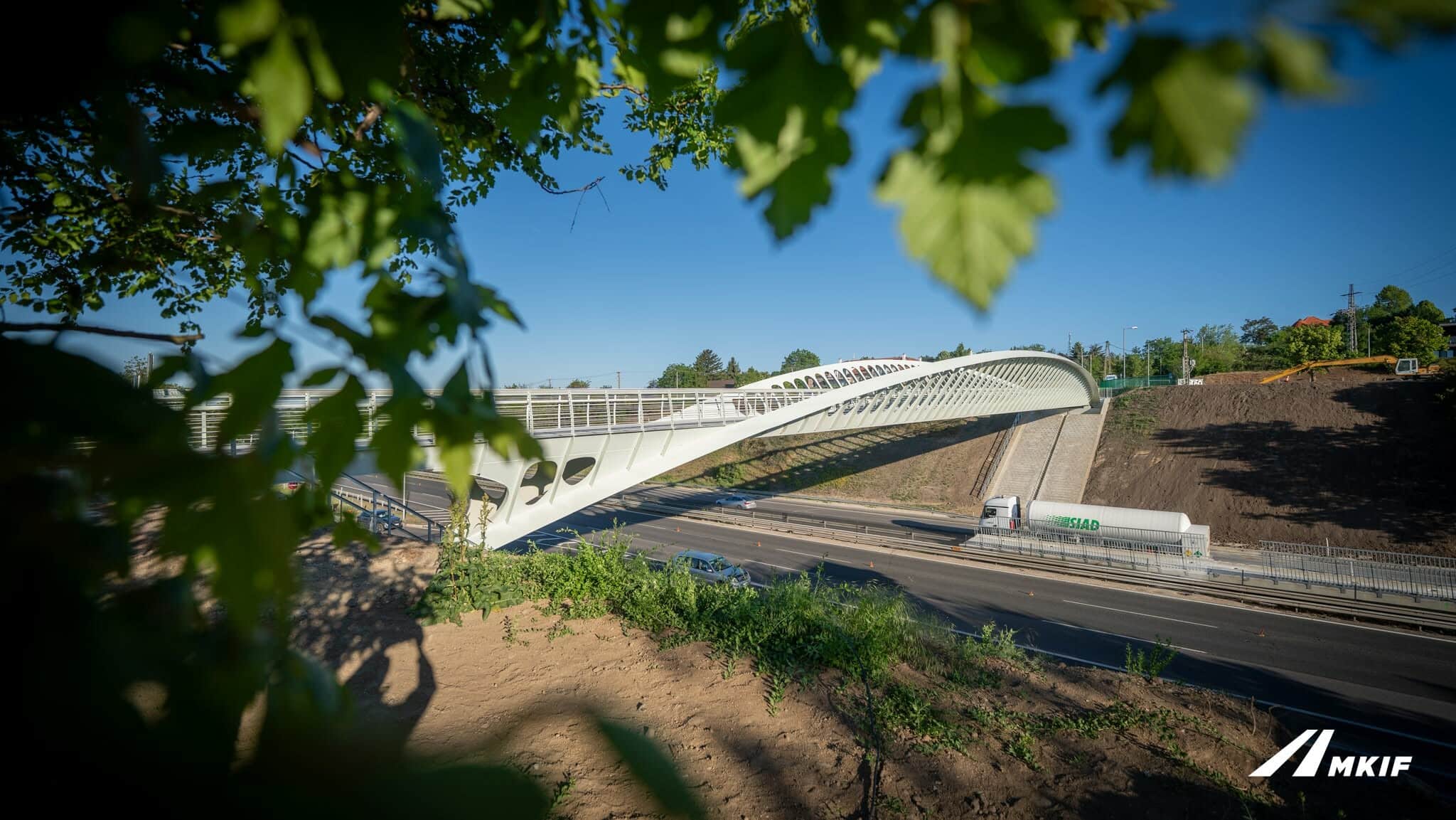
The arched main girder, recessed-track steel structure is now almost one and a half times wider than before; it also features an access route designed with gentler gradients and barrier-free ramps, in line with modern cycling standards. The designers developed the concept in just four months, using digital BIM-based modelling, and has also won international professional awards.
Not just a bridge, but a complex engineering project
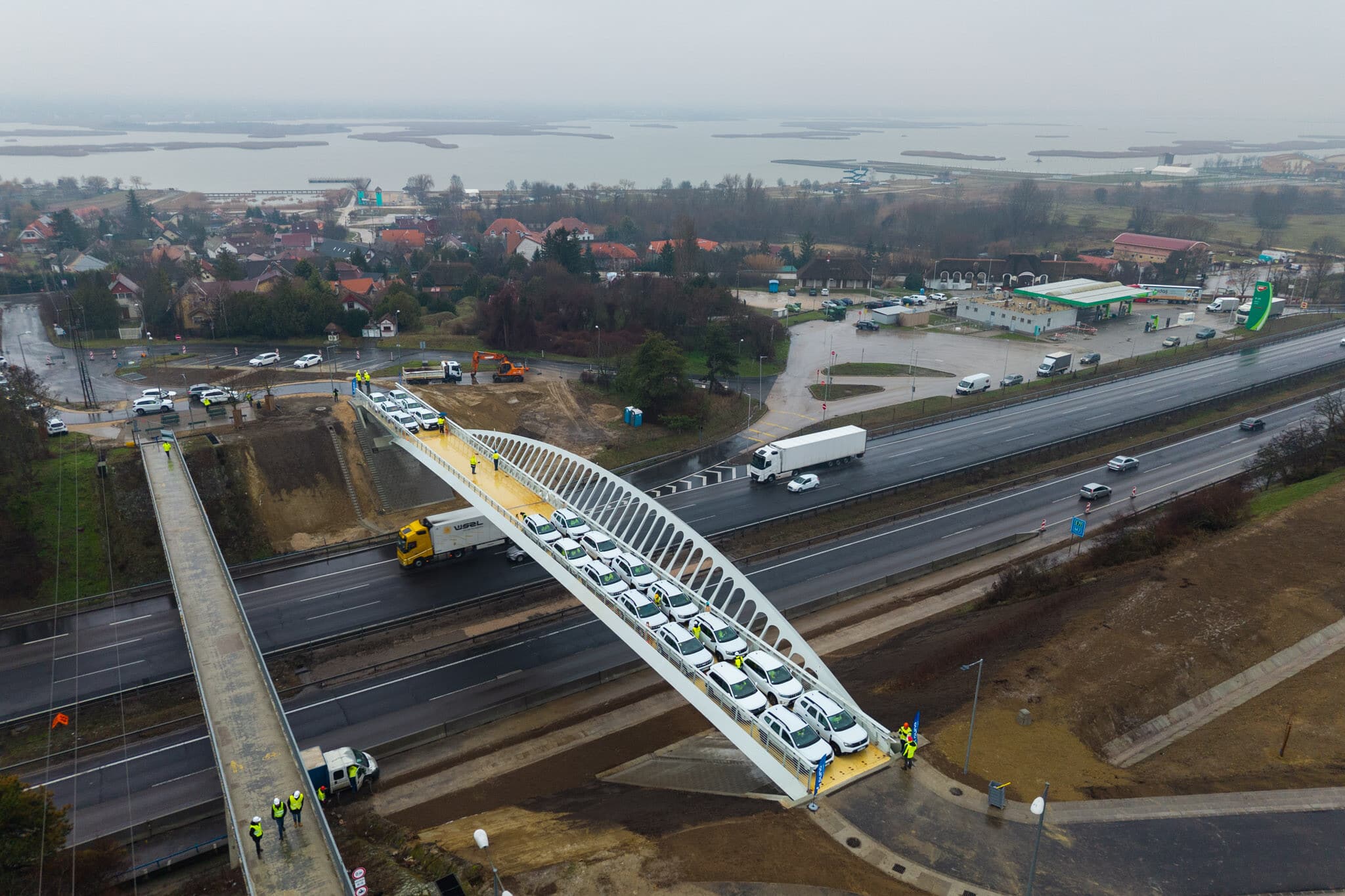
Construction began at the end of 2024; the steel structure was manufactured in Poland, after which the components were painted and assembled in Hungary. Following the piling work, the construction of the bridge abutments and the development of the road junctions on site, the bridge sections were hoisted into place in autumn 2025. The opening to traffic static and dynamic load tests carried out using 32 passenger cars, during which experts from the Budapest University of Technology and Economics monitored the structure’s behaviour.
Tests have confirmed that the bridge is performing in line with the design specifications, and it was therefore opened to pedestrians and cyclists in May 2026.
It took them two nights to dismantle its predecessor
Immediately following the opening of the new bridge, demolition of the reinforced concrete structure, which was over fifty years old, began. The work could only be carried out during night-time and weekend windows, taking into account traffic on the M7 motorway, public holidays and the approaching summer tourist season. Blasting was out of the question due to the surrounding residential areas, Lake Velence and the newly completed bridge, so the structure was cut into sections and lifted away using heavy-duty cranes. Some of the steel components recovered during demolition will be recycled, whilst the concrete structure will be processed and used as raw material for road construction.
A spectacular milestone in the modernisation of the M7
The pedestrian and cycle bridge in Venice is a good example of how a modern structure can simultaneously promote road safety, sustainability and the development of tourism.
The crossing, which has become a key part of the Budapest–Balaton cycle route (BUBA), will improve access to the Lake Velence area in the long term, whilst also serving as a symbol of the ongoing modernisation of the M7 motorway.
As a result of the resurfacing works carried out over the past three years (in 2023, 2024 and 2025), the proportion of road surfaces on the motorway that are less than five years old has risen from 2 per cent to 80 per cent, which clearly illustrates the scale of the renewal of the country’s motorway network.
The full podcast episode is available here
YouTube: https://youtu.be/jRp-W4Qn6os?si=y5AN288RgbH2U0QU
Spotify: https://open.spotify.com/episode/3UrylaolbteGTorCQ0C8Tq?si=sKDfG7aDRma7b4SxAe23Tg
Source: Link









The town centre on the banks of the Tisza is being regenerated

The Market has fulfilled its promise: it has delivered the 10,000 tonnes of natural stone offered for the raising of the bottom sill at Paks

The construction industry is both vast and marvellous – the Duna Group Szabadegyetem has been launched

ESG is now a business issue for suppliers in the construction industry too

Rain gardens are coming to Budafok, with over 3,000 square metres of green space set to be developed

Contemporary art deco in Csopakon

Four new bridges to be built in the heart of the former industrial city

Safer driving on the motorways: new digital signs for the MKIF
-

 Industry news 2026. 08. 18.
Students were introduced to the high-tech construction industry at BME’s field camp in Göd
-
Bound track 2026. 08. 17.
New pedestrian crossings and a junction with traffic lights are being built in Angyalföld
-
What is being built? 2026. 08. 18.
Hungary’s new McDonald’s restaurant has moved into a modernist listed building in the centre of Budapest
-
What is being built? 2026. 08. 18.
New paving, a playground and visitor facilities are being planned for the Várkör area in Pannonhalma