What is being built?
ICOMOS award-winning reconstruction in the town of Perczelek

A major reconstruction of a significant historical building has been completed in Bonyhád: the more than 100-year-old Ermel-Vojnits mausoleum located in the Tolna County settlement's graveyard has undergone a complete renovation.
During the reconstruction work, Bonyhád-based Bonycom Kft., as the general contractor for the project, utilised the extensive product range of Mapei Hungary Kft. as the general contractor for the project, utilising its wide range of products. In addition to the complete renovation of the mausoleum's façade and interior, the specialists also carried out landscaping work. The project was designed by architects József Denkinger and Gábor Szász, while Szászépterv Mérnökiroda Kft. was responsible for the restoration work, which required special expertise.
The renovation of the neo-Gothic style chapel, which was carried out to an outstanding standard, has also been awarded the ICOMOS prize by the UNESCO heritage organisation.

Bonyhád, the town of the Perczeles
The town of Bonyhád is also known as the town of the Perczeles, as the history of the family that came to Bonyhád in the 18th century is intertwined with the life of Bonyhád. The best known member of the family is Mór Perczel, who was a general in the 1848 War of Independence. Mór Perczel was born into a large family with 18 brothers and sisters, and the children's tutor was the young Mihály Vörösmarty. From the 19th century, the Perczel family of Bonyhád rests around the mausoleums on the town's Calvary Hill.
The mausoleum on the Calvary Hill in Bonyhád was built between 1905 and 1907 for Erzsébet Ermel-Vojnits, daughter of Barnabas Vojnits and Etelka Perczel, Mihály Vörösmarty's muse.
Reconstruction of the mausoleum
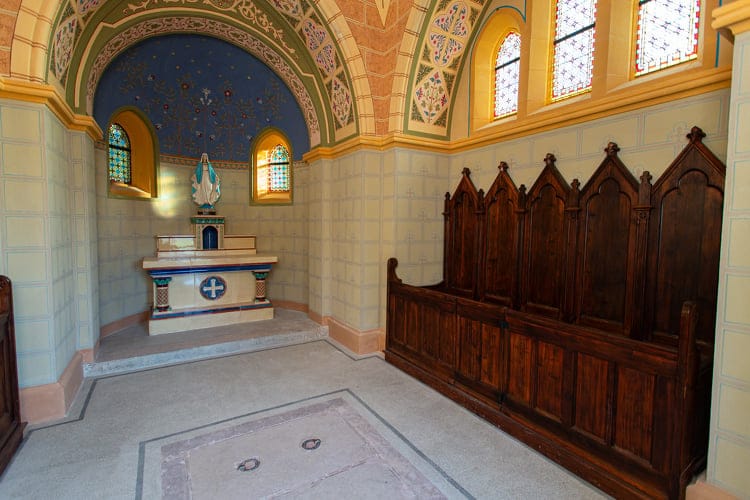
The neo-Gothic style chapel of Bonyhád has been under monumental protection since 2002, the most valuable part of its interior is the Zsolnay ceramic altar with a statue of Mary.
The building has recently deteriorated badly, but thanks to the persistent will of the city, it was finally saved from final decay and restored to its former glory at the last minute.
In 2021-2022, the monument underwent a complete renovation lasting more than a year. In addition to the complete renovation of the mausoleum's façade and interior, the reconstruction included the restoration of its surroundings (tree felling and planting, grassing, steps and landscaping, footpaths, and the restoration of the surrounding tombs, mostly associated with the Perczel family).

The professional challenge for the contractor was to restore the condition of unforeseen structural parts, coordinate the work of the restorers, replace the Zsolnay elements and deal with the special circumstances.

Masonry renovation with the Mapei cementless wall drying plaster system
Another challenge for the contractor was the need to retrofit waterproofing in the interior based on the recommendations of the wall diagnostics report, and then to ensure the damp masonry was dehumidified.
It was also important to be able to create a surface with the cementless dry plaster system that could accept decorative painting.
After breaking down the existing plaster and scraping out the joints, the professionals applied the Mapei cementless wall drying/repair plaster system by hand on the surface under the first sill, up to a height of about 2.5 m.

The product has been applied using the following layering scheme:
Layer 1: Mape-Antique Rinzaffo salt-resistant, cement-free, premixed adhesion-enhancing (scratch) mortar, applied as a first layer on stone, brick and tuff structures under Mape-Antique MC drying plaster,
2nd layer: Mape-Antique MC vapour-permeable, premixed, cement-free, light-coloured drying mortar for wet stone, brick and tuff wall structures,
3rd layer: Mape-Antique FC Civile vapour-permeable, cement-free, fine smoothing mortar, primarily for smoothing MAPE-ANTIQUE drying plaster (in order to allow decorative painting to be applied).

Prestigious recognition for the reconstruction
In 2023, the Hungarian National Committee of ICOMOS, the UNESCO's heritage organisation, recognised the restoration of the Ermel-Vojnits Mausoleum with the prestigious professional award, the ICOMOS Prize.
The designers and contractors were awarded the prize for the restoration of the building, the careful preparation, the exemplary cooperation of all participants and the worthy creation of a national memorial.
The Mapei is very proud to have been able to contribute its products to this high quality project, where the refurbishment has allowed an important piece of the past to be reborn in a dignified way.

A spectacular video of the renovation was also shot on site:
For further information or assistance with the Mapei solution above, please contact Mapei consultants who will be happy to help answer your questions, even at the project site!Source : Link







The STRABAG in Szombathely prevented the release of asbestos-containing dust using a special sealing layer

Stones of the past, solutions for the future – Saving the stone walls of the Citadel

The replacement of the expansion joints on the Erzsébet Bridge is continuing with the third phase

Up to 1,500 cubic metres of concrete are being poured in each phase of the Paks expansion

Hungary's biggest motorway upgrading programme is underway

Perhaps the world's most elegant McDonald's restaurant opens in Budapest

Szeged to become one of Europe's leading industrial centres with the construction of the BYD factory, the city strengthens its position with a worthy investment package

Viablokk porous concrete masonry element from a Hungarian factory, as a Hungarian product, is set to conquer the world
-

 Road building 2026. 04. 07.
Innovation on the motorway: digital models, drones and future-proof solutions in operations
-
What is being built? 2026. 04. 07.
Budapest’s Citadel has opened – Renovation of the Citadel is complete
-
Industry news 2026. 04. 07.
The biggest problems with paving stones have been resolved
-
What is being built? 2026. 04. 07.
The Galerius in Siófok has reopened as a year-round water park