Road building
An important moment: the Croatian motorway meets the Hungarian M6

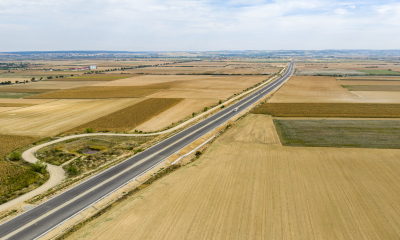
In Croatia, the last five kilometres of the 5C motorway running north-south through the country were opened on 6 October. Traffic on the section from Pélmonostor to the Hungarian-Croatian border is expected to start on Tuesday morning.
Thanks to this development, the section of the M6 motorway between Bóly and Ivándárda on the Hungarian side, which was handed over last year by Strabag and Duna Aszfalt Zrt., is now of international significance. rel="noopener">the M6 motorway section handed over last year by Strabag and Duna Aszfalt Zrt. has now become internationally significant (the section was also used for activities corresponding to its name by Főmterv Mérnöki Tervező Zrt. also carried out activities in line with its name on this section). The new section of the Croatian motorway connects to the Hungarian M6 motorway at the border, thus offering numerous opportunities in the southern direction of the M6.
The 5C will provide expressway access to Bosnia and Herzegovina via Esti and Diakovar, while crossing the E70 corridor near the Bosnian border, which connects Zagreb and Belgrade on a four-lane road.
An important European road transport corridor is born
The project closing event in Croatia on Wednesday was attended by János Lázár, Minister of Construction and Transport. The Minister pointed out that the linking of the Hungarian M6 and the Croatian A5 is not just a matter for the two countries. "It is not only important for the two peoples, but also for Europe in search of itself," he said.
He said that the motorway is perhaps the most important part of the European rail-road transport corridor, which connects the Baltic and Black Sea regions more broadly, and Central Europe more narrowly, with the Balkans. "The Danube to the Adriatic, if you like," he said. The minister said that this was a way of restoring circulation to what was once - in the happy times of peace a hundred years ago - one of the fastest growing and prosperous intellectual and economic "unions" on the old continent.
Source Link








The town centre on the banks of the Tisza is being regenerated

The Market has fulfilled its promise: it has delivered the 10,000 tonnes of natural stone offered for the raising of the bottom sill at Paks

The construction industry is both vast and marvellous – the Duna Group Szabadegyetem has been launched

ESG is now a business issue for suppliers in the construction industry too

Rain gardens are coming to Budafok, with over 3,000 square metres of green space set to be developed

Contemporary art deco in Csopakon

Four new bridges to be built in the heart of the former industrial city

Safer driving on the motorways: new digital signs for the MKIF
-

 Industry news 2026. 08. 18.
Students were introduced to the high-tech construction industry at BME’s field camp in Göd
-
Bound track 2026. 08. 17.
New pedestrian crossings and a junction with traffic lights are being built in Angyalföld
-
What is being built? 2026. 08. 18.
Hungary’s new McDonald’s restaurant has moved into a modernist listed building in the centre of Budapest
-
What is being built? 2026. 08. 18.
New paving, a playground and visitor facilities are being planned for the Várkör area in Pannonhalma