Industry news
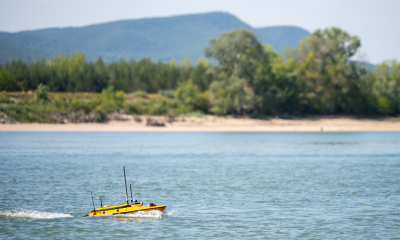
The team of the University of Győr achieved a first place with a canoe made of concrete

SZEnavis, a non-profit organisation of Széchenyi István University in Győr, makes canoes, but not just any canoes, but concrete canoes, according to a statement from the competition team.
According to the information, the organisation was launched in 2012, following a number of national and international examples. Over the years, the team and the University have produced countless good professionals, successful entrepreneurs and educators. András Pollák, Dániel Harrach and Dr. Attila Németh are the three most influential people in the team's 10 years of existence, as they have become founding members, as well as excellent lecturers at the University, and they still help and guide the team's daily life.
The aim of the association is to provide students of architecture and civil engineering, who will work with concrete in the future, with an interesting and exciting way to learn about concrete technology, concrete design and the development of new formulations, following foreign models. Since then, they have proven themselves in several competitions and are the only Hungarian team representing Hungary in some international competitions.
Concrete on water?
The idea of a concrete floating vehicle is not that far from reality. Most boats are made of steel, which weighs twice as much. An object floats on water if the ratio of its volume to its mass is less than 1000 kg/m3. So it's just a matter of generating as much volume as possible with as little mass as possible.
In 2012, the first boat weighed 380 kg. The wall thickness of the canoe reached 100 mm. Thanks to continuous improvements, the young craftsmen were able to achieve ever more precise and accurate designs. In 2022, at the Brandenburg race, they competed with a canoe weighing 47 kg and with a wall thickness of 1-3 mm. In 2023, the canoe was slightly re-fattened for stability and safety, and they competed in the Netherlands with a weight of 64 kg and a wall thickness of 3 mm.

The team is committed to continuous improvement
Year after year, the team strives to create the most ideal shape for the races. Work on the new formula for the Dutch event began in February 2023. The basic concept was to replace the low tensile strength of the concrete with geotextile, so that the boat would be made of textile concrete. A major challenge in creating the recipe was to get fresh concrete that could soak through the geotextile mesh, adhere well to the material and create as little excess concrete as possible, they say.
As they said, the March trial mixes proved that the recipe changes were successful, with reduced body density and increased strength. At 7 days of age, the concrete used already met the C30 concrete quality category.
The canoe was completed in April 2023. The competition was the first time the team had competed in the Netherlands. Strabag-MML Kft. provided essential assistance in getting there as the main sponsor. The team has been partnering with the company for two years now, as the competition to be held in Germany in 2022 was also made possible with their support. In addition to its sponsorship, the company strives to showcase its work as much as possible, giving students an insight into each project under construction.
They were successful in the competition
SZEnavis competed in a total of 6 rounds during the competition. Men's, women's and mixed teams competed in 50 and 100 m. In the 50 m they reached the finals in all events, where they won the women's event. In the 100 m distances, the men's pair reached the semi-finals, and they also finished 2nd in the mixed 50 m race.
The team not only designs and builds canoes, but also produces various promotional materials made of concrete, such as concrete key chains, concrete roses, concrete Christmas trees and Christmas ornaments.
The organisation aims to become as widely known as possible, and plans to create a canoe shape that can easily handle changes of direction.
Source : Link








The first municipal thermal power station in Transylvania is under construction

A huge brush was driven through the Sopron tunnel on the M85 – with video

The town centre on the banks of the Tisza is being regenerated

The Market has fulfilled its promise: it has delivered the 10,000 tonnes of natural stone offered for the raising of the bottom sill at Paks

Rain gardens are coming to Budafok, with over 3,000 square metres of green space set to be developed

Contemporary art deco in Csopakon

Four new bridges to be built in the heart of the former industrial city

Safer driving on the motorways: new digital signs for the MKIF
-

 Industry news 2026. 08. 18.
Students were introduced to the high-tech construction industry at BME’s field camp in Göd
-
Bound track 2026. 08. 17.
New pedestrian crossings and a junction with traffic lights are being built in Angyalföld
-
What is being built? 2026. 08. 18.
Hungary’s new McDonald’s restaurant has moved into a modernist listed building in the centre of Budapest
-
What is being built? 2026. 08. 18.
New paving, a playground and visitor facilities are being planned for the Várkör area in Pannonhalma