Industry news
Béla Markovich: "The supply and demand for professionals is gradually recovering"

He presented his research on the shortage of specialists at a press conference, regularly organising programmes in the field. educational opportunities and community-building events, as well as awards Mapei Kft.
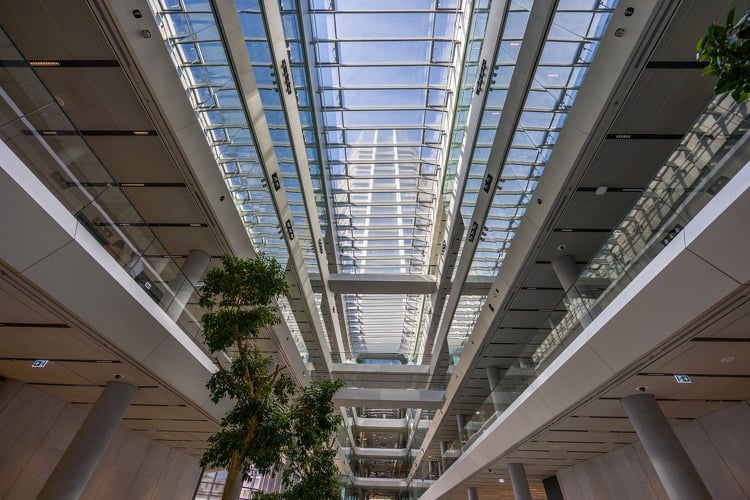
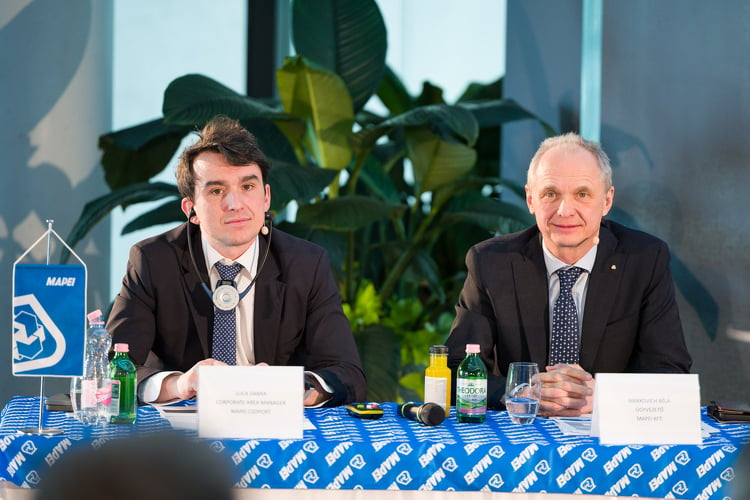
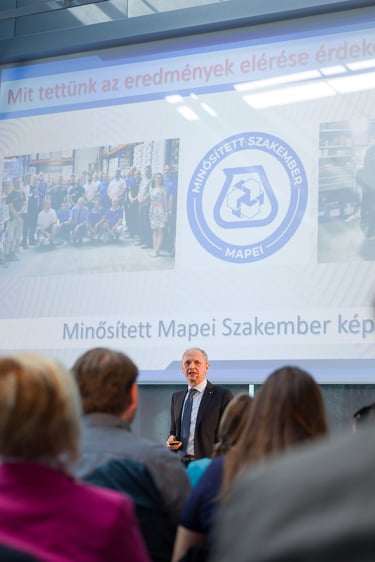
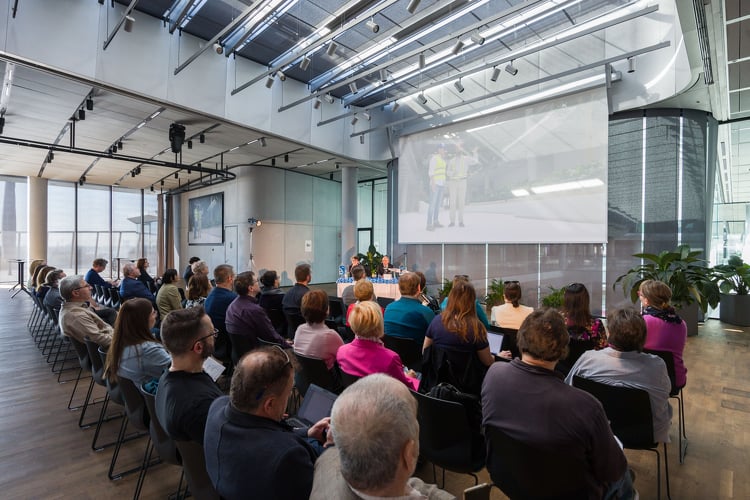
The construction materials manufacturer also used its products using its products in MOL Campus, 134 metres above ground, on 20 March. First, Luca Damia, Corporate Area Manager of Mapei, presented the group's international strategy, followed by Béla Markovich, Managing Director of Mapei Kft., who presented the research results relating to domestic experts in detail.
On average, you have to wait 52 days for a specialist
In February 2024, there was a 52-day shortage of professionals in Hungary, which is the average time you would have to wait for a professional if you asked for a job offer now. This is a slight decrease of 10 percent compared to last year, the company said in a press release.
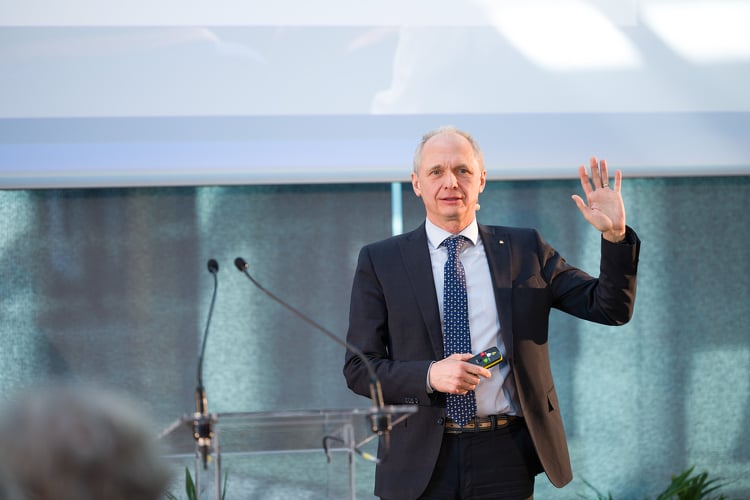
"The supply and demand for professionals is gradually rebalancing. The average waiting time of 52 days is now tolerable for both professionals and clients. Unfortunately, however, the decrease in waiting times is a consequence of the decreasing demand. Although there were signs of a recovery in January, the market is still waiting. Shortening waiting times and a decreasing shortage of skilled workers will contribute to the market recovery"
- explained Béla Markovich.
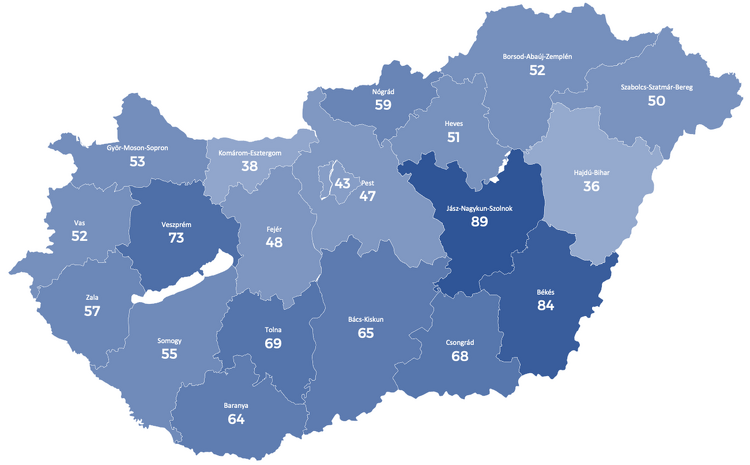
(number of days from the time you contact the professional until the work starts)
The distribution of skills shortages by county shows a varied picture. Hajdú-Bihar county has the lowest waiting time of only 36 days, while Jász-Nagykun-Szolnok county stands out with a high waiting time of 89 days. The shortage of specialists is below the national average in Budapest with a waiting time of 43 days, 47 days in Pest county, 38 days in Komárom-Esztergom county and 48 days in Fejér county.
The waiting time for a specialist is longer than average in Békés county (84 days), Csongrád-Csanád county (68 days), Bács-Kiskun county (65 days), Tolna county (69 days), Baranya county (62 days) and Veszprém county (73 days).

This is how much the waiting time varies by occupation
The length of the waiting time varies depending on the profession and the size of the job. Minor repairs take 39 days on average, while minor construction and renovation work takes 46 days. For medium-sized works the waiting time is 56 days, while for large works it is 68 days.
Masons and tilers are the ones who have to wait the longest, 59 and 57 days respectively. The waiting time for general contractors has dropped significantly, from 75 days to 53 days. Electricians are the fastest, with a waiting time of 33 days. This is followed by plumbers and gas fitters with 41 days, building services engineers with 42 days and painters with 43 days.
Price per square metre above the ten thousand forint psychological threshold
Labour costs have increased significantly compared to a year ago. Today the average price per square metre is 10 215 HUF, 18 percent higher than last year. The price increase is partly due to the impact of inflation, and some professionals have tried to compensate for the fall in their incomes by raising prices in response to falling demand.
There are significant regional variations in labour costs in the region, with the average labour cost per square metre exceeding 10,000 forints only in Budapest and Pest County.
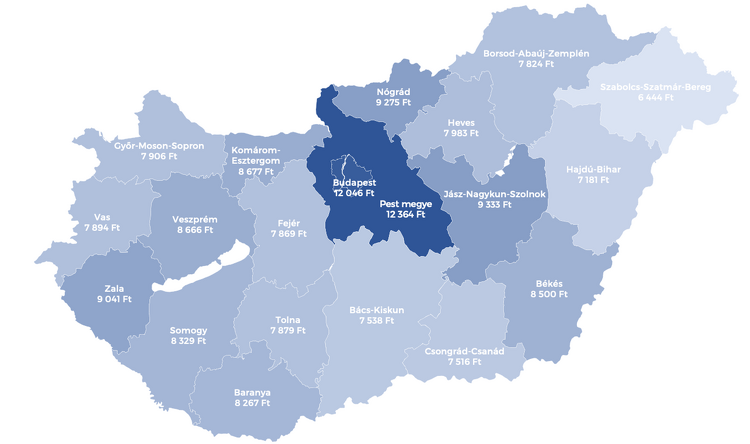
square metres), February 2024
The price per square metre of professional work was 12 046 HUF in Budapest and 12 364 HUF in Pest county. The lowest prices were found in the North Great Plain, where the price per square metre was 7 649 HUF. The price is not much higher in the Southern Great Plain, at HUF 7 985 per square metre. In Central Transdanubia, the price per square metre is 8 410 HUF, while in Western Transdanubia it is slightly higher at 8 517 HUF. Southern Transdanubia offers slightly more favourable conditions, with an average price per square metre of HUF 8 078. In Northern Hungary, the average labour cost is HUF 8 324.
The highest average increases were in Budapest (28 percent) and Pest (31 percent). The lowest increases of 13 percent were in South Transdanubia and 16 percent in West Transdanubia.

Rates are adapted to the economic situation of a region
"These differences do not only reflect the dynamics of supply and demand for professionals, but are also closely linked to the economic situation of different regions and the income and living standards of their inhabitants. For example, higher labour costs in Budapest and Pest county are linked to the higher economic performance of the metropolitan agglomeration, while lower costs in the Northern Great Plain region are the result of less favourable economic conditions"
- explained Béla Markovich.
60% of professionals surveyed plan to raise prices this year. The average rate of price increases planned by professionals is 12 percent. Inflation and rising costs were the main reasons given by the professionals surveyed.

On the other hand, those who do not plan to raise their rates consider the level of the wage to be appropriate and are sensitive to the market situation, fearing a drop in orders.
Deteriorating sentiment, with positive signs
As a result of market challenges, professionals' sentiment has deteriorated further, and they are less optimistic about the future than a year earlier. Only 16% of professionals surveyed believe that the construction industry is heading in the right direction. 26% of respondents believe that things are not changing in the construction sector, while 58% of professionals surveyed feel that the sector is not currently heading in the right direction.
Bela Markovich is nevertheless optimistic, because those who believe that the construction industry is moving in the right direction cite the development of the sector (26%), such as the increasing demand for quality, the reduction of the number of contractors (21%), technological advances that make work easier (11%) and the positive impact of state aid (10%) as reasons for the improvement. According to the expert, these are encouraging signs that point to an evolution in the construction culture and an improvement in demand.
Research methodology
The research aims to understand the extent of the skills shortage in Hungary. The data was collected through a self-completed online questionnaire. Data collection date: February 2024. Sample size: 713 active construction professionals. The analysis was performed using statistical methods. The survey is not representative.
The survey is similar to a similar survey conducted in the same period in 2023, by interviewing professionals. The target group and the methodology of the survey were the same as in 2023, so a comparison of the results of the two years gives a reliable picture.
Source : Link








The first municipal thermal power station in Transylvania is under construction

A huge brush was driven through the Sopron tunnel on the M85 – with video

The town centre on the banks of the Tisza is being regenerated

The Market has fulfilled its promise: it has delivered the 10,000 tonnes of natural stone offered for the raising of the bottom sill at Paks

Rain gardens are coming to Budafok, with over 3,000 square metres of green space set to be developed

Contemporary art deco in Csopakon

Four new bridges to be built in the heart of the former industrial city

Safer driving on the motorways: new digital signs for the MKIF
-

 Industry news 2026. 08. 18.
Students were introduced to the high-tech construction industry at BME’s field camp in Göd
-
Bound track 2026. 08. 17.
New pedestrian crossings and a junction with traffic lights are being built in Angyalföld
-
What is being built? 2026. 08. 18.
Hungary’s new McDonald’s restaurant has moved into a modernist listed building in the centre of Budapest
-
What is being built? 2026. 08. 18.
New paving, a playground and visitor facilities are being planned for the Várkör area in Pannonhalma