What is being built?
The Citadel rebuilding is a major task

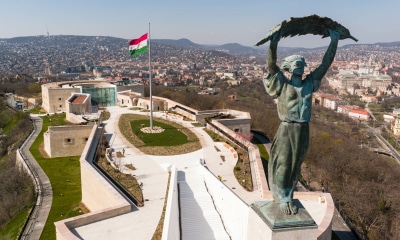
One of the symbols not only of Budapest but of Hungary is the Citadel, built 170 years ago on top of Gellért Hill. The former fortress has witnessed countless fate-turning events throughout our country's turbulent history, but the building's condition has become life-threatening due to decades of neglect. The rondella, built as a barracks, is now being reborn as an exhibition space. The Freedom Museum will surround the inner courtyard, the Freedom Park.

Neglected for decades
The contractor for the complete renovation of Art1st Design Stúdió, which has undergone several historical reconstructions, and Pagony Táj- és Kertépítész Kft. is ZÁÉV Zrt. and ZÁÉV Zrt. and Market Építő Zrt.. The walls of the fortress towering over the capital bear the marks of every armed conflict of the past century, and have also been significantly eroded by water damage. The current reconstruction can therefore be considered historic, as the rondella's reception area will be created with an exciting glass support structure and a glass covering built on top of it.
Because of the span and height of the built-in elements, the lobby is a real design specialty, a unique solution in international building practice.

Working on several points at once
As the chief engineer of ZÁÉV informed us, structural work is currently underway. The reinforced concrete structure of the outer main staircase behind the Statue of Liberty and the sliding gate base plate of the northern cut-through are being constructed, as well as the reinforced concrete base plate of the inner courtyard area of the rondelle. The slabs of the two side wings and their insulation are also being constructed, and work is under way on the reconstruction of the closing slab of the nacelle.
Meanwhile, the interior construction of the rondella is progressing well, with the steel structures of the opening exits, the reinforced concrete stairs and the elevator shafts being built.
Providing the utilities is perhaps the biggest challenge, as the main backbone cables are placed under the base plates and literally have to be carved into the rock.
The peculiarity of building on a hill is that very soon, after 40 centimetres in the case of the Citadella, the rock is in the way of the contractors. A reservoir is being built at the base of the north bastion and is currently being waterproofed, while the roofs of the north and south wings are also being waterproofed.

With good organisation, hard work can be well scheduled
The basic electrical installation also concerns reinforced concrete slabs and brick floors. The electrical network must be routed through these, which can only be done by drilling. This is a very serious task, as the vaults often have to be drilled 2 to 2.5 metres in length to allow the electrical backbone cables to be installed.
The section is on schedule to be handed over next summer, when the contractors will have to finish the structural work. Further renovations are currently underway, such as repairs to the façade cladding, restoration work with scaffolding demolition and construction.

Source : Link






The STRABAG in Szombathely prevented the release of asbestos-containing dust using a special sealing layer

Stones of the past, solutions for the future – Saving the stone walls of the Citadel

The replacement of the expansion joints on the Erzsébet Bridge is continuing with the third phase

Up to 1,500 cubic metres of concrete are being poured in each phase of the Paks expansion

Hungary's biggest motorway upgrading programme is underway

Perhaps the world's most elegant McDonald's restaurant opens in Budapest

Szeged to become one of Europe's leading industrial centres with the construction of the BYD factory, the city strengthens its position with a worthy investment package

Viablokk porous concrete masonry element from a Hungarian factory, as a Hungarian product, is set to conquer the world
-

 Road building 2026. 04. 07.
Innovation on the motorway: digital models, drones and future-proof solutions in operations
-
What is being built? 2026. 04. 07.
Budapest’s Citadel has opened – Renovation of the Citadel is complete
-
Industry news 2026. 04. 07.
The biggest problems with paving stones have been resolved
-
What is being built? 2026. 04. 07.
The Galerius in Siófok has reopened as a year-round water park