
What is being built?
A present rooted in the past: a decorative barn and a residential house evoke Swabian folk architecture in the Sóstó Museum Village

The aim of the Swabian Heritage project, which is partly funded by the EU, is to research and showcase the cultural and historical heritage of the Swabians by developing a sustainable cultural and tourist route linking Nyíregyháza and Palota.
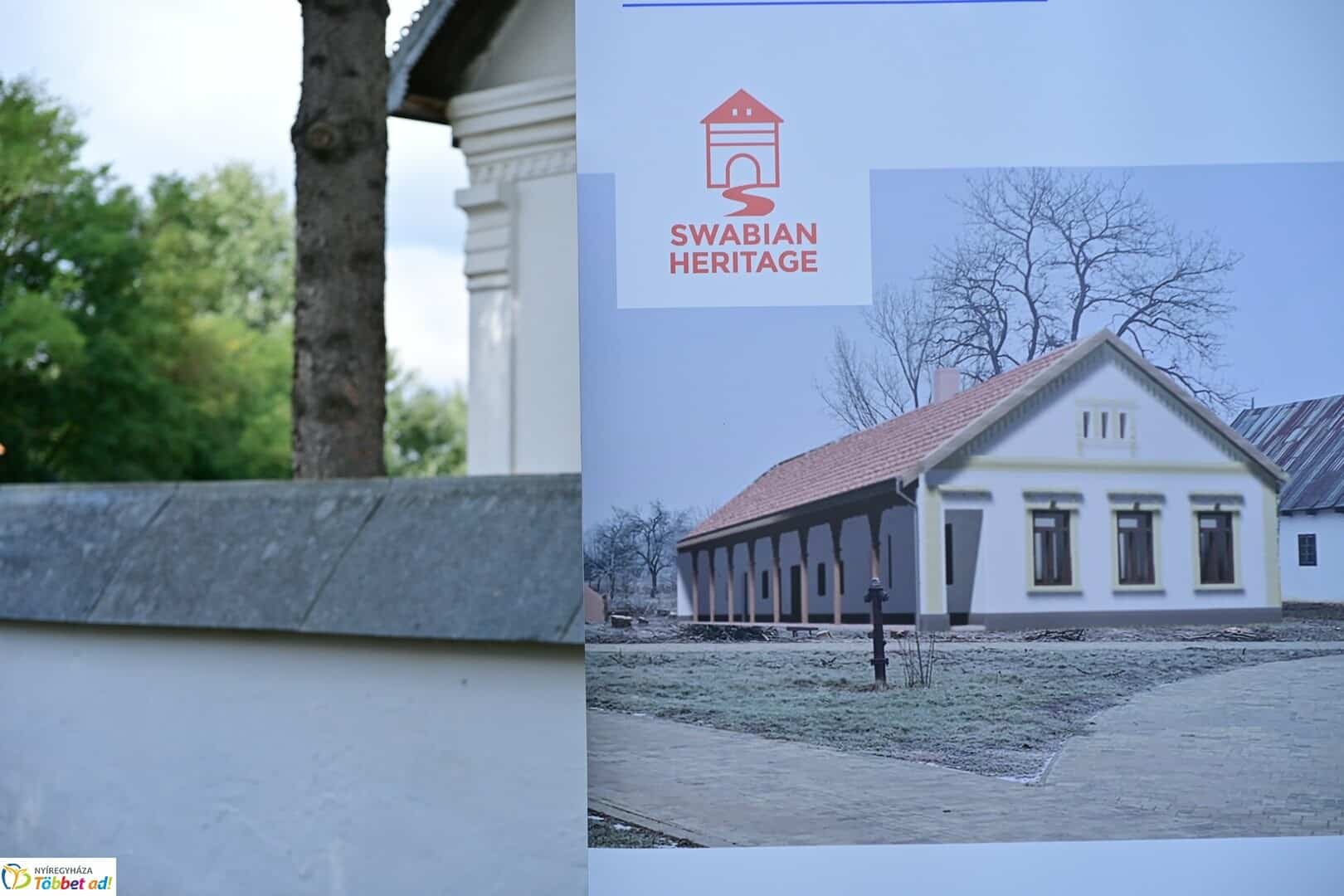
Photo: nyiregyhaza.hu / Lajos Szarka
As part of the project in the Sóstó Museum Village, experts from the Jósa András Museum, funded by the museum, are KE-VÍZ 21 Építőipari Zrt. experts are constructing a Swabian farmhouse and barn in Vállaj. The buildings will be converted into a historical memorial site and exhibition space, which will also serve as one of the stops on the Swabian Route linking Nyíregyháza and the Romanian town of Palota.

Photo: Town Image Manual
The ornate barn
Vállaj lies along the Kraszna River, some 70 kilometres from Nyíregyháza. The first written record of the village dates from 1335. From the mid-17th century onwards, wars and epidemics set back the development of this once-thriving village. The settlement was part of the Rákóczi family’s estate; after the suppression of the War of Independence in 1711, it was confiscated from the family, then purchased by Ferenc Károlyi from the treasury, who revitalised the settlement’s economy with German settlers. Vállaj became famous as a Swabian village for its craftsmen, meat products and farmers. A characteristic feature of the village’s Swabian farmsteads are the so-called hall barns, which were built by local stonemasons in a distinctive eclectic style, and are therefore often referred to as ‘ornate barns’.

Photo: Town Image Manual
It is not just an outbuilding, but the heart of the farm
The most fascinating feature of the development is the barn, which was one of the most important buildings in the Swabian farming community of Vállaj. An imposing, hall-like space even by the standards of vernacular architecture, it served simultaneously as a place for storing crops, threshing, storing tools and carrying out the day-to-day operations of the farm.
The size of the barn also revealed the strength of the farm in question: the storage units dividing the interior space were referred to by the locals as „drawers”.

The residential building and barn will be built on a site of over 450 square metres
According to the
The net floor area of the residential building is 187.15 square metres, whilst the barn will cover 265.10 square metres.
The residential building will house an entrance hall, a stable, a pantry, a kitchen, a loft access, four rooms and a bakehouse.
The barn is described in the technical specifications as a large, open-plan space, evoking the generous use of space typical of farm buildings in Vállaj.
Wood and adobe – building the natural way
The buildings are constructed on strip foundations, with the load-bearing structures comprising a combination of rammed earth and brick masonry. The floor slab will be a traditional timber slab, dimensioned to provide structural support. The façade windows and doors, which define the character of the residential building, will be of a timber frame with interlocking sash and mullion construction, whilst the interior doors will be painted timber. The rooms will be fitted with brick and ship deck flooring.
The Nyíregyháza development is being implemented under the Interreg VI-A Romania–Hungary Programme. Funding consists of 80 per cent EU support, 15 per cent Hungarian state contribution and 5 per cent from the museum’s own resources.
Source: Link



A new beach is being built at Tolna’s largest natural bathing spot

A present rooted in the past: a decorative barn and a residential house evoke Swabian folk architecture in the Sóstó Museum Village

Pothole repair at five times the speed – that’s what JCB’s specialised machine is all about

Every day, Hungary’s natural land area shrinks by the size of a large factory

Hungary's biggest motorway upgrading programme is underway

Perhaps the world's most elegant McDonald's restaurant opens in Budapest

Szeged to become one of Europe's leading industrial centres with the construction of the BYD factory, the city strengthens its position with a worthy investment package

Viablokk porous concrete masonry element from a Hungarian factory, as a Hungarian product, is set to conquer the world
-

 What is being built? 2026. 04. 27.
Research and teaching capacity has quadrupled thanks to the development of Semmelweis University
-
Industry news 2026. 04. 27.
An agency born out of the media – A fresh approach to communications in the construction industry
-
What is being built? 2026. 04. 27.
The roof structure of the burnt-out cave spa in Miskolc has been completed
-
Road building 2026. 04. 27.
The HE-DO project will renovate 11,000 square metres of road and build a new Park & Ride car park in Gyöngyös


