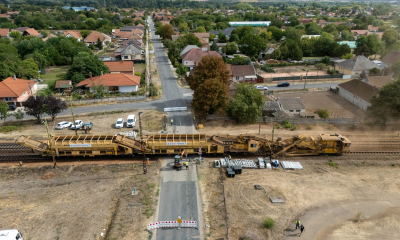
What is being built?
Work is underway to make the façade of the theatre in Győr, known as the ‘ski jump’, safer

The Győr National Theatre has awarded a contract for the removal of its facade cladding, which had become a safety hazard, and for the associated accident prevention work. The public procurement contract was awarded to Horváth Color Építőipari Kft. for a net value of 114.99 million forints – reports kozbeszerzes.hu.
The aim of the project is to eliminate the safety hazards that have existed on the building’s façade for decades. The marble slabs and ceramic tiles covering the theatre, which were installed during the original construction, have become loose in several places, and some elements have even fallen off over the past few decades.
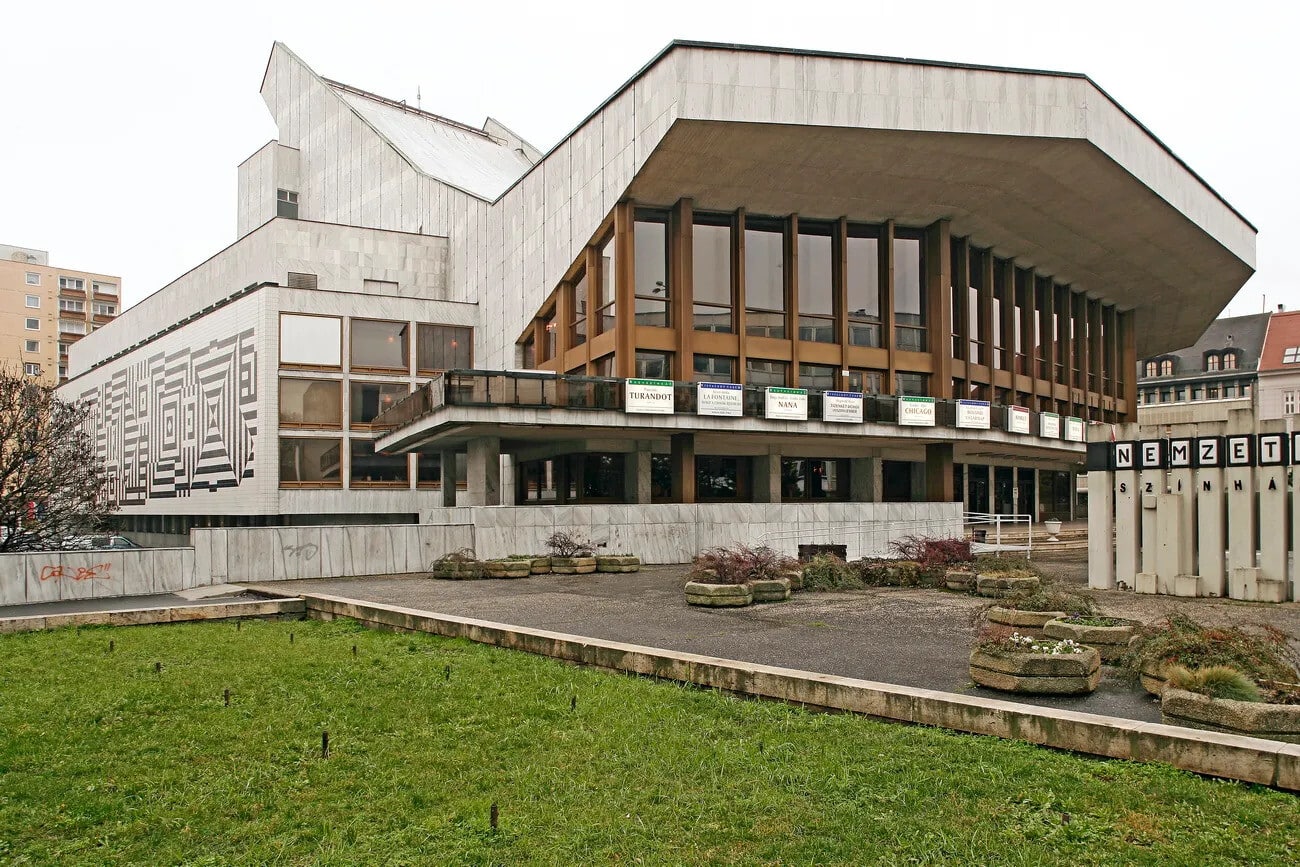
A work by Victor Vasarely adorns the side façade
According to the article at moderngyor.com states that the Győr National Theatre, designed by lead architect Kálmán Vincze, was built between 1973 and 1978 and became one of the defining works of late socialist Hungarian architecture.
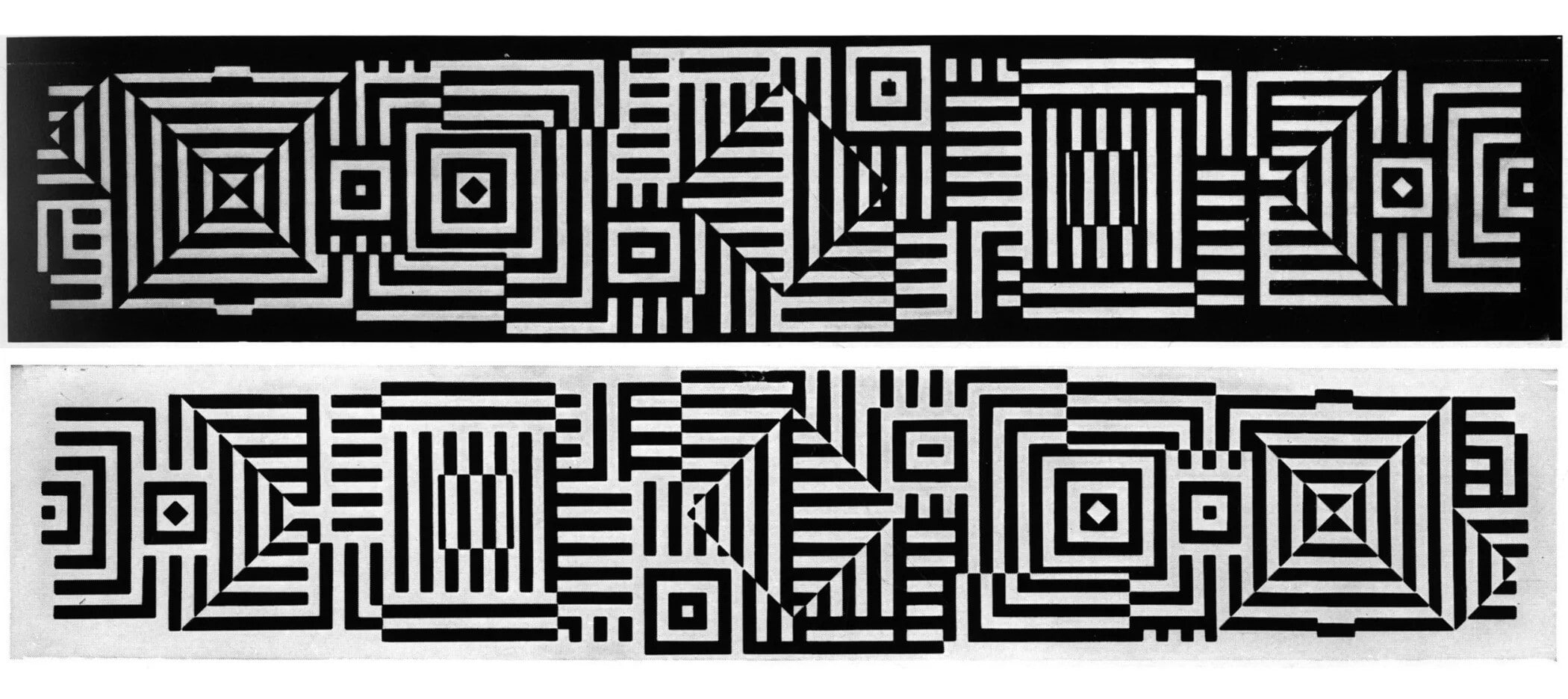
The building, known locally as the „ski jump”, features Victor Vasarely’s monumental work on its two windowless side façades; the interlocking patterns adorn the building over a length of 55 metres and a height of 10 metres.
When the theatre was built, materials of exceptional quality for the period were used. The foyer features Carrara marble, whilst the exterior façades are clad in Greek marble, and the stage technology was also among the most advanced of its time.
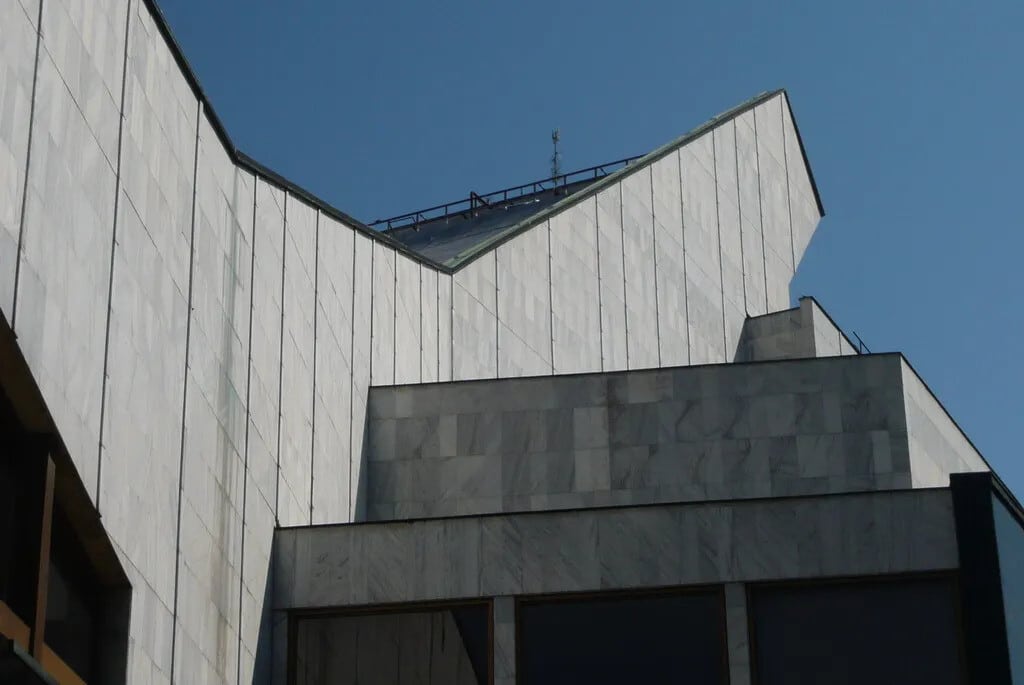
Erosion and corrosion have made the façade unsafe
The theatre’s external façade is largely clad in mechanically fixed marble slabs, with smaller sections covered in bonded ceramic tiles, aluminium cladding and decorative plaster. Over the decades, the fixings have become damaged in several places as a result of weathering, temperature fluctuations and material fatigue.
During the expert inspections, completely corroded metal brackets, crumbling concrete structures and cracked or broken cladding elements were found in numerous locations. As there is significant pedestrian and vehicular traffic beneath the affected façades, falling cladding elements pose a serious risk of accidents.
Dangerous cladding is being removed from four façades
During the works, a total of around 1,400 square metres of cladding will be removed from various sections of the theatre’s façade.
The works will also affect the façades on Czuczor Gergely Street, Bajcsy-Zsilinszky Street, Schweidel Street and Teleki Street. Following demolition, the surfaces will be cleaned, loose fixings removed, structural defects repaired, and a new façade surface created through plastering and painting.
On the Teleki Street side, the work is being carried out in certain sections using industrial rope access techniques, particularly around the gable walls of the attic.
Canopies and barriers for safety
As part of the project, a safety barrier approximately 100 metres long and a covered pedestrian shelter canopy measuring 210 square metres will be constructed.
Near the artists’ entrance, on the corner of Teleki and Schweidel Streets, a timber-framed, sheet-metal-roofed canopy is being constructed, which will extend up the façade to provide shelter for pedestrians.
In addition, several green spaces and sections of pavement will be cordoned off with safety fencing, and warning and directional signs will be put up around the work site.
They are also taking steps to protect the Vasarely murals
As part of the optional works package, a safety net can be installed along the entire length of the Vasarely-style façades, stretched across a steel framework. The aim of this solution is to catch any cladding elements that may come loose, thereby improving safety for pedestrians.
The mesh will be supported by steel beams fixed to the existing reinforced concrete cantilevers; during their installation, particular care will be taken to preserve the building’s reinforced concrete structure.
Source: Link








One of Abony’s most important transport routes is to be redesigned

This is how flash floods on the vineyard-covered hills in the Pécs conurbation are being prevented

Order has been restored: production of the new Közlekedési Múzeum can now go ahead as originally planned

We took a look at how the refurbished Igazságügyi palota building turned out

Four new bridges to be built in the heart of the former industrial city

Rain gardens are coming to Budafok, with over 3,000 square metres of green space set to be developed

Contemporary art deco in Csopakon

Safer driving on the motorways: new digital signs for the MKIF
-

 Current at 2026. 09. 09.
A first-hand look at a career in engineering – Duna Group Szabadegyetem is back
-
Climate-X 2026. 09. 09.
Nyíregyháza Spartacus FC goes green – four hundred solar panels to be installed on the stadium roof
-
Bound track 2026. 09. 15.
Nearly 50,000 people travel on it every day – the refurbishment of the Cegléd main line continues
-
Current at 2026. 09. 09.
Rental flats, Rákosrendező, decentralisation – important ideas were put forward on the Real Estate Beach Conference stage